Letters CCCXLV
|
Date: Fri, February 22, 2013 3:33 am (Answered 24 February 2013) Hi again Terrance, I know that you've already covered this before and have clearly shown that AA's 12 steps are derived from the Oxford Group steps but I thought that you'd appreciate what I found below:
"The founding members had been using six steps borrowed from the Oxford Groups, where many of them started out. Bill felt that more specific instructions would be better, and in the course of writing A.A.'s basic text, Alcoholics Anonymous, he expanded them to twelve." AA's 12 steps are not, as we are led to believe, the distillation of years of experimentation and trial and error which resulted in 12 unique and effective behaviors designed to aid the alcoholic in achieving and maintaining sobriety. No, the 12 steps are just an expansion of the Oxford Group's 6 steps. Iamnotastatistic Hello again, Iamnotastatistic, Yes, thanks for the input. A.A. true believers and "A.A. History Lovers" often try to gloss over the Oxford Group roots of the 12 Steps. I can't count how many have written to me and told me that,
But even the official council-approved A.A. history books like Lois Wilson's book say:
By this time Bill was ready to start the fifth chapter, "How It Works." He was not feeling well, but the writing had to go on, so he took pad and pencil to bed with him. How could he bring the program alive so that those at a distance, reading the book, could apply it to themselves and perhaps get well? He had to be very explicit. The six Oxford Group principles that the Fellowship had been using were not definite enough. He must broaden and deepen their implications. He relaxed and asked for guidance. Of course the 12 Steps are not "principles", they are practices. And Bill Wilson himself explained that he had to make the Oxford Group six "steps" — really, the "Six Practices of the Sane" — into 12 steps because alcoholics were so dishonest and would "wiggle out of" their contracts:
Well, we finally got to the point where we really had to say what this book was all about and how this deal works. As I told you this had been a six-step program then. Bill Wilson also declared,
"Early AA got its ideas of self-examination, acknowledgement of character defects, restitution for harm done, and working with others straight from the Oxford Groups and directly from Sam Shoemaker, their former leader in America, and nowhere else." It's quite a stretch to try to twist all of that into a statement that Bill Wilson got the 12 Steps from God or from his experience with alcoholics.
Date: Fri, February 22, 2013 5:55 am (Answered 25 February 2013) Hi Orange, Sorry for the barrage of emails but I have some spare time and a lot of information to share so I hope you don't mind. I did a quick word search of AA literature and found that in the first 164 pages of the "Big Book":
In the book Twelve Steps and Twelve Traditions the first 125 pages, relating to the 12 steps:
And yet they insist that it's not religious! I remember being in an AA meeting once where the chairperson was pounding his fist on the table and loudly insisting that AA was spiritual and NOT religious. A few minutes later he lead the group, with hands held and heads bowed, in the Lord's Prayer. I could barely keep myself from laughing. What I also noticed from my time in AA was that leaders or chairpersons often prefaced the Lord's Prayer with the phrase "Who keeps us sober?" ...... then the members would respond with "Our Father who art in Heaven...". This implied to me that whatever belief a member held or whatever Higher Power they believed in was immaterial because it was God who was keeping AA members sober. I also remember a time when I was leading a small AA meeting (~10 people) when there was a Sikh guy and a Muslim guy present (both court ordered). As we stood to recite the Lord's Prayer, I suggested (in deference to those who were obviously from a different religion), that we would have a minutes silence so that everyone could say their own prayer. An oldtimer took a grave and very vocal offense to this deviation and loudly began to recite the Lord's Prayer. To my amazement everyone else (except the Sikh and the Muslim guys and me) joined in. Intolerance and conformity ruled! I was so ashamed of and disgusted with AA that day — I'll never forget it. iamnotastatistic Wow. Thanks for the story. Yes, A.A. really does a big flip-flop on whether they are religious or spiritual. And that "flip-flop" is also a few bait-and-switch tricks:
Oh, and I don't mind the input, or barrage of information, at all. I appreciate it. Have a good day now. == Orange
* orange@orange-papers.info * * AA and Recovery Cult Debunking * * http://www.Orange-Papers.org/ * * ** It may be difficult to determine where religious ** beliefs end and mental illness begins. ** — Elaine Cassel * ** At least two thirds of our miseries spring from human ** stupidity, human malice and those great motivators and ** justifiers of malice and stupidity, idealism, dogmatism ** and proselytizing zeal on behalf of religious or ** political idols. ** == Aldous Huxley 
Date: Fri, February 22, 2013 10:51 pm (Answered 25 February 2013) Hi, again, Orange, it is Paul here again (from Australia), I have written to you before. I am an alcoholic (and I also have been told by doctors I have bipolar disorder) and after almost 18 months sobriety I lapsed ( or relapsed?) back into alcohol abuse in mid January. After one absolutely terrible 3 day alcoholic spree in late January I was feeling very sick and very desperate and I rang the AA phone number in Sydney. The AA person I spoke to was sane and reasonable. We had a bit in common with experience of NSW Australian jails and prisons. This AA person on the phone also told me to NEVER listen to anyone in AA or NA who told me to stop taking bipolar meds. I suppose he said that because there are still at least a minority of AA people who can advise "dual diagnosis" people to stop their meds. So, despite of what I have expressed in previous letters to you, in desperation, I got back into AA. To be honest over the past month I have found much, but not all, that is said in the AA meetings itself boring and not very useful. The part of AA I like is the "meeting after the meeting", where I can drink coffee and have a normal conversation with those at the meeting I both like and I feel are on something like the same "wave length" as me. A sponsor was recommended (sp?) to me. This AA man has 27 years sobriety. Some of his advice is really good. For example, drink lots of water and less coffee, try to walk each day for exercise and eat well, write down things to be grateful for so as to fight self pity and resentments and maybe look at quitting smoking in a year or so; I even followed his advice in forcing myself to pray for people I believe have harmed me in my life (I have a long list of such people); I just forced myself to do this and I have felt some peace afterwards. BUT there are problems I am having with this sponsor. I feel I don't want and need to make AA my whole life and get to meetings EVERY day. I have in the past obtained 10, 22 and 18 months sobriety with little or no AA. Also, I have been in a great relationship with a wonderful woman for almost 2 years; and Melanie has 3 kids from her first marriage; and for this and other reasons I have obligations and things to do in my life that makes getting to a meeting every day not possible. Yet my sponsor wants me to have AA meetings as the number one thing in my life. My relationship with Mel is the most important thing in my life. I know I could ruin this relationship if I do not again stay sober for at least a long time; or even forever. Maybe I just dont have enough faith in AA; maybe I just don't believe a meeting a day is 100% necessary for me to stay sober? Mel has now read parts of your Orange Papers. She agrees with a lot of it. Obviously she does not want to live with a drunk. But she feels there are people in AA who truly do not understand the problems bipolar people have. Also, she belives what a doctor once said which was words to the effect that if my bipolar illness is properly managed then it sort of just follows that the alcohol abuse problem, to a large extent, is solved too. I am 50 now. 10 years ago I was on remand in maximum security prison for robbing a liquor store while manic and drunk. I saw 2 forensic psychiatrists in prison who wrote reports for court and both said the same; I suffer from a bipolar disorder but I am also an alcoholic. Because both shrinks said I was bipolar but did not have an antisocial personality disorder I got a lenient sentence and was fairly soon out of jail; but I had to do 10 months in rehab and a month in a psych ward before full release into the community. Thanks again for reading my letters and replying. BTW- I think AA in Australia must be more laid back than the USA. It is not unusual in AA or NA here to hear someone say things like he/she has never read the Big Book etc and it was certain AA people and not the AA program that got them sober. Paul. Hello Paul, Thank you for the letter. I'm sorry to hear about the difficulties that you have been going through, but glad to hear that things are getting better. You clearly understand the situation: Your real problem is the Bipolar Disorder. Your excessive drinking is caused by the Bipolar Disorder. I have a friend here who has the same problem. He regularly cycles every three years. That is, for like 18 months he seems to be normal, and then he goes off the rails for 18 months until he ends up arrested and losing his car from drunk driving, and things like that. Of course medications are essential for controlling Bipolar Disorder. The fools who tell people not to take their medications are playing doctor with someone else's life when they have no medical training at all. They are not qualified doctors, and they are not licensed to practice medicine, but they feel entitled to countermand the orders of a real doctor and mess with someone's recovery. A survey that was done here in the USA found that only 17% of the sponsors told their sponsees not to take their medications. But 34% of the newcomers got told not to take their medications. Obviously, those know-it-all anti-medications sponsors were trying to give instructions to more than one newcomer. (See: Alcoholics Anonymous and the Use of Medications to Prevent Relapse: An Anonymous Survey of Member Attitudes. ROBERT G. RYCHTARIK; GERARD J. CONNORS; KURT H. DERMEN; PAUL R. STASIEWICZ. Journal of Studies on Alcohol, Jan 2000 v61 i1 p134.) I agree about the advice to get more fresh air and exercise. I make a point of getting out and riding my bicycle around. Just yesterday, the rain let up and I got out to the Fernhill Wetlands and fed my feathered friends, and found that Gus' wife had returned from her winter quarters. And the mental exercises, like counting your blessings, are good. Think positively and the world looks better. And thinking good thoughts about people whom you have reason to hate is good, and will calm your mind.
Having a social circle is very good, and important, but I can't help but think that there must
be some better social circle than people who believe in a cult religion and
mistakenly repeat its superstitions as unquestionable wisdom. That presents big problems,
like your sponsor insisting that A.A. must be the most important thing in your life.
I don't know if there are any branches of SMART or SOS in Australia. I hope
so. Here is the contact list: You are right when you think that the sponsor is over-doing it — way over-doing it. You don't need to devote your whole life to A.A., or go every day, and A.A. does not have to be the most important thing in your life. That is crazy. That is cult talk. That is a common cult characteristic: The cult wants to own you. I would dump that sponsor. I don't care how many years of supposed sobriety or cult membership he has. He isn't doing you any good. I don't even see why you need a sponsor. What you need are medications and a good doctor. And maybe a counselor to tell you not to drink so much coffee, and to get fresh air and exercise, and to think better thoughts. And if you wish to continue associating with A.A. for the meeting after the meeting, okay, but please be aware of the fact that half of the "wisdom" that they parrot is nonsense. Take everything with a grain of salt. The teachings from your sponsor show a big problem with A.A., something that I call "The Partially True Rule". All of the stuff that they tell you is only partially true. Like getting more fresh air and exercise, and getting less jacked up on caffeine, and thinking good thoughts is good advice. But devoting your life to A.A., and going to meetings every day, and making A.A. more important than your wife, is very bad advice. And that is just so common with A.A.: For every good thing you learn, you learn a couple of bad, harmful, untrue things. And you have the problem of figuring out which is which. And sometimes the bad advice can lead to disastrous results before you learn which slogan or pious teaching is true and which is false. People regularly die from bad A.A. advice. And yes, your wife is worth more than A.A. Really, no joke. The Harvard Medical School said that:
On their own
Support from a husband or wife was important in sustaining the resolution. Have a good day now, and a good life. == Orange
*             orange@orange-papers.info        *
*         AA and Recovery Cult Debunking      *
*          http://www.Orange-Papers.org/      *
**    A flawed idea that AA is built upon:  The idea that a deeply flawed person
**    will cure another deeply flawed person.  A dynamic fraught with peril.
**      == Anonymous
[The next letter from Paul_K is here.] UPDATE: There is now an entire file of A.A. "No Medications" horror stories, here: A.A. "No Meds" Stories.
Date: Sun, February 17, 2013 11:12 am (Answered 26 January 2013) My name is David A and I was released just 10 days ago after spending 30 days in an alcohol rehab facility called Campobello in California. I came across your site after searching for a new community to begin my journey of abstinence, I read a lot of the material and came to the conclusion that I lean toward the ideas which are stated in the Orange Paper's site. I cast a shadow into the rooms of AA 4 years ago knowing I needed to find some way of quitting drinking. I found a sponsor, a wonderful 70 year old man with 18 years sobriety that showed me the steps and after the steps we worked the 12 by 12 for about a year. There was one thing that I didn't do, I did not quit drinking. AA worked for me only about 3 months and then I drank again hiding it from everyone, at least that is what I thought. In retrospect I can see that AA allowed me to twist and flip all of their suggestions to justify my drinking. My fellowship empowered me to be hopeless and powerless which enabled me to relapse. I know that no body put a gun to my head and made me drink, that was my decision, but in the back of my mind I knew that there was something not entirely right about AA for me. In those 4 years my drinking got progressively worse and the meetings became non-existent in my life as did my relationship with my sponsor. My dilemma between drinking and sobriety got so bad that I became hopeless. AA seemed to be the only alternative and I knew it would not work for me. I thought I was one of the Constitutionally Incapable of recovery. Admitting my self into Campobello's care sparked an interest in me that there may be a different path to sobriety instead of AA and it was as simple as not picking up that first drink, no matter what. Along with not drinking came the notion that I had really made a mess of my brain and that my frontal cortex was not working correctly as my mid brain kept it from doing so. I am a laymen about physiology and brain functions, but my case managers put it into a context that I could grasp. It was made clear to me that I have to be sober for at least six months before I can get back 65% of my frontal cortex which is where my good decisions are going to be made. If I can make it 9 months I have a 85% chance of staying sober for 5 plus years. So far, so good. Nearly everything said in "The 12 Biggest Secrets of AA" at your site rings true to me. This is what enlightened me to dig deeper into your writings and into my own needs for sobriety. It seems there is an agenda that the Orange Papers have against Bill Wilson and that is OK as any one doing research has to have a hypothesis which will either be proven or disproven when the work is peer reviewed. Like the Green Paper's web page, proponents of AA bring up this point but it seems that their argument does not stand a chance against your in depth analysis of Bill W. and AA. In treatment I asked the lecturer whether he fealt that AA is in the proccess of becomong out dated and he virtually agreed that it is. Perhaps one could say that AA is in need of reformation and not reaffermation. In your papers it is said that when a person decides to stop drinking only then will they decide to stop for good. It just happens to be where they are at that moment does that place or thing get credit. If a person is in a fellowship of AA at the time of abstinence then AA gets credit for the sobriety. I tend to beleive this and am going to base my recovery on this notion. Campobello gets credit with giving me a start in the right direction, but I am going to give my self credit for the time I have in sobriety. Again, so far, so good. I want to give all the relapsers in AA a chance to see the Orange Paper web site and perhaps empower them to see that they may be barking up the wrong sobriety tree. There are so many inconsistancies in the Big Book of AA which the Orange Papers bring to light it seems obvious that the book was written not by a professional in the medical field but by a failed business man searching for his own way to stay sober. Bill W. found his way to stay sober and it worked for others for a while. It seems it had become a business venture guised by a spiritual awakening and the road to revovery was either the AA way or the highway. Like me, alcoholics may be using AA as an excuse to continue their drinking because they feel that there are no other avenues for them to explore in keeping their side of the street clean. Hello David, Thank you for the letter and the many compliments. Yes, I try hard to tell the truth and make sure what I'm saying is true. People's lives are on the line. You make several points I'd like to comment on:
Have a good day now, and a good life. == Orange
*             orange@orange-papers.info        *
*         AA and Recovery Cult Debunking      *
*          http://www.Orange-Papers.org/      *
**     "There is nothing quite like dying for convincing you that you
**     really need to take better care of your health."
**       — Me
[ Link here = http://www.orange-papers.info/orange-letters345.html#Aldis_J ]
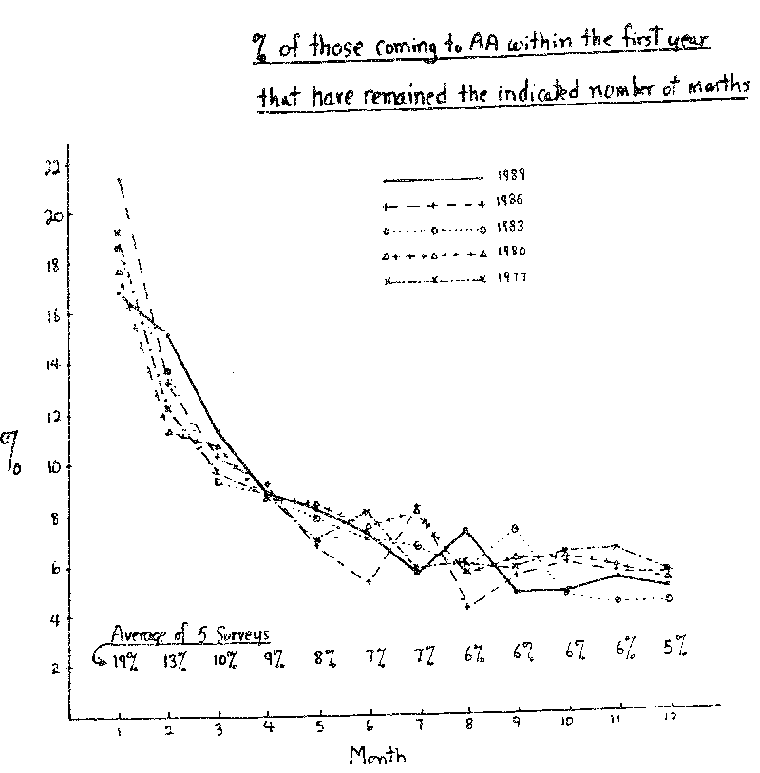
Date: Sun, February 24, 2013 5:38 am (Answered 27 February 2013) I have read from your site a number of times and am still at a bit of a loss about what basis you use for the claim that AA's success rate is only 5%. The various studies show the success rate of AA-based treatment, which is not strictly speaking AA. The triennial survey graph has a few things wrong with it: First of all, it's meant to show the distribution of sobriety over the first year. Five percent of those in their first year (except the ones who left before being counted) are in their 12th month, but if you assumed a 100% retention rate and a steady rate of newcomers, there would only be 100/12 months = 8.3%. The data as presented seem to show a 26% rate because 19% falls to 5%. There's no real telling how many people dabble by going to a meeting or two, giving them a 1 or 2 in 365 chance of being counted. However, even if it did factor out to 5%, you're comparing them with ALL the other alcoholics...those who haven't decided to quit and those who have...which would actually mean AA had a higher standard to meet than 5% until we have a way to cherry pick the serious natural remitters out of the general alcoholic population. That is why measures of coerced attendance may be pertinent I suppose...you include everybody, not just the ones who have made a serious decision to quit. The last problem of course is that the triennial surveys are AA's own data rather than an unbiased study. So how can you say their success matches natural remission? We don't really have any hard numbers for the dabblers who would have fallen outside the triennial survey. Hello again, Aldis, Thanks for the letter and the questions.
Alas, you are confusing the A.A. retention rate with
the A.A. success rate. They are two very different numbers. The only relationship that the
two numbers have is the fact that the A.A. success rate cannot be higher than the A.A.
retention rate. The famous graph in Comments on A.A.'s Triennial Surveys "5M/12-90/TC" did not show the answer to any questions about months of sobriety. The survey only asked the newcomers with a year or less of attendance how many months they had been going to A.A. meetings. It didn't ask how long they had been sober. They might have all been drunk all of the time and it wouldn't change the graph. Your other points are quite true, and right on:
Have a good day now. == Orange
*             orange@orange-papers.info        *
*         AA and Recovery Cult Debunking      *
*          http://www.Orange-Papers.org/      *
*
**     "A well conducted professional study" (page 19) showed that
**     "some 5% of newcomers are still attending meetings
**     after 12 months. This is a truly terrible statistic.
**     Again we must ask 'Where does the fault lie?'" (page 2)
**     == Dr. Ron Whitington, Chairman General Service Board,
**     AA Around Australia, Spring Edition No 90, October 1994
**     This quote was verified by A.A. in Australia. Look here.
Aaron M. posted in Orange Papers I can see the attraction of the trainwrecks on Celebrity Rehab. One reason I'm glad to have left the rooms is the slogan,"We will gladly refund your misery." This is very true. What better fodder for sharing than someone you've seen in the rooms, fail miserably? There's nothing like the abundant, skillfully crafted, cryptically coded, well rehearsed slogan-laced message of hope/doom with scandalous knowing glances and nods to brighten my day. Gladly refund my misery? What an enlightened, caring, God-conscious thing to say to someone.
Date: Mon, February 25, 2013 9:32 am (Answered 27 February 2013) even if only 1 person is changed from a self-destructive train wreck to a 're-born' person i say thank you for the help. what's wrong about that. Hello Dan, Thanks for the question. And the answer is: What's wrong about that is that A.A. kills more people than it saves. A.A. is such bad therapy that it:
When Dr. George E. Vaillant, who just loves A.A., and who went on to become a member of the Board of Trustees of Alcoholics Anonymous, tested A.A. and tried to prove that A.A. works, what he accidentally proved is that A.A. kills. The score he got with his first 100 A.A.-treated patients was: 5 continuously sober, 29 dead, and 66 still drinking. No way of treating alcohol abuse that Vaillant studied produced a higher death rate. So you tell me, is it okay to kill 6 people in order to save 1? Do you think it's still worth it? Then, of course, we have to consider the normal rate of spontaneous remission in alcoholics. About 5% per year will just quit drinking all on their own, without any treatment or "help" or "support group". When you subtract that 5% from the apparent 5% success rate that A.A. got, the result is a zero-percent A.A. success rate. A.A. did not make any alcoholics actually quit drinking. The only alcoholics who quit drinking are the ones who were going to quit drinking anyway. And Dr. Vaillant said so. Have a good day now. == Orange
*             orange@orange-papers.info        *
*         AA and Recovery Cult Debunking      *
*          http://www.Orange-Papers.org/      *
**
**    "Not only had we failed to alter the natural history of alcoholism,
**    but our death rate of three percent a year was appalling."
**      ==  Dr. George E. Vaillant, formerly a member of the A.A. Board of
**    Trustees, describing the treatment of alcoholism with Alcoholics
**    Anonymous, in "The Natural History of Alcoholism: Causes, Patterns,
**    and Paths to Recovery", Harvard University Press, Cambridge, MA,
**    1983, pages 283-286.
Date: Sun, February 24, 2013 2:24 pm (Answered 27 February 2013) Hi there, I have luckily discovered your web page while I was desperately searching for some help. A closest friend of mine has a problem with alcohol but she managed to stay sober for years without AA, on her own. Then she had drinks on a few occasions which ended up pretty badly and someone suggested that she should try to attend AA meeting and unfortunately she did so, this was over a year ago. They made her believe that she's an alcoholic and she started attending these meetings regularly and working on the 12 step program, since that day — that's is all she does. If she's not at a group meeting — she's in a cafe with a group or on the phone with other alcoholics, sponsors, newcomers and this is a vicious never-ending circle I wish to drag her out of it so badly. They made her believe that she will never recover, she will always stay an alcoholic no matter how long she stays sober and this 'recovery' process is for life and is endless. She would never consider quitting this sect or doubt their beliefs. I have no idea on how to approach her, I tried to talk about this a few times, the conversations did not go well. She's like a different person and I want her back. I got scared of what they've done to her and I cannot sit and watch them taking her and mine lives away like that. Do you perhaps have any guidance/advice or a program for friends and families of those in AA? There must be a way out of this. I really hope to hear from you. Thank you. Julia Hello Julia, Thank you for the letter. I'm sorry to hear about what you and your friend are going through. What you described is just classic — the standard way that cults suck people in. They want to monopolize all of the new recruit's time with constant meetings and get-togethers and activities and recruiting, and "book study" — studying the Bible or the A.A. Big Book or whatever, it doesn't matter. The cult always has some book for recruits to study. And the new recruits become obsessed with the organization. And of course the new recruit must believe everything that they tell her, or else. They use phobia induction to make the new recruit afraid that she will die or worse if she leaves the cult, or fails to perform properly. And your friend has become a true believer and reacts strongly when you criticize A.A. That is just standard cult behavior. They cannot discuss the issues rationally. And the kicker is that your friend doesn't even sound like an alcoholic. Getting drunk and obnoxious a couple of times does not make someone an alcoholic. (It makes her human.) It might be evidence that she probably should not drink alcohol, but that isn't evidence of alcoholism. Not yet.
What comes to mind is Steve Hassan's books about freeing a loved one from a cult. He teaches
a bunch of handy techniques for getting people out: We previously discussed the same issues in these letters, so I'll point you to the discussions and answers there:
Have a good day now, and good luck. == Orange
*             orange@orange-papers.info        *
*         AA and Recovery Cult Debunking      *
*          http://www.Orange-Papers.org/      *
**     Since mind control depends on creating a new identity within the individual,
**     cult doctrine always requires that a person distrust his own self.
**    ==  Combatting Cult Mind Control, Steven Hassan, 1988, page 79.
Last updated 20 January 2014. |