The Religious Roots of Alcoholics Anonymous
and the Twelve Steps
by A. Orange
Chapter 3:
The Religious Tenets and Doctrines of Buchmanism
Dr. Frank Buchman believed that the age of miracles had returned,
that people could have direct, personal access to God, that people
could be "changed", and that confession was necessary for
"change".
Frank Buchman also declared that people were essentially weak and sinful —
"defeated by sin", he called it — and that only
"surrender to God" and becoming totally "controlled by God" would save them.
Henry P. Van Dusen, writing for The Atlantic Monthly magazine in 1934,
described Buchmanism, a.k.a. "The Oxford Group Movement", this way:
Notice the repeated phrases "the only way",
and "one way and one way only".
That is one of the first and most obvious characteristics of any cult.
They almost always claim that
they have the only way
— the only way to Heaven, or to salvation, or spirituality, or eternal
bliss, or higher knowledge, or sanity, or mental powers, or recovery,
or
whatever it is that
the cult promises to deliver...
A corollary to cults' claims of having The Only Way is the assertion that
"the other people" do
not have The Way. "They" are
all misguided and missing the boat, and "they" won't be going to Heaven (or
whatever the declared goal of the cult happens to be). Thus the cult encourages an
isolationist "us versus them" mindset, which naturally segues into
an attitude that
the cult members are
special — that they are
superior to the common rabble who haven't been "saved" and who don't have
The Big Answer....
Another common cult characteristic shown there is the demand for
Surrender to the Cult.
You can't just join the group; you have to surrender to the cult and give
it everything — your life, your mind, your heart, your loyalty,
your obedience, and even your soul.

The first and most obvious characteristic of Buchmanism was
meetings, meetings, meetings. The
Buchmanites were always forming groups and having lots of
meetings, just like Alcoholics Anonymous would do
decades later. A slang term that some others used for Buchmanism was
"Groupism" — the religion of those people who believe in
groups and meetings.
The early house-parties attracted varying numbers, from twenty to 150.
Sometimes they were week-end affairs; sometimes they were prolonged for ten days.
Young people in the twenties predominated. It was the practice, I believe,
for them to contribute 5s. a head as "registration fee."
The purpose of house-parties, it was stated, was to "relate modern
individuals to Jesus Christ in terms which they understand and in an environment
which they find congenial."
There were "informal talks on sin," and a feature of those
days, apparently, was separate groups for men and women for the discussion
of sex problems "in a more intimate vein than is possible in a
mixed gathering."
Inside Buchmanism; an independent inquiry into the
Oxford Group Movement and Moral Re-Armament,
Geoffrey Williamson, Philosophical Library, New York, c1954, page 202.
Frank Buchman always maintained that converts should remain in their
own church. New people may be converted to believing in Buchmanism,
but they were supposed to continue as members of their original
church while simultaneously attending numerous Group meetings.
Buchman declared that his sect was not a new religion, but rather something
that would supplement and revitalize the existing Christian churches —
"The Oxford Group is not a new religion; it is religion anew."
That seemingly generous attitude had the side effect of
making everyone, no matter what their religion, fair game for
conversion to Buchmanism, and their former church couldn't even
complain about losing a member.
But one contemporary noticed that, while the Oxford Group claimed to not
be in competition with other churches, many Oxford Group meetings were
scheduled for
Sunday morning, at an hour which prevented O.G. members from attending
the services of other churches, even if they wanted to...
An important part of the Buchmanite meetings was
confession and "sharing."
There were two distinctly different kinds of sharing:
1) sharing as confession, and
2) sharing for witness.
Sharing as confession was supposed to unburden one of the sins which Buchmanites
declared kept people separated from God,
while sharing for witness was intended to convince new prospects to join the Group
and "surrender to God". That is, sharing for witness was just a lot of testimonials
that were intended to convince newcomers that Buchmanism is the answer.
The Buchmanites were really big on public confession, and were always
openly confessing everything they had ever done to meeting rooms full
of strangers. They entertained their
audiences with wild, humorous, and sometimes licentious
stories of their sins, misadventures and escapades before they got
changed into moral people by Frank Buchman and his followers.
And converts would "share" the message
that their lives had been much improved
by following Frank's "Guidance" and "principles".
Rev. Geoffrey Allen was a leader and a true believer in the Oxford Group
Movement who attempted to explain and rationalize all of the practices of the Oxford
Groups, like receiving Guidance from God in séances
and "sharing" sins with others
who are not ordained priests or ministers.
As first created by God, the infant has a transparent purity of soul.
In early childhood, how early who can say, the devil passes by.
Fear and pride and self-will enter in.
The child becomes ashamed and fears to confess its shame.
The evil by the great illusion is buried deep within the personality.
The poison of repressed fear or shame festers in the depths of
the soul.
Then there must come the healing work of God. Man must be converted,
not with an empty change of opinions, but with the turning inside out of
his life. Sins must be confessed openly on the lips, that they may be
purified in God's fair air, and that so there may be room for His gift
of love and peace within the newly cleansed heart.
He That Cometh; A Sequel to 'Tell John,' being further essays on
the Message of Jesus and Present Day Religion, Geoffrey Allen,
Fellow and Chaplain of Lincoln College, Oxford, 1933, pages 121-122.
Sooner or later, when we are ready to receive it, the Spirit will lead us
to a deeper sharing of all that has been weighing on us from the past.
It is a healthy practice for everyone, when they are led by God to do so,
to share to the depths whatever in the past has most burdened their memory
with thoughts of guilt. Such deep sharing may often be of things of which
it is a shame to speak in public, and it will be right to accept the guidance
of the Spirit, and to share with some one older individual. Such an individual
will then stand to us as ambassador of the forgiveness of Christ. In a Church
which was fully Christian the natural person to whom to take such confession
would be the priest.
Whether in the actual Church the priest is always the
right person is questionable. He might be shocked; and that might be good
neither for him nor for us.
The person who receives such confession
must be someone who has learnt from his own
experience, both under the Cross and
in the Christian fellowship, that the forgiveness of Christ outreaches the
furthest sin of man.
He will therefore never be shocked; before the utmost
evil he will say without blame, as Christ would say: 'Thy sins are forgiven;
go and sin no more.'
He That Cometh; A Sequel to 'Tell John,' being further essays on
the Message of Jesus and Present Day Religion, Geoffrey Allen,
Fellow and Chaplain of Lincoln College, Oxford, 1933, pages 131-132.
-
Notice how Rev. Geoffrey Allen implied that non-clergy (i.e., Oxford
Group members) were more qualified, or at least better equipped, than
ordained clergy to hear confessions, because they wouldn't be shocked
by what they heard.
Rev. Allen declared that the poor innocent cloistered feeble-minded old
priests might be harmed by shocking confessions, but some worldly,
experienced old degenerates from the back alleys could handle the job
with ease.
-
Rev. Allen also claimed that the people who heard the confessions must be experienced
sinners who have learned about the sin from their own experience.
So let's see... Logically,
Catholic priests can't hear confessions about wild sexual affairs unless they have
had a few dozen themselves... And murderers can only confess their sins
to another experienced murderer... Right?
-
Rev. Allen also claimed that unordained non-clergy (like Oxford Group members)
had the power to forgive and absolve sins in the name of Jesus Christ
— that they could
"stand to us as ambassador of the forgiveness of Christ" —
"Thy sins are forgiven; go and sin no more." —
which is a new religious doctrine that will certainly
start some interesting theological debates:
"Who needs seminaries or trained clergy? Who needs ordained
ministers and priests? Some college dropouts with
a couple of months of indoctrination in cult religion should be good
enough..."
That shows typical cultish arrogance. Cult members like to claim that
they are special,
and somehow more qualified than ordinary people —
even more qualified than the experts or the professionals.
Like an A.A. member declared, after
reading the "Big Book" Alcoholics Anonymous:
Here was a book that said that I could do something that all
these doctors and priests and ministers and psychiatrists that I'd
been going to for years couldn't do!
The Big Book, 3rd Edition, page 473.
-
And of course Allen would have us believe that all of the Groupers were constantly
receiving Guidance from God, Who was even telling them whether they should confess
something and to whom they should confess it. Rev. Geoffrey Allen's theology
was a radical departure from mainstream Christianity.
-
The mention of using laymen, rather than ordained clergy, to hear confessions
brings up another problem with the Oxford Groups. The Group members who hear
confessions are supposed to keep such confessions confidential,
but what about the people who leave the groups? How long will they remain
silent?87
And what about the Group members who are less than Absolutely Pure, and
tend to be gossips and blabber-mouths?
The Oxford Groups had just that problem — gossips who could not keep secrets.
More on that here.
And of course Alcoholics Anonymous has the same problem today. Anything you say in
an A.A. meeting
can become common knowledge all over town
as the local gossips
have a hey-day. And your "sharing" can even be
used against you in a court of law.
- Rev. Jeffrey Allen simply assumed that everyone was burdened with feelings of guilt over things
that they had done in the past. That was one of the fundamental Buchmanite beliefs — that
everyone is separated from God by a long list of things that they haven't
confessed. That is also
Standard Cult Characteristic Number Two: You Are Always Wrong
— it's all your fault. No matter what the situation is, you are to blame for it.
Rev. John A. Richardson wrote a critical analysis of the Oxford Groups where
he stated:
It was customary in the early days of the Church to give literal obedience
to the injunction of St. James, "Confess your faults to one another,"
the only passage in the New Testament, I think, that can properly be
quoted in this connection.
We know, however, that the practice of public
confession, or, as the Groups would put it, confession in the fellowship,
was deliberately abandoned in the fifth century, because it became a cause
of moral mischief. The minds of the young were contaminated by the practice,
and the sensibilities of older persons needlessly offended.
It is freely affirmed upon what seems to be unimpeachable evidence that the
revival of this ancient custom by Dr. Buchman has not been altogether
unaccompanied by moral evils similar to those that occasioned its abandonment.
Members of the Groups assure me that in their own experience they have
seen nothing of the sort, but I cannot help feeling that they have been
singularly fortunate in that regard; for there is not lacking evidence
that sometimes, at least, things have happened in this connection
to cause grave concern. Thus one, whom Dr. Hensley Henson [the Bishop of Durham]
certifies to be
"a very thoughtful and devout Churchwoman, who was present at the
Oxford House Party," in 1933, I fancy, states that "some of
the confessions were terrible. One in particular should never have been
made in public to an audience mixed in every sense of the word."
...
Within my own hearing, further, it was said by one prominent among
Canadian Church leaders that at a meeting of the Groups in
British Columbia — at Vancouver, if I am not mistaken — that he and
his wife were forced to leave the hall in protest against the character
of some of the sharings.
The Groups Movement, The Most Rev. John A. Richardson, pages 60-61.
Morehouse Publishing Co., Milwaukee, Wis., 1935.
As Rev. Richardson pointed out, the practice of public confessions in
the very early Christian church caused grave problems:
- The minds of the children were contaminated by the practice. The children will hear
adults confessing what they have done, and the children will think that they might like to
try that too...
- Plus, the children will start to think that
"Everybody does it, so why shouldn't I? It's no big deal;
everybody does it."
- The sensibilities of older persons were needlessly offended.
- People took pride in their sins.
(As in, "My sins and infidelities and binges were lots bigger
and longer and more outrageous than yours... Why, you're just a wimp
when compared to a big hardened old reprobate like me.")
- And then people become desensitized to the sins confessed. Something
about which people talk every day, and admit every day, becomes commonplace
and loses its power to shock or shame. The unthinkable becomes thinkable.
Rev. H.A. Ironside described Oxford Group confession sessions this way:
A group of them go off by invitation to some country inn, beautiful city hotel, or
country home. They boast that they are generally not after the down-and-outers
but the up-and-outers, people of wealth, people of fashion and culture, and they
gather together to spend several days in fellowship. Their meetings are largely
of this character: they come together as groups and devote a great deal of time
to testimony. These testimonies are generally in the nature of confessions.
They act on the scripture that says, "Confess your faults one to another," and
stop there and do not notice the rest of the connection. They take it that the
way to get help is to come together and confess their faults one to the other.
Sometimes as a matter of decency women meet together and confess their sins to
each other, and men meet together and confess their sins to each other. When I
was in Boston, I found a good deal of scandal had been occasioned by mixed companies
holding these parties and confessing their sins, many of which were of such a character
that Scripture says, "It is a shame even to speak of those things which are done
of them in secret" (Eph. 5: 12). Yet they confessed these things openly, men
before women and women before men. You can understand that the result was
anything but helpful. Where do you find anything in the Word of God that suggests
this kind of confession of sin? They say when they come together and honestly
face their sins and tell about them, it gives them a certain spiritual strength
that enables them to turn from their sins and so enter upon a new and a changed
life.
The Oxford Group Movement; Is It Scriptural?
by H. A. Ironside, Litt. D.;
A Sermon Preached in Moody Memorial Church
The tone of the confessions at Buchman's meetings was often anything but repentant.
Converts would tell grand entertaining tales of their "extremely sinful ways"
before being "changed" into a Buchmanite in a manner that bordered on
bragging. The confessional stories were often told in a jocular manner that
kept the audiences laughing. As Marjorie Harrison, a contemporary critic, said in her book,
When Dr. Buchman invited converts to stand up and confess at
one meeting that I attended, he said: "Remember these three
points when you speak: BREVITY, SINCERITY, and HILARITY."
Members of his group are taught to be funny and jocular about
their sins. I should like to know how that can be reconciled
with the teaching of any religion.
Saints Run Mad; A Criticism of the "Oxford" Group Movement,
Marjorie Harrison (1934), page 145.
The Salvation Army has deliberately adopted a method that it
considers suitable and successful in attracting corner men
and women. The [Buchmanism] Group uses measures equally
undignified as a means of appeal to gilded youth.
In place of tambourines it has a slangy jargon:
instead of sanguinary hymns, modern catch-phrases:
its emotional appeal is subtle and insidious instead
of blatant. Above all, and in this it differs from
every other form of revivalism, the "penitents' bench"
with its genuine, if hysterical manifestations of sorrow,
is superseded by the slap-stick confessional.
But apart from superficial methods, there is no other likeness
between the Salvation Army and the Group Movement.
Saints Run Mad; A Criticism of the "Oxford" Group Movement,
Marjorie Harrison (1934), page 26.
Then Harrison described a ten day meeting in January, 1934, in London:
The Church Times sent a special representative whose report is
obviously written with care and a sense of responsibility. His
description is extraordinarily reminiscent of many meetings that I
have attended. ...
He ... calls attention to the fact that "very many sins were
confessed amusingly and greeted with laughter."
... I have heard Dr. Buchman himself enjoin new converts to make
their testimonies with hilarity!
Saints Run Mad; A Criticism of the "Oxford" Group Movement,
Marjorie Harrison (1934), page 31.
Marjorie Harrison attended many Oxford Group meetings, and noticed that
the confessions changed as members gained experience in making public confessions:
You will see an instance of how "changing" can be
for the worse, if you go to a Group meeting when new converts
are asked to testify.
These people are very touching in their complete sincerity,
humility and deep reverence.
Then hear the various members of the "Teams" — the
same type of people after they have had an intensive training
in Group methods and have recounted their sins at many public
confessions. There is no longer any ring of sincerity; they are
glib.
There is no humility; they are smug, complacent, and insufferably
priggish. And the reverence is gone completely.
Saints Run Mad; A Criticism of the "Oxford" Group Movement,
Marjorie Harrison (1934), page 91.
Contemporary clergy criticized Buchmanite sharing by saying,
There is subtle temptation to spiritual vanity which assaults the public
speaker, especially if he posses the orator's gift and knows it;
and against that temptation, even the most humiliating self-accusations
provide no sufficient protection. ...
The penitent may feel a strange pride in the sins which he publicly
proclaims as once his own.
The Oxford Groups; The Charge Delivered At The Third Quadrennial Visitation
Of His Diocese Together With An Introduction, Herbert Hensley Henson, D.D.
(the Bishop of Durham),
1933, page 54.
Again, we see the warning about people taking pride in their sins:
"My sins were much bigger and more outrageous than your wimpy-ass little sins."
The practice "emphasizes past occurrences unwholesomely,"
says Dr. Douglas J. Wilson, Prof. in the University of Western Ontario,
to whose article in The Christian Century of August 23, 1933,
allusion has already been made, "becomes artificial and partially
insincere, and
breeds a perilous spiritual pride."
...
The spirit of pride is never likely to be far away from one who makes
repeated and habitual recital of sins before a public gathering; and
herein, one cannot but think, lies a danger which even the leaders of
the Groups cannot wisely disregard. "What you talk about without
embarrassment," says the Bishop of Durham wisely, "you do
not feel deeply. The gravity of the wrong-doing dwindles as it is discussed"
(The Group Movement, 2nd Ed., Part II, p. 55). ...
The sincerity of those adherents of the Groups who spend weeks and months,
and in some cases, even years, in traveling from place to place
in the interests of the Movement will not be called in question.
No thoughtful person can doubt, however, that their repeated sharing
for witness before large public gatherings must strain that sincerity
severely.
A mechanical element enters into the telling of the same story over
and over again, and it becomes stale in its recital. Instead of a
spontaneous witness to victory won, it tends insensibly to become
a routine performance, and the sincerity of the confession diminishes.
"It would be less than human," as it has been said,
"if, in such circumstances, the story should not become exaggerated
and embroidered."
Hilarity, moreover, has been almost exalted as a virtue by the Groups,
and, if the press reports of the meetings are to be believed, a
jocular element enters not seldom into the sharings, bringing with it
a danger of which many public speakers with a gift of humour are well
aware — the danger of making the real end of the story the laughter
that it provokes, instead of the truth that it is intended to tell.
A typical case in point was brought to my attention some little time
ago by one whose statement no one who knows him would dream of questioning.
In the course of her sharing at a large meeting in Montreal, a youthful
member of an international team sketched briefly the background of her
life. She was a clergyman's daughter, she said. On Sunday morning, of course,
they all went to church, and then came home to a good, hot dinner, during
which, "while father carved the joint, mother always carved the
congregation." The flippant statement was rewarded with the applause
and laughter which it was obviously intended to provoke.
Not long after, the same team was operating in another city, where my
informant happened to be, and once more he attended a large gathering,
at which sharings were being given. The same lady gave the same sharing
in substantially the same words, and again her story found its climax
in the same pitiful joke at the expense of her mother, "While father
carved the joint, mother always carved the congregation," and
once more her mot was rewarded with laughter and applause.
I do not suggest that such instances of bad taste are common.
The story shows sufficiently, however, one danger to which those who
are called upon to tell habitually the story of sins forgiven are
inevitably subject.
The Groups Movement, The Most Rev. John A. Richardson, pages 68-71.
Morehouse Publishing Co., Milwaukee, Wis., 1935.
One critic of the Oxford Groups noted how superficial the confessions
at the house parties really were.
People routinely confessed to having thought ill
of someone, or having been jealous, or having had a selfish urge,
or having worn make-up or drunk a cocktail or smoked a cigarette,
but rarely did anyone ever confess to having committed a real crime or to
anything serious (other than sex).
At one house party, when it came Frank Buchman's turn to confess something,
he admitted that he had cheated the Post Office out of small change
by putting insufficient postage on some letters. The whole group
then ceremonially trouped down to the Post Office where Buchman
"made amends" by paying the postage due.
Some of Frank Buchman's followers then marveled at what a wonderfully
honest and spiritual man Frank was, to have confessed to such
a trivial thing.
One of the peculiar features of Buchmanism was "Guidance
sessions."
People would sit quietly with a notebook in hand, and listen for God's messages
during "The Quiet Hour", and God would
speak to them, they believed.
Buchman liked to describe it as Group members receiving "powerful
spiritual radiograms".
So the members of Buchman's groups
were forever claiming that God had guided them, and told them
to do this or that...
An Oxford Group pamphlet gave these instructions:
6. In the attitude of "Speak Lord for Thy servant heareth"
wait patiently and quietly, listening for what He has to say,
what he has to reveal to us concerning ourselves, what He wants us
to do in His service, what message He wants us to bear,
what piece of work He wants us to do, or what new truth He
wants us to learn about Himself.(John
16:13-14)127
7. You may find it real help to write down the ideas and
thoughts which the Holy Spirit has caused to arise in the mind.
The advantage of this is two-fold; It is an aid to concentration
and acts as a reminder of duties to be performed, and is of value
in checking at the close of the day thoughts received each
morning and through the day. (Jer.
10:2)128
from THE QUIET TIME By Howard J. Rose
And Frank Buchman declared,
Our destiny is to obey the guidance of God.
Frank Buchman, speaking at the opening of the Moral Re-Armament Training Center,
Mackinac Island, Michigan, July 1943, quoted in
Remaking the World, the speeches of Frank Buchman, Frank N. D. Buchman,
page 201.
The London newspaper reporter Arthur James "A. J." Russell,
who intended to write an exposé of Buchman, but
who was "changed" into a devoted Buchmanite and became the first Oxford Group archivist,
described his introduction to Frank Buchman's Guidance this way:
And then, of course, Frank suggested the inevitable Quiet Time.
Taking two sheets of notepaper, he handed one to me. We sat down
and listened in prayerful silence. I tried to pick up another
of those luminous thoughts. Nothing exceptional came: quit a lot
of ordinary human thoughts, but no luminous ones. I had no wish to
confess my sins to the person Frank had named, but I wished to see
the thing through as an honest test. Yet my thoughts in that Quiet Time
agreed with what Frank urged, though my wishes did not. I wrote
down my thoughts; then read them aloud to Frank, who confidently
and surprisingly pronounced them to be God-given thoughts.
"Oh, come," I said to myself. "That's much too strong
an interpretation." How on earth could a few wandering thoughts,
unattended by mystical feeling or luminosity, scribbled on a sheet
of notepaper, be catalogued as God's thoughts by anyone in his right
senses? Still, I was determined to see the thing through, being a
believer in the pragmatic method of learning by doing.
For Sinners Only, A. J. Russell, page 95.
In spite of his initial skepticism, Russell was soon converted into
a true believer who went on to write two whole books of praise for
Frank Buchman (For Sinners Only and One Thing I Know).
Eventually, A. J. Russell became the historian and chief publicist for
Frank Buchman's organization.
Notice how Frank Buchman claimed that he had the ability to tell whether
a thought had come from God or not. We never got any explanation of just how,
when, or where Dr. Frank N. D. Buchman acquired that great magical power,
but Frank still felt entitled to routinely
censor or re-interpret other peoples' Guidance,
because he allegedly saw God's will and
knew God's mind
far more clearly than they could.
Rev. Geoffrey Allen, a minister at Oxford University who became a true believer
and a leader in Buchman's cult, described Guidance this way:
It is a custom to be recommended, that those who seek to receive instruction
from God in quiet should take pencil and paper, and write down the thoughts
to which His Spirit leads. If any feel superior to the use of such material
aids, they may well question whether God also is convinced that they do
not need them. The custom of writing slows the rapid pace of wandering
thoughts, that the voice of the Spirit may be heard; it enables us the
more surely to remember His lessons, and to see that His requests are
performed.
He That Cometh; A Sequel to 'Tell John,' being further essays on
the Message of Jesus and Present Day Religion, Geoffrey Allen, pages 99-100.
That sounds very similar to the common occult practice called
Automatic Writing, which is another favorite trick,
like the Ouija board, of would-be psychics.
What you do is, you just relax and let your hand write anything
that comes into your mind. Then you imagine that you are
"channelling"
someone else's thoughts — usually the thoughts of a dead person, ghost, or spirit.
Well, Buchmanites went so far as to imagine that they were channelling God.
B. W. Smith, who investigated the Oxford Group in 1936, described
Frank Buchman's "guided" behavior as:
Always, he says, he follows his "guidance." Sometimes he
is guided as to how much to spend for postage. Once, in Canada, when
they quoted him a rate of $12 a day for rooms, he said that God had
told him to pay only $3.50. Once, just at the beginning of an important
Group meeting in Aberdeen, Scotland, he suddenly said that he had
been "guided" to take a ship to South America. It turned
out that the ship he was guided to go and return on also carried
the Prince of Wales. It is not recorded what progress Dr. Buchman
made with the Prince, but I believe he "changed" the
ship's doctor.
Buchman — Surgeon of Souls, B.W. Smith, Jr.,
American Magazine, 122:26-7+, November 1936, page 151.
Frank Buchman would walk into a room full of followers and brightly announce,
"I knew someone here needed me. I received Guidance to
come." That kind of ego game is easy to play; in any group of
a dozen or more people, it is easy to find someone who was supposedly
in need of a few words of divine wisdom.
Vic Kitchen,
another long-time true believer in the Oxford Group, wrote
a book where he listed some of the benefits of living a surrendered and "Guided" life:
... Even with no change in the curriculum or staff, a surrendered and God-conscious
student can gain much more from the present modes of education than any of his
pagan friends.
There is first of all the matter of choosing schools and of finding the means
to go there. I have seen youngsters in the Oxford Group, for instance, select
their schools or colleges, not according to parental preference, not according to
ideas of their own, but according to the direct and often amazing guidance of God.
This guidance sometimes leads to most unexpected institutions that neither the
student nor parent had considered. At other times God shows the opportunity for
attending leading universities that the student had considered beyond hope.
In one case, due to depression, a young man had given up all idea of going to
college. Then God told him that he ought to go — told him where to
go — and told him where to find the money. This is not an unusual
occurrence. It is only one case in many.
Once in his school or college, moreover, the guided student finds the right
selection of studies and he finds a greater ability to study — a certain sharpening
of the mind such as I have tried to describe in my own experience. He finds himself
able to attack the most intricate studies and to master subjects that have always
been a bugbear. He finds, moreover, that God does not let his studies suffer when,
as sometimes happens, He diverts him temporarily to other details of His work.
I Was A Pagan, V. C. "Vic" Kitchen, pages 96-97.
Obviously, that just reeks of the common cult characteristics,
"We Have The Panacea",
and
"Magical, Mystical, Unexplainable Workings".
And then there is the name-calling and
"Devaluing the Outsider"
— non-members are all "pagans".
Vic Kitchen also made use of the propaganda technique called
Proof By Anecdote.
Stories about a few students who got into better schools than they had
hoped do not prove that God is manipulating reality for the happiness
of Oxford Group members.
There's more:
Guided living also eliminates the frictions which are bound to arise when two self-centered
people revolving on different axes are brought into close proximity.
There is little friction between my wife and myself because, when we see a difference
of opinion in the offing, we have a quiet time and refer the matter to God.
He settles it, without argument or dispute, in the way He knows is best for both
of us.
...
[Ah, but who gets to decide what God said?]
These, of course, are only a few — a very few — of the many blessings which occur
when an ordinary marriage is turned into holy wedlock through surrender of self-will
and the sharing of one's sins.
I Was A Pagan, V. C. "Vic" Kitchen, pages 112-113.
So Vic Kitchen considered
surrender to the cult
and
confession of one's sins
to be a panacea.
Peter Howard, the fascist disciple of Buchman
who took over the leadership of Buchman's organization
after Buchman's death, wrote a book that defended the Oxford Group
Movement and Moral Re-Armament. In 1940 to 1941, during World War II,
Peter Howard wrote:
Some people in the Group have received the most remarkable and dramatic
pieces of guidance from God. I have heard a naval officer describe, with
obvious sincerity, how in the middle of a naval action he received precise
guidance from God which told him which decisions to take and which helped
him and his ship through.
Others record how they suddenly received guidance to go to a certain
street and there met people who needed their help. ...
When the air raids began, I was frightened, but foolhardy. Thus,
although I felt alarmed, I goaded myself to stand out in Ludgate Circus
and watch the bombardment when the first mass daylight raid on
the London docks came our way.
Soon after promising Garth Lean to listen to God, I received a message
that if I trusted myself to God there was no need to fear. But that
to go about in the streets unnecessarily when a raid was on was wrong.
Explain it as you like, I have not from that moment felt over-alarmed
in air raids.
Innocent Men, Peter Howard, page 33.
Similarly, another faithful Buchmanite wrote a book about his war experiences,
and credited his survival to practicing Frank's style of Guidance.
Edward Howell wrote in Escape to Live that God spoke to him
and told him how to escape from a prisoner of war camp in Greece. Then God told him
which way to run, "the author seeking guidance whenever he feels at a
loss."72
I decided that the situation was out of my control if indeed it had ever
been in it. God must decide and tell me what to do.
From Escape to Live, quoted in
Inside Buchmanism; an independent inquiry into the
Oxford Group Movement and Moral Re-Armament,
Geoffrey Williamson, Philosophical Library, New York, c1954, page 51.
Edward Howell went on to say that, by following God's Guidance, he eventually
met up with a group of escaped Australian soldiers,
and together they made their way to Turkey and safety.
Arthur Strong quoted Howell at greater length:
In the Spring of 1942 Wing Commander Edward Howell began to recover from wounds he sustained
in the Battle of Crete, May 1941. While commanding a Hurricane Fighter Squadron he
was shot down, and was seriously wounded in ground fighting. He was left for dead.
Eventually, picked up by German paratroopers, he was flown to prison-camp hospitals
in Greece, where he had an experience which changed the course of his life. In his book
"Escape to Live" he tells an amazing story.
"Having long been an atheist, I decided to stop trying to run my life and to let God,
if he was there, tell me what to do. The result was immediate and fascinating. I found
myself able to communicate with Him and receive constant instruction.
Still in very poor health, I was half my normal weight and had both arms crippled
with open wounds, so that everything had to be done for me by others. I had lost most
of what we normally value, yet I suddenly found myself happier than I had ever been, and
that I cared about the people around me with an inner peace and purpose I had never known
before. I had escaped from self-concern and self-interest into a new way of living.
I had escaped to live.
"Then God showed me how to escape from prison. In my condition it seemed quite impossible
but I chose to trust and obey Him and miracles resulted. There was no one about where there
should have been; a locked door had been left unlocked; a sentry had his mind somewhere else.
I managed to scale a high wall without using my helpless arms and fell, literally, on my
feet instead of my head. A star became my guide. My wounds healed overnight. Shepherds
and villagers in the Greek mountains became my friends and helpers despite language
barriers. Finally, a smuggler's boat took me by night from Mount Athos, the Holy Mountain,
to safety in Turkey and so back home again.
"Home was the end of that journey and the beginning of many others, also fascinating
and rewarding. I took part in the planning for D Day and was also on the Air Staff at the
Pentagon in Washington. Since the war I have worked with MRA in many countries, and have
also been in business in the United States and Greece.
"The worst experience of my life had been transformed into the best. I became aware
of the immense network of God's people, those who respond to Him, giving the continuing
hope and promise of a new world. The star had led me into wholly new ways — and still does."
Preview Of A New World; How Frank Buchman Helped his country Move from isolation
To world responsibility; USA 1939-1946, Arthur Strong,
page 112.
The Buchmanites believed in a God who micro-manages the world.
According to Buchmanism, God has a grand plan for everything, right
down to the germs.
Everything that happens is caused by God. There are no coincidences
or accidents, they say.
This quote from the "Big Book", Alcoholics Anonymous,
is typical of Buchmanite beliefs:
And acceptance is the answer to all my problems today.
When I am disturbed, it is because I find some person, place, thing,
or situation — some fact of my life — unacceptable to me,
and I can find no serenity until I accept that person, place, thing,
or situation as being exactly the way it is supposed to be at this
moment. Nothing, absolutely nothing happens in God's world by mistake.
The A.A. Big Book, Alcoholics Anonymous,
3rd Edition, the story Doctor, Alcoholic, Addict, page 449.
According to Buchmanism, everything is subject to the will of God.
God is concerned with even the tiniest of details in this world.
God even cares whether you choose to drink coffee, tea, Coke, Pepsi, or
water with lunch today.
A follower who has properly
"Surrendered to Guidance", and who lives a life that is
"under God-control", will intuitively make
the choice that pleases God. And God, in turn, will make things turn out
right for those followers who please Him. To hear the Buchmanites
tell it, God is constantly kept busy pulling millions of puppet
strings, to make things happen just the way He wants them to.
And God allegedly does not hesitate to let His wishes be known by
broadcasting messages — "powerful spiritual radiograms" as Frank Buchman
called them — to those people who will listen.
P.R.A.Y. = Powerful Radiograms Always Yours
The group had ostensibly clearly heard God's Will during
their first "Quiet Time", and such Guidance was supposed to be
nearly infallible,
but when Frank Buchman came in and contradicted them, the whole group
changed its opinion of "God's Will" in two minutes flat.
So much for getting infallible guidance from God during one's Quiet Time.
Also notice how Buchman called those who had
not joined his group "pagans".
That is common cultish behavior — name-calling,
devaluing the outsider, and
encouraging an us-versus-them mindset.
So is the attitude that
the leader is always right.
Geoffrey Williamson, a journalist who investigated the Oxford Group and Moral Re-Armament,
said of such "received Guidance":
It is idle to speculate whether these promptings emanate from a living God,
from the depths of the subconscious, from an individual's own conscience,
from a latent "better self", or from a form of wishful thinking.
Inside Buchmanism; an independent inquiry into the
Oxford Group Movement and Moral Re-Armament,
Geoffrey Williamson, Philosophical Library, New York, c1954, page 168.
And Marjorie Harrison, another contemporary investigator, stated:
As The Times [of London] put it in a leading article,
"It would be incredible if the bulk of the 'guidance'
received in 'quiet times' would not consist of submerged thoughts
and desires. Most of what is put forward as guidance received in
these periods of relaxed attention is so trivial that it would
be impious to ascribe it to the promptings of God."
The Group itself does not deny this. Dr. Buchman himself admits
that "thoughts might come from the sub-conscious self or from
the evil one".
The author of
What is the Oxford Group?
says:
"The human mind ... takes up a train of thought it finds
hard to discard, invents or remembers a thought of its own.
But to those closely in touch with God, it becomes easy after
a short while to differentiate between spiritual and human
messages."
Was there ever a more thoughtless, dangerous and careless
pronouncement on a subject of gravest importance to the lives
of so many people?
Saints Run Mad; A Criticism of the "Oxford" Group Movement,
Marjorie Harrison (1934), page 64.
And, I would add, "Such arrogance, such conceit."
That Buchmanite just assumed that he was "closely in
touch with God"
because he had practiced Buchmanism for "a short while".
For a short while?
In the history of the world's great religions, we often find stories
of saints who spent most of their lives in prayer and meditation —
just to finally get a mere few paragraphs of enlightened wisdom — and those
saints felt that it was worth the wait.
And those saints did not claim to be "closely in touch with God"
because they had prayed and meditated "for a short while".
The Bishop of London wrote to A. J. Russell,
I think I explained at St. Ermin's Hotel that I believe absolutely
in Guidance by the Holy Spirit, without which belief I could not be for
five minutes Bishop of London.
But instances have been brought before me of mistaken views of Guidance
on the part of the Group, which lead me to suppose
that many of them leave out the light of reason (also a lamp given
us for our Guidance) and what might be called sanctified common-sense.
One Thing I Know, A. J. Russell (1933), page 285.
The Bishop later explained:
"...I would say now that of course we Christians rely on Guidance.
'As many as are led by the Spirit of God, these are the Sons of God.' We take one day at
a time, and we trust the Holy Spirit to see us through, and so He does. That has been my
slogan for years. ...
"Yet frankly I have seen dangers and foresee dangers. For instance, in the matter of Guidance,
we must remember that the Lamp of Reason was given us by God to guide us. Therefore,
we must do nothing against reason. This will save us from mistaking a mere whim or
desire as Guidance by the Holy Spirit.
I illustrated that point when giving a farewell charge to thirty-three Groupers who left
England in 1932, as a team to visit Canada and the United States. I told them of a very
unhappy story of misguidance, which I knew to be true, for it was given to me by the father
of the girl who was the victim of it. Because of the behaviour of a young man in the Group
towards my informant's daughter, the father was completely put off by the movement.
His attitude was understandable, if not quite logical.
"The young man had written a love-letter to his daughter on the Friday, but
on the Monday he had been 'guided' to propose to another girl.
'The father said he wanted a horse-whipping, for his sense of decency should have come in
to check such ungentlemanly conduct. The Group should insist upon such safeguards as the
Lamp of Reason, and the observance of good taste and decency when interpreting Guidance.
When I told my story at the Group meeting, it raised a laugh; but it is a serious
objection, none the less, for the story is true."
One Thing I Know, A. J. Russell (1933), pages 291-292.
What was so darned funny? The Bishop told the very sad story of a
girl who was hurt by a Grouper's goofy "Guidance", and the team of Oxford Group recruiters
laughed when they heard it.
Did their laughter indicate that they just couldn't bear to hear the truth?
(That was also a subtle form of resistance to criticism — just laugh
at anything that might be a valid criticism of the Oxford Groups or of
Frank Buchman's teachings. Don't take it seriously; don't really consider
it or think about it. Just frivolously laugh it off and pretend that it
is all very funny.)
Marjorie Harrison wrote:
The Bishop of London, speaking on the Group some time ago, said:
"God has given us intelligence and reason to be the lamps to
guide us."
The Group by its interpretation of Divine Guidance advocates the
dowsing of these lamps.
To return to the simile of a father and his children. The Group
teaches the child to regard his father not as a guide and
defence generally and a ready help in time of trouble, but
someone to whom the child turns for actual direction in everything
he does. Father, shall I play with my train or my bricks?
Father, shall I build a house or a bridge?
Father, shall I use red bricks or blue?
Father, shall I knock it down?
Father, shall I build it up?
Father this and father that, until a father might well wonder
whether his child is a half-wit, instead of a reasonable being.
Why should we storm the courts of Heaven to know whether we shall
buy cigarettes or take the 10.45 or the 11 o'clock train to town,
or as a critic has said: "render God responsible for our
neckties or whether we choose to eat beef or mutton at luncheon."
Believe me, these instances are no exaggeration. Dr. Buchman acknowledges
that he asks for guidance for the expenditure on postage.
Saints Run Mad; A Criticism of the "Oxford" Group Movement,
Marjorie Harrison (1934), page 55.
Another Bishop declared:
Groupists actually speak of 'listening-in' to the Holy Ghost:
whenever they run up against a difficulty they stop for guidance.
Such an idea of God is crudely anthropomorphic, derogatory to God's honor,
and contrary to natural morality.... Guidance as understood by the Groups
encourages all kinds of illusions; it undermines the sense of personal
moral responsibility, it leads to fanaticism.
The Rt. Revd. M. J. Browne, Bishop of Galway, in his Catholic Truth Society
Pamphlet, quoted in
The Mystery of Moral Re-Armament, by Tom Driberg,
New York: Alfred A. Knopf, 1965, pages 195-196.
And Dr. Herbert Hensley Henson, the Bishop of Durham, said in his
criticism of the Oxford Groups:
Groupism discloses in its conception of 'Guidance' precisely the same error
as that which infects its conception of 'witness'.
It 'seeks a sign'.
It insists on something precise, concrete, calculable.
Its temper of mind is
rather Pharisaic than Christian.
It seeks proofs of Divine action in what is abnormal, amazing, even miraculous.
Its view of inspiration is mechanical, and its treatment of Scripture
literalist. Thus it comes about that, even in the process of exalting
the genuinely Christian conception of the 'guided life', it perverts
and lowers it.
The Oxford Groups; The Charge Delivered At The Third Quadrennial Visitation
Of His Diocese Together With An Introduction, Herbert Hensley Henson, D.D.,
1933, page 70.
Marjorie Harrison interviewed Frank Buchman, and asked him about "Guidance".
I asked him to justify "Guidance" as he teaches it.
He asked me if I had read the Book of Ezekiel lately.
I replied that I had not. But I have since done so: I fail
to see the slightest connection between the vision of Ezekiel, prophet
and priest, a man set apart by God and chosen by Him, not when
Ezekiel desired it but when God willed — to be the recipient of
direct Divine Guidance, and the little circular clumps of converts,
heads together, notebooks in hand, seated in the lounge of a
fashionable hotel. Their heads are bent; eyes screwed up.
Then in a moment or two they start scribbling in the little books.
They read out the result in turn. They laugh and chatter and
seem to enjoy themselves hugely. They appear to be playing
"consequences", they believe they are having an
audience with God.
No, Dr. Buchman, there does not appear to be any connection
between this and the burning vision of Ezekiel "among
the captives by the river Chebar" when the heavens
opened and he saw "visions of God".
Saints Run Mad; A Criticism of the "Oxford" Group Movement,
Marjorie Harrison (1934), pages 115-116.
And many Oxford Group members did behave irrationally as a result of
their "Guidance". There were numerous stories of students getting
"Guidance" to neglect or abandon their studies and skip their final exams,
to abandon their careers and just devote their entire lives to the Oxford Group:
The Group boasts of the reunion of parents and children thanks
to its influence. It does not count the homes sundered through
the same cause. Parents, who have made sacrifices to send their
sons and daughters to the University, are exasperated and distressed
to find time wasted, work neglected and careers ruined. I was
told recently of a man who, at considerable financial inconvenience,
had undertaken the education of a young nephew. In the midst of
his University career the boy insisted on throwing up his work
and attaching himself to the Buchmanites. No sense or reason
can be used as an influence. To every argument they blandly
reply that they know that they are right because God told them so.
Saints Run Mad; A Criticism of the "Oxford" Group Movement,
Marjorie Harrison (1934), page 57.
Here is another instance of the shallowness of thought and extremes
of teaching of which the Group must be held guilty.
In a booklet issued by the Group entitled The Guidance of God,
there is a story of a three-year-old child taught to be quiet and
listen to God's Voice. He looks up and remarks: "God says
that you must eat more porridge this morning." Although
the child is obviously reiterating an injunction of his mother's,
this is put forward as a direct instance of Divine Guidance.
In the same booklet there is the dangerous injunction: "Look
for the coincidences" as sign-posts of Guidance.
...
... If every passing thought is to be followed as Guidance,
and every coincidence regarded as a Divine intervention,
where are we to stop this side madness?
Dr. Buchman has no authority whatever for his doctrine
of direct guidance available at any moment.
The result of such a teaching, made "with an infallibility the
Pope would envy", is to rob men and women of their God-given
intelligence, and to weaken their sense of reason and their capacity
for judgement until they become almost non-existent. ...
It is a pitiable fact that many young children are now being brought
up this way. I believe that there are no words too strong to
condemn such a teaching, and that its consequences can be so terrible
that no warning is too grave.
The "Quiet Time" encourages introspection: the pseudo-guidance
is its result. Minds deranged, homes made tragic, careers broken, bitter
disappointment following the unhappy or negative outcome of this
so-called guidance — these are the consequences.
I would sum up in the words of The [London] Times:
"It must be the most serious charge against the Groups that they
encourage their members to shirk the discipline of thought in
favour of impulses received from they know not where."
The teaching on Guidance is as great a superstition as any purged
from the Church at the Reformation.
Saints Run Mad; A Criticism of the "Oxford" Group Movement,
Marjorie Harrison (1934), pages 67-68.
It is not easy to get a direct answer to a direct question.
People who have followed this pseudo-guidance for long lose
the ability to think to the point. They are, even in conversation,
under guidance and following the ideas that come into their heads
at the moment.
Groupers become extraordinarily evasive people.
Saints Run Mad; A Criticism of the "Oxford" Group Movement,
Marjorie Harrison (1934), page 62.
Rev. John A. Richardson also wrote about 'Guidance':
A young man writes a love-letter to one girl on Friday, and is "guided"
to propose to another girl on the following Monday. (Related to Mr.
Reginald Lennard, Fellow and Tutor of Wadham College, Oxford, as authenticated
by the Bishop of London, "Morals and the Group Movement,"
The Nineteenth Century and After, Nov., 1933, pp. 600-601.)
...
No less a person than Canon Grensted says, "I was once worrying as to
which I should do: go a long journey by car or by train. After a long time
wasted in weighing the pros and cons, guidance came suddenly through
with the message: 'Don't be a fool, go by car.'"
(For Sinners Only, A. J. Russell, Eng. Ed., Hodder & Stoughton, Ltd.,
p. 288).
It is hardly in such language that we may expect the Holy Spirit to speak
to us, but we may let that point pass.
The significant thing about Prof. Grensted's testimony is that he regards
it as wasted time to consider for a few moments the advantages and disadvantages
of two contrasted courses of action in the experiences of ordinary life.
He would have us believe, it seems, that the exercise of common sense by
a Christian is superseded by dependence upon supernatural intimations.
... Prof. Douglas J. Wilson [Prof. in the University of Western Ontario]
... informs us that within his own experience
"Group leaders were 'guided' to break important engagements
while
large gatherings of people sat waiting in confused ignorance"
("A Critique of Buchmanism," The Christian Century,
August 23, 1933).
I have it on excellent authority, moreover, that similar breaches of
courtesy and common sense were observed in Toronto during one of the
great gatherings of the Movement.
Sunday pulpit engagements are said
to have been actually broken without a word of warning even at the last
moment, leaving embarrassed ministers to improvise a sermon. Called to account
later on for their inconsiderate behavior, the defaulting persons are
said to have replied with apparent unconcern that they had been
"guided" to go elsewhere. ...
With such incidents in view, few rationally-minded persons are likely
to disagree with the Bishop of Durham, when he says with his customary
directness that such a conception of guidance cannot be reconciled "either
with piety or with good sense. It appears to be equally inconsistent
with the character of God and the self-respect of man"
(The Group Movement, 2nd Ed., Part II, p. 66).
Nor will they find it difficult to make their own conclusion arrived at
in the matter by Mr. Reginald Lennard.
"The practical dangers of 'guidance,' however," he affirms,
"great as they are, do not seem to me to be the most serious objection
which can be urged against it on ethical grounds. It is all-important
to notice the fundamental implications of the doctrine — its ethical
implications, I mean;...
Guidance is only to be sought in those matters which are usually matters
for reason and common sense or for principles and conscience.
No suggestion is ever made that we should substitute 'guidance' for our
eyesight and walk across a busy street under 'guidance' with our eyes
blindfolded.
In other words, that in man which he shares with other
animals is honored and trusted to do its work.
The reason, which most obviously distinguishes him from other animals,
is dethroned.
(The italics are my own. [—Richardson])
It is difficult to conceive anything more degrading.
The theory and practice of 'guidance' is not merely foolish and likely to lead
in practice to moral pitfalls. It is in itself fundamentally immoral....
Imagine a world in which everyone lived wholly by 'guidance,'
making each day simply the execution of commands received in the morning
'Quiet Time' and noted in the guidance book! All planning and thought,
everything permanent in human relationships and human purposes,
everything which makes life really human and worth living, would be
brushed aside as an irrelevant waste of time if this theory were worked
out to its logical conclusion and acted upon to the full"
("Morals and the Group Movement," The Nineteenth Century and
After, Nov., 1933, p. 602).
I leave the subject by merely recording the opinion of the Rev. E. R.
Micklem, of Mansfield College, Oxford, one of the contributors to
Oxford and the Groups. "To look for daily intimations,"
he says, "— subtle promptings — which indicate the tasks God
has in mind for us, rather than to look for illumination on the way
of grasping the multifarious and obvious opportunities of service which
our ordinary daily life presents, is to attempt to live in a world
of mechanical responses rather than of personal relationships" (p. 144).
The Groups Movement, The Most Rev. John A. Richardson, pages 75-79.
Morehouse Publishing Co., Milwaukee, Wis., 1935.
Rev. Richardson made a couple of great points there. Nobody walked across
a busy highway while wearing a blindfold, trusting Guidance to safely
guide his feet. The reason that they didn't is because, deep down in their hearts,
they knew that Guidance didn't really work.
And Rev. Richardson was quite correct when he called the practice of 'Guidance'
degrading.
It would reduce humanity to being just so many remote-controlled toys of God.
Children like to play with radio-controlled toy cars or airplanes, but
Frank Buchman would have us believe that God prefers radio-controlled
hairless monkees that mindlessly, unquestioningly, obey the orders that they receive
through "spiritual radiograms".
The practice of Guidance would reduce people to being just so many brainless robots.
Rev. Geoffrey Allen of Oxford University, who became a true believer
and a leader in Buchman's cult, even taught followers to be ready to
break appointments whenever they received Guidance to do so:
As we surrender our prejudices to God, so also we must surrender our engagements,
so that we allow Him to direct in perfect freedom how He would have us spend
our day. We shall not start our time of quiet before Him, blocking in the
day that lies ahead with all that we have planned to do, and then asking Him
how He would have us spend what is left of our time.
God is Lord of the whole of our time.
If He wills that we should go to apparently fixed engagements, He will send us
to them.
If He wills that we should break free from them to be used for other
work of His, He is able to guide us how without damage to others of His
children we may be set free.
Of course, under His guidance, we may be at liberty to fill our diaries with
engagements for days and weeks and months ahead. We must, however, then each
new day allow God to redirect us as His purposes demand.
It is men and not God who are fickle; but where men in revolt live their days
by their own changing, selfish wills, God must be also free to adjust His
plans to their changing situations, so as best to use those who obey Him,
for calling the world back to His service.
He That Cometh; A Sequel to 'Tell John,' being further essays on
the Message of Jesus and Present Day Religion, Geoffrey Allen, pages 99-100.
Rev. Geoffrey Allen claimed that God would teach the Oxford Groupists
how to break appointments without pain to others —
"He is able to guide us how without damage to others" —
but his young followers seem to have failed to learn that part of their lessons.
(Note that Rev. Geoffrey Allen changed his mind about the Oxford Groups
in a few years' time, and broke away from the
Groups.82)
Dr. H. H. Henson, the Bishop of Durham, strongly disagreed with Rev. Allen
about his doctrine of breaking appointments:
I have read this passage several times, and considered it carefully, but I
have not been able to reconcile it either with piety or with good sense.
It appears to be equally inconsistent with the character of God and the
self-respect of man. If generally acted upon, it would make social life
almost impossible. It suggests that the Almighty may first 'guide' His
children to frame engagements, which, when they fall due, He may 'guide'
them to break. Instead of directing his course by reason and conscience,
illumined no doubt by the Spirit of God, but indestructably free and
responsible, the Christian is reduced to dependence on specific directions
which he cannot foresee, may not understand or approve, and must not
disobey.
Dr. H. Hensley Henson, the Bishop of Durham, quoted in
The Mystery of Moral Re-Armament, by Tom Driberg,
New York: Alfred A. Knopf, 1965, pages 195-196.
Curiously, few of the Oxford Group believers ever got any "Guidance" that
conflicted with any of Frank Buchman's "Guidance".
You would think that some conflicts
or collisions would be inevitable, because anybody could think, or imagine that
he heard, anything
he wanted to, but apparently, "God" managed to keep His followers from
making any mistakes. How convenient.
Actually, Buchman implemented a system of checks for the regular followers:
they had to submit their received Guidances to the other group members,
or, preferably, the group elders, for approval.
That was called "Checking Guidance".
The other members or elders would interpret and approve of the Guidance,
or not approve of it. If it conflicted with the guidance handed down
from Frank Buchman and his lieutenants, then such erroneous Guidance
must have come from The Evil One, not God.
In that way, no follower could get a message from God like,
"Frank Buchman is crazy. Quit this stupid cult right now."
Collective guidance is the test of individual guidance. The Group demands
total loyalty to the inner group.
Some have had to leave the movement because
of the Groups' demands which conflict with truth or duty.
The Oxford Groups; The Charge Delivered At The Third Quadrennial Visitation
Of His Diocese Together With An Introduction, Herbert Hensley Henson, D.D.,
1933, pages 73-74.
(The demand for
total loyalty to the group
is another standard cult characteristic.)
It was obvious to contemporary theologians that Frank Buchman went off on an occult tangent
in developing his theology.
Buchman and his followers were allegedly
channelling God while
receiving Guidance,
not much different, really, from some spiritist or medium who claims to be
channelling the spirits of dead people.
There were even stories of Buchmanites getting together for
Quiet Time "spook sessions",
where they attempted to contact spirits other than God.
In his historical novel Wide is the Gate (1943),
Upton Sinclair described
Oxford Groupers holding séances in London
with a self-proclaimed medium who claimed to channel the spirits of the
Indian chief Tecumseh and a long-dead Ceylonese Buddhist monk.
The contemporary clergy were certainly aware of the occult aspects of Buchmanism — they
lumped Buchmanism in with other psychic phenomena like communicating with the dead:
The sycophant Sam Shoemaker's hero-worshipping remarks were simply untrue.
Frank Buchman did not tell the rich, the famous, and the titled nobility
"what they are".
Frank Buchman did that to the poor. Towards the rich,
Frank's behavior would be better described by the word
"grovelling".
Another important concept in Buchmanism is the idea that
everyone has been "defeated by sin", and is "insane".
Buchman redefined the word "sanity" to mean "living according to
the Will of God" and "insanity" was living a life not "Guided"
by God.
Thus, only Frank Buchman and his
arrogant followers were sane; everyone else in
the world was "insane" and in need of Frank's
"Guidance". Thus Buchman taught that people were
incapable of running their own lives, and needed to surrender to
"God-control" (i.e.: to Frank-control). A Buchmanite text teaches:
What we want to do is get in touch with Him and turn our lives
over to Him. Where should we go to do it?
At once the lad replied:
"There is only one place — on our knees."
The lad prayed — one of those powerful, simple prayers which
are so quickly heard by Him who made the eye and the ear: "Oh
Lord, manage me, for I cannot manage myself."
For Sinners Only, A. J. Russell,
(Harper & Brothers, New York and London, 1932), p. 62.
That theology is a Gnostic heresy. One aspect of Gnostic theology was the idea that this world and
all of the people in it were irredeemably corrupt:
The earth and life on it are irredeemably evil, and separation from earthly life is precisely
salvation.
... The Gnostic view is that this world was the creation of an evil spirit. Matter itself is chaos;
it is the baser half of their dualistic universe.
Gosticism's pretense to exclusive divine knowledge is also implicitly millenarian, for prophetic
knowledge is often exactly of this kind; suitable only for the awareness of a select few who can
comprehend it.
A Doomsday Reader: Prophets, Predictors, and Hucksters of Salvation,
edited by Ted Daniels, page 42.
Buchmanism declared that you were inherently so corrupt and evil that you were incapable of
managing your own life or of doing good things with your own free will,
and that salvation was only
possible through surrendering control of your life and your mind to "God"
(i.e., to Frank Buchman and his minions who were supposedly in closer contact with God than you were).
That is a heresy, in direct conflict with the Christian
idea that you can repent your sins, change your ways, and choose to live a good life.
Christianity generally believes in free will; Buchmanism teaches that you are
the powerless slave of evil impulses, hopelessly "defeated by sin".
Frank Buchman was also in love with the word "obey".
Oxford Group slogans declared:
-
"When man listens, God speaks. When man obeys, God acts.
When men change, nations change."
-
Our destiny is to obey the guidance of God.
Frank Buchman, speaking at the opening of the Moral Re-Armament Training Center,
Mackinac Island, Michigan, July 1943, quoted in
Remaking the World, the speeches of Frank Buchman, Frank N. D. Buchman,
page 201.
-
"God spoke to the prophets of old. He may speak to you. God speaks to
those who listen. God acts through those who
obey."73
And Buchman went on to say,
"The future lies with the men and nations who listen to God and obey."
The New York Times, August 28, 1939, page 9.
God has an inspired plan for peace and the means to carry it out through men
and women who are willing to obey.
Frank N. D. Buchman, Remaking the World, page 104, quoted in
Experiment With God; Frank Buchman Reconsidered, Gösta Ekman, 1971,
page 84.
"The secret lies in that great forgotten truth that when man listens,
God speaks; when man obeys, God acts; when men change, nations change."
Frank Buchman, quoted in
Britain and the Beast, Peter Howard, 1963,
pages 107-109.
But note that somehow Frank Buchman always managed to twist things around
so that "obeying God" ended up meaning that everybody had to
agree with Frank and do what Frank said. Everybody had to
check their guidance
with Frank or his lieutenants, and then Frank decided what God was
really saying and what God was really ordering them to do.
Again and again, Buchman declared that people could not manage their own lives,
that they must obey God and follow God's orders (as interpreted by Frank Buchman or his
lieutenants):
God alone can change human nature. ...
God made the world, and man has been trying to run it ever since.
That must stop... Many have been waiting for a great leader to emerge.
The Oxford Group believes that it must be done not through one person,
but through groups of people who have learned to work together under
the guidance of God.
Frank Buchman, quoted in
Experiment With God; Frank Buchman Reconsidered, Gösta Ekman, page 44.
In other words, people are so bad that the Oxford Groups should run the world.
Vic Kitchen, another one of Buchman's dedicated followers, agreed:
My own political thought therefore no longer looks to political expedients for a real answer.
It is given to the possibilities of theocracy under the Oxford Group and other
working Christians in all sections of the world.
Our old system of democracy, like our old system of economics, is gone — never to return.
No intermediate stage of man-made adjustment is likely to linger with us for
very long. Therefore, on whether you and I accept this new awakening of the Holy Spirit,
depends the outcome of present political experiments. They will not escape disaster
unless the tide turns to God. There, and there only, lies the Nation's Real Advantage
— a "new deal" of the kind that enables everyone to hold a winning hand, and the
only programme which enables everyone to play a vital part.
I Was A Pagan, V. C. "Vic" Kitchen, 1934, page 136.
So theocracy under the Oxford Group is the only answer to the Great Depression.
Frank Buchman's definition of "democracy" was downright Orwellian:
An increasing number of citizens in democratic states are now unwilling
to acknowledge in speech and action those inner authorities on which
the life of democracy depends. Each man has his own plan.
It's so wonderful each to have his own plan. It's such freedom, such liberty!
Everyone does as he pleases. But not in the Oxford Group. There you have
true democracy. You don't do as you please, you do as God guides.
You do God's plan.
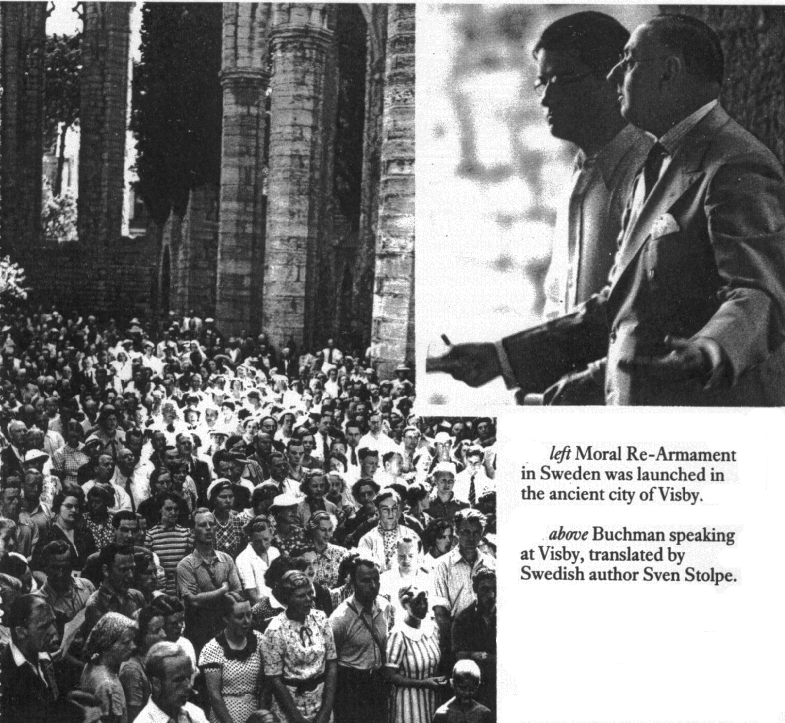
Frank Buchman, speaking at Visby, Sweden in 1938, quoted in
Experiment With God; Frank Buchman Reconsidered, Gösta Ekman, pages 44-45.
Ah, but who gets to say just what God's plan is? The Oxford Group sure didn't
hold elections.
Likewise, Frank Buchman's convert Herbert Grevenius praised Buchman with this
Orwellian double-think:
His enormously active life is built on one thing only — guidance.
He openly admits it. He is a sail always waiting to be filled by the wind,
a man with a great and warm and humble heart, a democrat who wants to
set men free under God's dictatorship.
Herbert Grevenius, quoted in
Experiment With God; Frank Buchman Reconsidered, Gösta Ekman, page 21.
and
Remaking the World, the speeches of Frank Buchman, Frank N. D. Buchman,
page 266.
Frank Buchman's program consisted of "personal
evangelism" with emphasis on:
- 1) both public and private confession of sin;
- 2) reception of divine "guidance" during "quiet times";
- 3) complete surrender to this "guidance";
- 4) the living of a "guided" life in which every
aspect of one's actions was controlled by God;
- 5) the practice of the Buchmanite Four Absolutes — Absolute Purity,
Absolute Honesty, Absolute Love, and Absolute Unselfishness;
- 6) making restitution to those one has harmed; and
- 7) carrying "the message" to those
"still defeated by sin" — that is, going recruiting for the Group.
Note that the "Four Absolutes" are pretty typical cult fare.
Many cults make impossible demands for
super-human perfection
from their members. Such impossibly lofty standards are good for
making members feel inadequate and inferior, which is good for
inducing lots of guilt, which then makes
the members much easier to manipulate and control.
Tom Driberg, the London newspaper reporter and Labor Party Member of Parliament,
pointed out that...
... the Four Absolutes, when compared with any of the classical codes of ethics,
do not form a well-balanced or comprehensive rule of life.
They read as if they were framed on the spur of the moment, in a
flash of Guidance, by Dr Buchman; and as if, since 'Frank's guidance was
always right', nobody ventured to question his authority and to
suggest that other Absolutes, too, might be required.
... there is in
this code no mention of the social virtue of justice or of the personal
virtue of humility. ...
In any case, is absolute honesty or purity (in the MRA sense of the word)
really desirable? To quote the usual examples of the justified 'white lie':
if a violent psychopath is looking for a gun, the honest citizen is not
obliged, when asked, to tell him where it is; and it is not sinful dishonesty,
but common courtesy, to let a worthy bore think that you are glad to see him.
...
An advocate of MRA has no right to shrug off such examples as absurdly extreme
cases in which common sense would obviously come into play: 'of course we
wouldn't behave so extravagantly'. For extravagant behavior is exactly what
the Absolutes require. If you tell the psychopath that you don't know where
the gun is, when you do, you are not being absolutely honest.
This is the cleft stick into which MRA's absolutism forces its disciples:
either they must behave extravagantly or they fall into dishonesty —
minor dishonesty which they are debarred from calling, as others would
call it, excusable. So, by deliberate training, they must come to lack that
most precious of civilised human attributes, a sense of proportion.
The Mystery of Moral Re-Armament; A Study of
Frank Buchman and His Movement, Tom Driberg, 1965, pages 230-231.
And it seems that the Four Absolutes were not original material, either. They had a long
history:
Ethics
The Buchman ethical structure was based on the four moral standards of
absolute honesty, absolute purity, absolute unselfishness, and absolute
love. They were to be applied personally, socially, and nationally.
The four standards were a part of the legacy from his personal
evangelism mentor, Henry B. Wright of Yale. Wright, in turn, had found
the four standards in the writings of Robert E. Speer.23
23 Wright, The Will of God, and, Speer, The
Principles of Jesus.
World Changing Through Life Changing: The Story of Frank Buchman and
Moral Re-Armament; A Thesis for the Degree of Master of Sacred Theology
at Andover Newton Theological School,
T. Willard Hunter, 1977, page 125.
Marcus Bach studied the Oxford Group / Moral Re-Armament organization, and
reported,
I had no intention of posing as a spiritual saboteur, but when Ned [Barton]
and a young English friend, Aylmer, talked me into going with them on
a "guidance walk",
I took along the explosives that had been accumulating in my mind since I first
heard of Frank N. Buchman.
In response to their exaggerated praise of the man, I contended that his genius
lay in the appropriation of other men's ideas. "Your four absolutes,"
I recounted, "came from Henry B. Wright, who got them from Robert E. Speer, who
got them from Henry Drummond, who very likely got them from someone else."
Aylmer responded to my mention of these men with "Never heard of them!"
I was in the awkward position of an outside informant enlightening the neophytes.
They did not know that the workable technique which Buchman had popularized had
been tested in the laboratory of a Yale professor's life. At the time of his
death in 1923, Henry B. Wright was collaborating with Buchman on a treatise devoted
to personal religion. Wright's earlier publication, The Will of God and a Man's Life Work,
was Buchman's text. Before Buchman became famous, he confessed that much of
the best in his message had come from Henry B. Wright. It was Wright who made Buchman
"system-conscious";
it was Wright who taught him the first words of his spiritual
lingo.57
Neither of my companions on this morning walk was impressed or disturbed
by my exposé of their leader. Aylmer, with a gesture of unconcern,
said, "All that may be true,
but don't we always ascribe originality to the man who makes a thing memorable?
And you'll have to admit that F. B. has certainly sold the Oxford Group idea to the world."
"But I must protest against the use of that name," I retorted. "There
was an Oxford Group long before Buchman ever set foot in your country, Aylmer.
It was initiated in 1833 and was intended to clarify the position of the Anglican Church
in light of its higher function. I've often hear the charge that Buchman was never
averse to capitalizing on the prestige this name afforded. It slyly put him into
the company of men like John Henry Newman and John Keble and tied him to a great
tradition in a way that was downright misleading."
"Oh," said Aylmer deprecatingly, "let's not quibble about that."
They Have Found A Faith, by Marcus Bach, pages 146-147.
More Buchmanism: The Five Procedures of the Sane:
- Guidance
- Checking Guidance
- Giving in to God
- Restitution
- Sharing
What they meant was:
- Guidance == Conduct a séance and "listen to God" talking to you.
- Checking Guidance == Ask the cult elders whether they agree with what you think God said.
- Giving in to God == "Surrender" to the "guidance" and do what the voices in your head tell you to do.
- Restitution == Go around apologizing and making amends to all whom you have offended.
- Sharing == Deliver testimonials at meetings, "sharing" stories
of how you lived a decadent life of terrible sin until you were saved by
Dr. Frank Buchman's wonderful religion.
And more Buchmanism: "The Five C's": These steps were the
procedure for recruiting more members. The most important duty of
members was to "win more souls" for the Group. The five
C's were:
- Confidence
- Confession
- Conviction
- Conversion
- Conservation
What they meant was:
- First, the recruiter got the prospect's Confidence and
trust by utilizing whatever mind games were required.
(Yes, it's a "con" — a confidence game.)
- Then, the recruiter Confessed something to the prospect
in order to get his trust,
and encouraged him to Confess something about himself in return.
Gradually, the recruiter pressured the prospect to Confess
all of his innermost dirty little secrets. The Oxford Group manual
called "Soul Surgery" tells us that recruiters must
be "lovingly relentless" in insisting that a confession be made.
- Then came Conviction — the recruiter betrayed the prospect's trust,
and turned his confession around and used
it against him, amplifying and exaggerating it,
in order to make the prospect feel as guilty as possible.
The recruiter got the prospect to 'Convict' himself of sins — that
is, to find himself guilty of having committed many sins and to confess that
he was a worthless sinner who had been defeated by sin.
- Then, the recruiter held out religious Conversion as the only
way to escape from the feelings of guilt.
The prospect was told that he must "surrender himself to God"
(really, surrender to the Oxford Group recruiters).
- And the last 'C' was "Conservation", which was
somehow redefined to mean that the new convert had to go out
and recruit more new cult members, using the same Five C's as
were just used on him, doing unto others what had just been
done unto him.
A very disturbing feature of those "Five C's"
is the belief that it is okay to deceive the prospective new
member in order to get his confidence and confession, and get
him to join the group.
The recruiting member, who is called
a "Soul Surgeon," should twist the truth, mask details,
tell half-truths, present only facts which will appeal to the prospect,
and "confess" or "share" stories — true or
untrue — telling how Buchmanism saved the recruiter from misery —
basically, say anything — in order to entice the prospect to
join the Group.
"It's all okay," they said,
"because
it is all done in the service of God."
The truth is,
deceptive
recruiting is a standard practice of most all evil cults, and
so is the rationalization that
the end justifies
the means.
And so is
aggressive
recruiting.
Ken Ragge, in his book More Revealed, stated:
The extraction of Confession was considered of ultimate importance and
great effort was made to get it.
When he is certain that the need for confession exists, the soul surgeon
must be lovingly relentless in insisting that the confession be made...
(18)
This "loving relentlessness" takes on a rather sinister
air when the
group's "hospital work" is considered. An alcoholic patient,
locked away
in a hospital, would be given only a Bible to read and was allowed only
Groupers for visitors during the "Oxfordizing" period.*
The poor victim
was under steady pressure, perhaps for days, weeks, or months, to accept
Oxford Group interpretations of the Bible and Oxford Group's will as God's
will. Even outside of hospitals, the grouper's techniques sometimes led
to severe emotional damage including nervous and mental breakdowns.(19)
* All cults use some method to separate their target from outside
sources of information.
18. Walter H. A., Soul Surgery The Oxford Group, Oxford:
1932
19. Driberg T., The Mystery of Moral Re-Armament:
A Study of Frank Buchman and His Movement Secker &
Warberg London: 1964
More Revealed, Ken Ragge
http://www.morerevealed.com/
You will notice that Frank Buchman just loved lists of
"principles" or "procedures" or step-like things.
Frank had:
- The Four Absolutes,
- The Five C's,
- The Five Procedures of the Sane,
- The Six Basic Assumptions,
- and The Six or Seven "Principles" or "Practices of the Sane".
The Twelve Steps and The Twelve Traditions of Alcoholics Anonymous
are just another couple of iterations of the same old list-making routine.
(But note that Buchman never exactly called them "Steps" —
although Sam Shoemaker talked about
"taking the next step".
"Steps" was more Bill Wilson's terminology.
When Earl T. wrote in his Big Book story,
He Sold Himself Short,
that the early A.A.'s were using a 6-step program
[on page 292 of the 3rd edition, and on page 263 of the 4th edition],
that was a slight misnomer.
It was Buchman's 6-step program all right, but Buchman called it
something more like "the six principles" or
"The Six Practices of the Sane".)
The Five Procedures included:
- giving in to God,
- listening to God's directions,
- checking guidance,
- making restitution, and
- sharing one's sins openly.
The Six Basic Assumptions were that
- men were sinners,
- men can be "changed",
- confession is necessary to "change",
- the "changed" person has direct access to God,
- the age of miracles has returned,
- and those who have been fortunate enough to
be "changed" should seek to "change" others.
(Those who had been converted to Buchman's beliefs were called
"the changed", and those who proselytized and recruited
for the Oxford Groups were called "life changers" or
"Soul Surgeons".)
The Oxford Group manual Soul Surgery
(page 4) lists
"The Principles Of Personal Evangelism" ("the Five C's") as:
- Confidence — Get the trust and confidence of the targeted victim.
- Confession — Confess something to the victim, and get him to confess something about himself in return.
- Conviction — Turn the victim's confession back upon him and amplify and exaggerate it and make him convict himself of all kinds of sins.
- Conversion — Offer religious conversion as the only way out of the guilt.
- Conservation — Send the new convert out to get other victims by using these same practices on them.
Next: The Cult Characteristics of the Oxford Groups
Previous: Frank Buchman
Click Fruit for Menu

Last updated 25 December 2014.
The most recent version of this file can be found at
http://www.orange-papers.org/orange-rroot090.html
|
 "Sam Shoemaker"