The Effectiveness of the Twelve-Step Treatment
Statistical analysis of AA's actual success rates
|
by A. Orange
RARELY HAVE we seen a person fail who has thoroughly followed our path. Those who do not recover are those who cannot or will not give themselves completely to this simple program, usually men and women who are constitutionally incapable of being honest with themselves. There are such unfortunates. They are not at fault; they seem to have been born that way. Nothing could be further from the truth. Even the most ardent true believers who will be honest about it recognize that A.A. and N.A. have at least 90% failure rates. And the real numbers are more like 95% or 98% or 100% failure rates. It depends on who is doing the counting, how they are counting, and what they are counting or measuring. A 5% success rate is nothing more than the rate of spontaneous remission in alcoholics and drug addicts. That is, out of any given group of alcoholics or drug addicts, approximately 5% per year will just wise up, and quit killing themselves.6 They just get sick and tired of being sick and tired, and of watching their friends die. (And something between 1% and 3% of their friends do die annually, so that is a big incentive.) They often quit with little or no official treatment or help. Some actually detox themselves on their own couches, or in their own beds, or locked in their own closets. Often, they don't go to a lot of meetings. They just quit, all on their own, or with the help of a couple of good friends who keep them locked up for a few days while they go through withdrawal. A.A. and N.A. true believers insist that addicts can't successfully quit that way, but they do, every day. Every disease has a spontaneous remission rate. The rate for the common cold is basically 100 percent — almost nobody ever dies just from a cold. People routinely just "get over it", naturally. Likewise, ordinary influenza — "the flu" — has a very high spontaneous remission rate, greater than 99%. Yes, some old people do die from the flu every year, but not very many. Most people just get over it. On the other hand, diseases like cancer and Ebola have very low spontaneous remission rates — left untreated, they are very deadly and few people recover from them. Alcoholism is in the middle. The Harvard Medical School reported that in the long run, the rate of spontaneous remission in alcoholics is slightly over 50 percent. That means that the annual rate of spontaneous remission is around 5 percent. Thus, an alcoholism treatment program that seems to have a 5% success rate probably really has a zero percent success rate — it is just taking credit for the spontaneous remission that is happening anyway. It is taking the credit for the people who were going to quit anyway. And a program that has less than a five percent success rate, like four or three, may really have a negative success rate — it is actually keeping some people from succeeding in getting clean and sober. Any success rate that is less than the usual rate of spontaneous remission indicates a program that is a real disaster and is hurting the patients.
A.A. is also more than happy to convince the person who just quit that it is all due to A.A. and the Twelve Steps. And many of them will believe it. At meetings, you will sometimes hear testimonials like "I tried everything, the V.A. program, the Christian Brotherhood, and finally, A.A. is what worked." The speaker is forgetting one of the famous corollaries to Murphy's Law: Many people who are in recovery require one or more relapses to convince themselves that they really can't drink or dope any more, not even just a little bit, now and then. They will think that they can just nibble, or "just have one", and that it will be okay. They will go through a lot of programs while they experiment and fail. It's a learning process. In the end, when some of them finally quit, really totally quit and stay quit, rather than die, they often give the credit to whichever program they just happen to be in when they finally quit. (All of them tend to overlook the fact that they stopped examining other programs after they successfully quit drinking. They just stuck with the program that they were in.) Thus the Christian sects have a bunch of totally convinced true believers who say that Jesus saved them, and the Veteran's Administration has some veterans who believe that the V.A. program is the best, and Alcoholics Anonymous has a bunch of people who insist that A.A. and the Twelve Steps are the only answer.
Yes: "they become loyal to the 'successful therapy' — and, unfortunately, sometimes antagonistic or unfavorable in their attitude toward other therapeutic programs." That is the mind-set of A.A. members in a nutshell.
The Harvard Medical School says that the vast majority
of the people who successfully quit drinking for a year or more
— eighty percent of them —
do it alone, all by themselves, without
any treatment program or "support group".
Naturally, those do-it-yourselfers will also insist that they have
the sure-fire solution that really works: When you are at an A.A. meeting, you are in a self-selecting group. You won't hear from the Jesus-freak Christians, or the gung-ho V.A. guys, or the do-it-yourself guys, because they aren't there. You will only hear from the A.A. true believers, who will be happily reassuring each other that they are doing the only thing that really works.

On their own So much for the sayings that "Everybody needs a support group" and "Nobody can do it alone". Most successful people do.
Likewise, American Health Magazine reported:
...people are about ten times as likely to change on their own as with the help of doctors, therapists, or self-help groups.
Spontaneous Remission in Alcoholism The key sentence is the last one — for a treatment program to claim success, it would have to produce recovery rates greater than the usual rate of spontaneous remission. Alcoholics Anonymous comes nowhere near exceeding a 4 to 18 percent per year recovery rate. Personally, I find the 18 percent number to be far too high to believe. (At that rate, 85% of all of the alcoholics in the country should have recovered in just the last 10 years. Obviously, that has not happened.) I agree with R. G. Smart, who calculated a spontaneous remission rate for alcoholism of between 3.7 and 7.4 percent per year. As a simple rule of thumb, the middle value of 5 or 5.5 percent per year is quite believable. Still, the claimed success rate of Alcoholics Anonymous does not even exceed that much lower rate of spontaneous remission.
Imagine that we have 10,000 alcoholics, and they are spontaneously recovering at a rate of five percent per year. The math works out like this:
Even after 21 years, one third of the alcoholics are still drinking. In addition, in those 21 years, another whole new younger generation of alcoholics has matured and started drinking (so, theoretically, we have at least another 10,000 new alcoholics added to the mix). So no way does the problem spontaneously disappear, even though almost two-thirds of the original group of alcoholics are no longer drinking. Many, many alcoholics do just recover spontaneously, and yet, the problem still never goes away. Actually, we haven't computed the deaths from alcoholism and subtracted them out. That will make the number of remaining alcoholics decline much faster. (And we haven't even considered the deaths from tobacco. Most alcoholics are also heavy smokers, and more than half of the time, tobacco kills them before the alcohol does.) The real numbers are more complex than this chart indicates, but it is accurate enough for you to see the principle at work. Likewise, the younger generation of alcoholics does not all start drinking at 21 years of age. They may start at any age from 12 to 35, or even later. So, in the real world, we have many successive waves of alcoholics starting and quitting simultaneously, producing very complex patterns of numbers. But the one simple, undeniable fact is that generation after generation, while all of the individual alcoholics do either quit drinking or die, the problem doesn't go away.
There is experimental evidence that the A.A. doctrine of powerlessness leads to binge drinking. In a sophisticated controlled study of A.A.'s effectiveness (Brandsma et. al.), court-mandated offenders who had been sent to Alcoholics Anonymous for several months were engaging in FIVE TIMES as much binge drinking as another group of alcoholics who got no treatment at all, and the A.A. group was doing NINE TIMES as much binge drinking as another group of alcoholics who got rational behavior therapy. Those results are almost unbelievable, but are easy to understand — when you are drunk, it's easy to rationalize drinking some more by saying, "Oh well, A.A. says that I'm powerless over alcohol. I can't control it, so there is no sense in trying. I'm doomed, because I already took a drink. One drink, one drunk. I'm screwed, because I already lost all of my sober time, and I have to give back all of my sobriety coins. Might as well just relax and enjoy it now. Pass that bottle over here, buddy." It's also easy to rationalize taking the first drink with, "I'm powerless. I can't help it. The Big Book says that I have no defense against those strange mental blank spots when I'll drink again. Bottoms up!" Dr. Jeffrey Brandsma and his associates Dr. Maxie Maultsby (co-inventor of Rational Behavior Therapy) and Dr. Richard J. Welsh did a study where they took some alcoholics who had been arrested for public drunkenness, and randomly divided them into three groups, which got one of:
And the results were:
The variables that showed significant differences at outcome could be organized into three categories: treatment holding power, legal difficulties, and drinking behavior. Treatment holding power was indicated by the percentage of dropouts between intake and outcome (p = 0.05), the mean number of treatment sessions attended (p = 0.05), and the mean number of days in treatment. Less than one-third (31.6%) of the clients assigned to the AA group qualified for outcome measures in contrast to almost 60% for the lay-RBT group, and this occurred with equivalent attempts by our social work staff to keep the men in treatment, whatever type it was. Table 32 highlights these differences. That is a clear description of a real disaster. Alcoholics Anonymous greatly increased the amount of binge drinking that the alcoholics were doing. Their bingeing didn't just increase a little bit — it was FIVE TIMES higher than the alcoholics who got nothing, no help or treatment at all. On the other hand, Rational Behavior Therapy, as taught by laymen (amateurs, non-professional counselors), really did help the alcoholics to cut down on their drinking. They were doing less binge drinking than the control group. Notice the statement about "holding power".
Less than one-third (31.6%) of the clients assigned to the AA group qualified for outcome measures in contrast to almost 60% for the lay-RBT group, and this occurred with equivalent attempts by our social work staff to keep the men in treatment, whatever type it was. A.A. couldn't "keep them coming back." A.A. seems to have been so repulsive to the alcoholics that more than two-thirds of them just walked out and didn't come back. Obviously, A.A. can't do much good if it just drives the alcoholics away. And at the 12-month follow-up:
There were no significant results to report at 12-month follow-up. In certain cases where the data were inspected, part of the reason for this seemed to be the improvement of the control group. Over the long haul, the no-treatment control group did just as well as the others. That was spontaneous remission at work, again. A lot of people, even hard-core alcoholics, really do just quit drinking when they get sick and tired of being sick and tired. Dr. Brandsma and co-authors concluded:
DISCUSSION: In other words, Emrick was wrong when he suggested that the untrained lay therapists of A.A. — "sponsors" — were better recovery counselors than the trained professionals. Again, RBT was far superior to A.A. because RBT was able to keep the majority of the its alcoholics — almost 60% of them — in the treatment program, while A.A. lost more than two-thirds of its people. And RBT reduced binge drinking, while A.A. increased it. And note how Doctor Brandsma reported that "The 3-month follow-up indicated that AA members had increased their binges and more often drank in order to feel superior." Bill Wilson repeatedly declared that all alcoholics must have their egos crushed. "Getting rid of ego and self" by humiliating people with constant self-criticism and confession sessions is a big part of the A.A. program. But what Dr. Brandsma saw was that people responded to such treatment by drinking to get their egos back. But of course. The urge to heal oneself, to fix whatever is broken, is one of the most deep-seated basic drives in life. Attack people's egos and selves, and they will respond by trying to repair their egos and sense of self. Many will drink so that they can feel good about themselves again. People will fight oppression however they can. For another description of the Brandsma study, see the "More Revealed" web site: http://www.morerevealed.com/library/resist/r_chap_2.htm
A controlled study of the effectiveness of Alcoholics Anonymous was conducted in San Diego in the mid-nineteen-sixties. It is described in "A Controlled Experiment on the Use of Court Probation for Drunk Arrests", by Keith S. Ditman, M.D., George C. Crawford, LL.B., Edward W. Forgy, Ph.D., Herbert Moskowitz, Ph.D., and Craig MacAndrew, Ph.D., in the American Journal of Psychiatry.1
In the study, 301 public drunkenness offenders were sentenced by the court
to one of three "treatment programs". The offenders were randomly divided
into three groups:
All of the subjects were followed for at least a full year following conviction. Surprisingly, the no-treatment group did the best, and Alcoholics Anonymous did the worst, far worse than simply receiving no treatment at all. When the rates of re-arrest for public drunkenness were calculated, the following results were obtained:
In every category, the people who got no treatment at all fared better than the people who got A.A. "treatment". Based on the records of re-arrests, only 31% of the A.A.-treated clients were deemed successful, while 44% of the "untreated" clients were successful. Clearly, Alcoholics Anonymous "treatment" had a detrimental effect. That means that A.A. had a success rate of less than zero. Not only was A.A.-based treatment a waste of time and money; A.A. was actually making it harder for people to get sober and stay sober. And the A.A. people got rearrested more often after many months of A.A. training — not in the beginning. The rate of rearrests was the same for the no-treatment and A.A. groups during the first month of treatment (22%), but the A.A. group's rearrest rate increased later, after months of A.A. indoctrination.
And, strangely enough, the professional treatment program had the same problem.
Their patients' rate of rearrests also
increased with time, by the same amount. The more 'treatment' the patients got,
the more they got rearrested.
The authors concluded:
The failure of both Alcoholics Anonymous and the alcoholism clinic to produce fewer recidivists than did no treatment at all ought to be of great concern. Some of the present writers were quite optimistic about the possibilities of enforced referral to treatment, but the early encouraging anecdotal reports are not borne out by present data. For another description of the Ditman study, see the "More Revealed" web site: http://www.morerevealed.com/library/resist/r_chap_2.htm
A 1999 study of Texas' correctional substance abuse treatment programs found that those who participated in an in-prison [Twelve-Step] program had the same recidivism rates as non-participants. Although those who completed the program did better than untreated offenders, those who entered but did not complete the program did worse. Moreover, probationers enrolled in treatment in Texas had an overall higher recidivism rate than non-participants. Peele also wrote: The two randomized studies in which AA treatment was assigned found AA to yield worse outcomes than other forms of treatment — or no treatment at all. There, the success rate of A.A. was again negative — worse than zero. A.A. was hurting people by making it harder for them to quit and stay sober. Those patients who got no A.A. "treatment" at all were better off.
In addition, Stanton Peele has argued, in an article in
The Sciences, that the most
widely used alcoholism treatments (Twelve-Step) are the least
effective. "This is seen in Deborah
Dawson's (1996) analysis of data from the 1992 National
Longitudinal Alcohol Epidemiologic
Survey." Peele suggests that the "brief
intervention" and "motivational enhancement"
treatments are more successful alternatives.
The reported results included:
Drinking Outcomes
Note that most of the people who were sent to A.A. (63%) ended up requiring hospitalization anyway. In addition, they actually got worse while they were in A.A., so that they ended up requiring higher rates of expensive follow-up treatment in the hospital. The total cost savings from sending people to the "free" A.A. treatment, instead of hospitalizing them right away, was only 10%. This contradicts the often-repeated A.A. declaration that A.A. is "the most cost-effective treatment program", because it is free. It isn't cost-effective or "free" when all it does is make the patients worse, and make it more expensive for some hospital to clean up the mess later on. Walsh et. al. wrote:
When we compared the costs of treatment for the A.A. and hospital groups, we found that the costs for the A.A. group averaged $1,200 less per person, a savings of just 10 percent. Even though the initial referral to AA was free, the AA group had much higher rates of additional treatment; 63 percent of subjects randomly assigned to AA eventually required hospitalization. And using A.A. to treat patients who were abusing both alcohol and cocaine was a total disaster:
In the period of 18 to 24 months after treatment, 80% of the A.A. group were still drinking. Once again, A.A. treatment had the worst outcome of any treatment method tested, and again, we see that the A.A. group required the most additional treatment in a hospital for uncontrolled drinking — far more than the other groups. Dr. Walsh and associates concluded:
To a company or union counselor or a clinician advising patients, our findings argue for hospitalizing problem drinkers who are also using cocaine or other drugs. For other problem drinkers with reasonable job stability and no serious medical needs, an initial referral to AA (or the offer of a choice of treatment) is somewhat less costly (about 10 percent), but it entails extra risk. Employees sent only to AA, and those offered choices, are more likely to have their drinking problems resurface. The less costly intervention may be more efficient in the longer term if the money saved is spent to identify and refer more substance-abusing employees or if nonhospital options encourage seeking help. But if AA alone is mandated, or if choice is offered, our study shows that close monitoring is essential, because many employees have serious relapses in the first six months. In other words, you have to watch them like a hawk because A.A. does not keep them sober. Unfortunately, this otherwise excellent study did not have a control group, so we cannot determine what the overall success rate of any kind of treatment was, compared to the normal rate of spontaneous remission. And there was also no group that got only threats of firing. That is, take one group of employees aside and tell them in no uncertain terms that if they don't immediately cut way down on their drinking that they will lose their jobs. The people in that study were undoubtedly made to understand that (because 31 of the employees were fired during the 2-year follow-up period), but the study did not test for what percentage of the employees would cut down or quit drinking of their own accord, rather than get fired, without any "treatment". That number has to be greater than zero, and may, in fact, account for a significant percentage of the successes in all three groups, all of which "improved during treatment". The authors recognized the effect of threats of firing, and found it in all three groups, but lacking a control group, were unable to measure it:
We found no differences among the three groups in any job outcome, including being fired. All three groups evidently brought their drinking problems under sufficient control at work for group differences in job performance to be rendered statistically insignificant.
Jim Ordford was, in 1977,
And Griffith Edwards was, in 1977,
You might notice that eleven out of one hundred is a rather high rate of success, when so many other tests and studies reported something closer to a five percent success rate — the usual rate of spontaneous remission in alcoholics. The two most obvious differences here are:
Dr. Vaillant's question was: does the A.A. program improve on the percentage of alcoholics who undergo spontaneous remission? Following the passage of the Hughes Act, the U.S. government — the NIAAA to be specific — funded studies of alcoholism treatment. Dr. Vaillant participated in the Cambridge-Sommerville [Massachusetts] Program for Alcohol Rehabilitation (CASPAR). It featured 24-hour walk-in services with medical treatment for detoxing. It treated 1000 new patients per year, did 2500 detoxifications per year, and had 20,000 outpatient visits per year. To study the effectiveness of various methods of treating alcoholism ("treatment modalities"), Vaillant compiled forty years of clinical studies. Vaillant and the director William Clark also conducted an eight-year longitudinal study of their own where Vaillant reported having followed 100 patients who had undergone Twelve-Step treatment. (That was an unusually large and long-term study.) Vaillant compared those people to a group of several hundred other untreated alcohol abusers. The treated patients did no better than the untreated alcoholics. Fully 95% of the treated patients relapsed sometime during the eight-year period that Vaillant followed them. Professor Vaillant candidly reported:
When I joined the staff at Cambridge Hospital, I learned about the disease of alcoholism for the first time. My prior training had been at a famous teaching hospital that from past despair had posted an unwritten sign over the door that read "alcoholic patients need not apply." ... At Cambridge Hospital I learned for the first time how to diagnose alcoholism as an illness and to think of abstinence in terms of "one day at a time." ... To me, alcoholism became a fascinating disease. It seemed perfectly clear that by meeting the immediate individual needs of the alcoholic, by using multimodality therapy, by disregarding "motivation," by turning to recovering alcoholics [A.A. members] rather than to Ph.D.'s for lessons in breaking self-detrimental and more or less involuntary habits, and by inexorably moving patients from dependence upon the general hospital into the treatment system of A.A., I was working for the most exciting alcohol program in the world.
a. These are studies by Orford and Edwards (1977), Kendall and Staton (1966), and Imber et al. (1976). Because at 1 year there was no difference between Orford and Edwards's treated and control populations and because at 2 years their report did not clearly separate the two populations, all 85 of their subjects on whom they had a 2-year follow-up are included.
In table 8.2, the results of the Clinic sample at eight years are compared with five rather disparate follow-up studies in the literature which are of similar duration but which looked at very different patient populations. Once again, our results were no better than the natural history of the disorder.
The Natural History of Alcoholism: Causes, Patterns, and Paths to Recovery, George E. Vaillant, Harvard University Press, Cambridge, MA, 1983, pages 283-286. What Professor Vaillant, a Trustee of Alcoholics Anonymous World Services, Inc. — in other words, one of the highest-ranking A.A. leaders — is candidly, clearly describing is a zero-percent success rate for his A.A.-based treatment program. The A.A. meetings and the Twelve Steps and all of the rest of A.A. program did not help the alcoholics at all. Zero improvement. Zilch. And it was even worse than no help:
Remember that these terrible numbers were reported by a Trustee of Alcoholics Anonymous World Services, Inc., by a real true believer in A.A., by one of the highest-ranking A.A. insiders, by someone who loves A.A. and was trying hard to make it look good, not by some harsh critic of A.A. who might be suspected of bias, or of fudging the numbers to make A.A. look bad... Remember this the next time you hear somebody say "Keep coming back! It works! (If you make it work...)"
Prof. Vaillant's own words on the subject were:
Recently the Annals of Internal Medicine editorialized that "the treatment of alcoholism has not improved in any important way in twenty-five years" (Gordis 1976). Alas, I am forced to agree. Perhaps the best that can be said for our exciting treatment effort at Cambridge Hospital is that we were certainly not interfering with the normal recovery process. How can I, a clinician, reconcile my enthusiasm for treatment with such melancholy data? Essentially, Vaillant is saying that we can't just give up and do nothing. We should keep on trying something. I totally agree. And he wants the government to keep on funding his programs. That's understandable. (I don't necessarily agree, but it's understandable.)
Then Vaillant wrote,
Then Vaillant asked the key question: Notice how Vaillant slickly equated A.A. with "treatment", without quite saying so. That is a deceptive word game. "Treatment" and "mandatory Alcoholics Anonymous meetings" are not necessarily the same thing. (That is an example of the propaganda stunt "False Equality" — imply that two different things are equivalent, when they are not.) If you want "treatment", why not send the alcoholics to any of the other treatment programs that had the same dismal failure rate as Alcoholics Anonymous, but much lower death rates?
In trying to answer that question, Vaillant went, by some lengthy,
tortured logic, from admitting that A.A. doesn't work,
to recommending that we send more alcoholics
to a program that is exactly like A.A. anyway, I smell a rat. And I think that the rat is the reason why Vaillant was on the Board of Trustees of AAWS (Alcoholics Anonymous World Services, Inc.). Vaillant has cards he isn't showing, beliefs he isn't revealing to us, like religious beliefs that A.A. is good for something besides treating alcoholism... Vaillant is a true believer in Alcoholics Anonymous. All through the rest of his book, Vaillant described how he used A.A. teachings, practices, and philosophy on his patients, and he told how wonderful he considered A.A. to be. The eight-year study described here is just a summation of that on-going program. Vaillant's enthusiasm for A.A. was hardly dampened by his discovery that it didn't work.
How can that be? The answer is, In A.A., before Prof. George Vaillant, there was Dr. Harry Tiebout, who was also not an alcoholic — he was a real, certified, psychiatrist — and he also abandoned his training and became a true believer in using Alcoholics Anonymous "treatment" to force his patients to "surrender". And then there is Dr. G. Douglas Talbott, the previous President of ASAM (the American Society for Addiction Medicine, another A.A. front), who drove other doctors to suicide with his A.A.-based "therapy". So there is no shortage of insane doctors, mad scientists, and other sick "therapists" who love to torture their patient-prisoners with fascist medicine. (See Straight, Inc. for more.)
Notice that Vaillant used
the same old stereotype
of "The Alcoholic" as A.A. does:
It's just another example
of standard cult behavior — the arrogant belief that
"Newcomers can't think
right, so we will have to do their thinking for them." Deliberately changing someone's belief system, possibly without his knowledge or permission, smacks of brainwashing and mind control, but that's what cults do. Deceptive recruiting is also what cults do. Deliberately giving people a treatment program that is a proven failure (Vaillant himself proved it), while calling that failed program a "placebo", and then telling the patients that they are in the greatest, most exciting, alcoholism treatment program in the world, sounds like a good way to bring on a host of malpractice lawsuits. I don't know how anyone can call that ethical behavior, especially considering that people's lives are at stake.
And then Vaillant actually recommends using a hocus-pocus witches' brew mixture of "the placebo effects of acupuncture, Lourdes, or Christian Science" combined with "the attitude change of an evangelical conversion experience" to manipulate people's minds. Unbelievable. Also note that you are supposed to get a religious "evangelical" conversion experience from this A.A. organization that says that it isn't a religion and it doesn't do religious conversions. Vaillant chose Jerome Frank's "transcultural model for healing that is nonspecific for disease or patient". What that means in plain English is that it is a generic cure-all. It's a cure-all that was designed with no particular disease or patients in mind; it's just supposed to be a general-purpose cure-all that is good for curing whatever ails you, just like good old-fashioned snake oil. It's just like the Twelve Steps, which are supposedly able to cure anything and everything from alcoholism to compulsive shopping to schizophrenia. And it's almost comical how Prof. Frank admits that such "therapy" suffers from "mounting complaints that such therapy may represent expensive fraud."
One wonders whether Jerome Frank's cure-all model was deliberately
patterned after the A.A. program. It sure resembles A.A.. The
similarity is far too much of a coincidence to assume that
Prof. Frank did
not write up his "model" in order to recommend the A.A.
program. Vaillant describes Prof. Frank's ideal therapy program as: There should be a "sanctioned healer ... with an unambiguous conceptual model of the problem which he is willing to explain to the patient." In other words, there should be a leader with some simplistic dogmatic explanations that he is happy to shove on the newcomers. The explanations don't have to be true, just "unambiguous". The program should offer "group acceptance, an emotionally-charged but communally-shared ritual, a shared belief system", and some phony dogma that "explains" the phenomenon of the illness. In other words, the program should be Alcoholics Anonymous, with its groups, ritualistic meetings, shared beliefs, and dogma. Note how Vaillant put quotes around the word "explains" when he wrote:
Such a ritual should be accompanied by a cognitive learning process that "explains" the phenomenon of the illness. The dogma isn't supposed to really explain "the phenomenon of the illness"; it is just supposed to mollify the stupid patient with some unambiguous simplistic fairy tales. (Cult true believers really like black-and-white thinking and simple, "absolutely-true" statements.) Vaillant clearly states that the goal is to use emotionally-charged rituals and "unambiguous" misinformation to play games with the patient's mind, and he rationalizes it this way:
The point is that if one cannot cure an illness, one wants to make the patient less afraid and overwhelmed by it.
So that he can die comfortably, I guess — die comfortably as a
"less afraid and overwhelmed" member of Vaillant's religion.
Likewise, Prof. Frank said that the goal was not to cure the patient,
but rather it was just to
"elevate his morale."
So that he can die with a smiley face on his head?
Personally, I'd rather really fix the problem, and I'd call quitting drinking, and staying quit, a workable cure. So some kind of a "cure" is possible, so there is no need to yammer about how we can't cure the illness, so let's play mind games on the patients.
Speaking of mind games, did you notice how Professor Vaillant's mind jumped
from: Vaillant's plan for a treatment program is another example of The Enlightened Counselor's Deception, where "enlightened" counselors will tell public officials, "Of course we know that this nutty religious or spiritual or superstitious stuff that is at the heart of the A.A. and N.A. programs doesn't really work, but it offers a wonderful placebo effect, and if the patients think that it works, and it helps to keep the patients off of drugs and alcohol, then the illusion is a good thing. It might save their lives. So let's encourage it." That is how the counselors who are true believers in the A.A./N.A. 12-step religion succeed in getting the government to financially support and promote their cult religion with public tax dollars and health insurance money, and that is how they talk judges into sentencing people to 12-step-based "treatment programs".
And finally, Frank and Vaillant want to get the patient to confess
his sins to a "high-status healer" to get an "attitude
change".
Since Vaillant already showed that Alcoholics Anonymous doesn't work, and doesn't
heal anybody, an A.A. sponsor doesn't qualify as a "healer".
And why should the patient confess his sins to that "healer"? No. Of course not. Vaillant knows full well that that doesn't really work. Vaillant has already candidly reported that the A.A. 12-step program, with all of its guilt-inducing listing of sins, and confessing of sins, and "admitting the exact nature of your wrongs", doesn't work at all. Eight years of thorough testing showed A.A. treatment to be completely ineffective and utterly useless, and even downright harmful — it raises the death rate. And yet Vaillant wants to send all of the alcoholics to A.A. to confess their sins anyway, obviously for some other reason than the effective treatment of alcoholism. The real reason for such confessions is because Vaillant is a thinly-veiled Buchmanite, or an A.A. true believer (same thing, really), who can't wait to get people on their knees, confessing their sins, because his cult religion tells him that people must confess their sins to each other in order to be holy. So, in order to better serve God, Vaillant has given himself the task of trying to get as many people as possible to confess their sins to each other, as well as to convert to his religion.
What does any of this have to do with curing alcohol abuse?! What Vaillant has done is pick out a "treatment model" — Jerome Frank's model — that matches his own Buchmanite religious beliefs, so that he can then recommend a religious program, specifically the Alcoholics Anonymous program, while pretending to be recommending a psychologically-oriented alcoholism treatment program. Vaillant wants to send more people to A.A. in spite of the simple fact that when he tested the A.A. program, it didn't work. It was a disaster. The best thing that Vaillant could say for A.A. was that it did nothing. But, the truth is, A.A. was far worse than nothing. Over-all, A.A. had the highest death rate of any treatment or "non-treatment" program tested. Look at the "Dead" column in Table 8.2 again. Vaillant clearly demonstrated that A.A. kills: Over an 8-year period, the A.A.-treated "Clinic sample" had a 29% death rate. That really is appalling. That is nearly one out of every three patients, dead. That's the Bataan Death March. Compared to the other programs, the A.A. death rate was anything from 128% to 580% of the other programs' death rates. So there is absolutely no sane reason to be sending more patients to Alcoholics Anonymous, or any program based on Alcoholics Anonymous, or any program that is even like Alcoholics Anonymous, when all of the other treatment programs killed fewer patients. But there is a dishonest, ulterior religious motive for doing so, if you are a Buchmanite or a member of Moral Re-Armament, or perhaps a hidden member of the Alcoholics Anonymous religion. Then, you would want to send people to A.A. to make them do the Twelve Steps, and confess their sins, and Seek and Do the Will of God, because you believe it will please God...
The A.A. saying is,
Yes. And if you keep on sending patients to A.A. and N.A., you will
keep on getting the same failure rate, and the same death rate.
For a final laugh, you might be curious to know where Vaillant was going with his argument. We stopped quoting him at the point where Prof. Frank was advocating sending all alcoholics to some program where they would confess their sins to "a high-status healer." Well, after that, Vaillant declared that dogmatic cult religion is the best cure for alcoholism. Now, he never used those exact words, "dogmatic cult religion"; he just said:
Frank's prescription for attitude change is initially interrogation by and confession of sins to a high-status healer. This process involves four components: indoctrination, repetition, removal of ambiguity, and opportunity for identification. It has been demonstrated that the patient's active participation in such a process "increases a person's susceptibility especially if the situation requires him to assume some initiative" for his own attitude change (p. 112). In the Stanford Heart Disease Prevention Program, internist John Farquhar (1978) and his colleagues (Farquhar et al. 1977) have examined different models of reducing smoking, altering diet, and increasing exercise. In their efforts to reduce coronary risk in large populations of patients, they found that explanation of risk and rational advice by physicians are less useful than systematic indoctrination and repetition using mass media and opportunity for identification through peer support groups.
Outrageous.
First off, note that Vaillant and Frank openly advocate
brainwashing the patients:
By the way, Vaillant and Frank really should
know enough about medical terminology to know that if a treatment
works, and yields a real, measurable, strongly positive effect,
then it isn't a placebo.
By definition, a placebo is a do-nothing medicine.
Vaillant claims real cures from Prof. Frank's "placebo"
"natural healing principles".
That's a contradiction in terms.
So is this nonsensical oxymoronic double-talk:
Now I know full well that there is such a thing as a placebo effect.
Sometimes, patients will show improvement or relief from symptoms
even if they are only given do-nothing sugar pills, because they
believe that the pills will work. But you sure can't count on that effect,
and you can't base a treatment program on hoping that you will
get enough of a placebo effect to heal the patients.
Next, Vaillant cited a study of the Stanford Heart
Disease Prevention Program, which found that patients had been
helped by a program that included
"opportunity for identification through peer support
groups."
Ridiculous. They did not "fortuitously follow Frank's prescription". They didn't even accidentally or coincidentally do the same things. Vaillant cherry-picked four studies that he thought looked sort of like Prof. Frank's ideas, but there is really not much similarity there at all. In fact, two of the four studies were done before Prof. Frank came up with his "non-specific natural healing program" in 1961, and they used drugs, not natural healing. Then Vaillant used just one of those four studies — an obscure report from Trinidad (Beaubrun 1967) — to try to show the effectiveness of Alcoholics Anonymous treatment. Apparently, the only study of anything like A.A. treatment that Vaillant could find that showed better than average results (the only study that he cited) was some people in the boondocks of Trinidad and Tobago in the 1960s, who used "indigenous calypso singing", combined with some A.A. rituals, for group therapy. (Vaillant didn't say whether they also used some voodoo rituals in their program.) Notice how Vaillant quietly discarded his own eight years of carefully-documented research which showed that A.A. didn't work at all, and Vaillant just grabbed at one study of calypso sing-alongs in the Caribbean as evidence that Alcoholics Anonymous and Jerome Frank's screwy mind-altering "placebo group therapy" really do work after all.
Remember that two of the four "successful" therapy programs that Vaillant cited as "proof" of Frank's "natural healing principles" actually used drugs — specifically emetine and disulfiram — to get their results, not Jerome Frank's psycho-babble nonsense about the wonderful benefits of placebos, brainwashing, and emotionally-charged group rituals.
And it's very strange that Vaillant cited the work of the
Sobell and Sobell
husband-and-wife team as "proof" that Frank's ideas work.
The Sobells were so hated and vilified by the A.A.
hierarchy (including hidden members and front groups)
for advocating the teaching of controlled drinking that they were driven
out of the USA, and had to move to
Canada to continue their practice, because
the A.A. faithful decided that teaching controlled drinking was
against the A.A. dogma, and they accused the Sobells of killing
alcoholics.
(Talk about the pot calling the kettle black. Talk about
psychological projection...)
Vaillant's use of them as an example of successful treatment is
also funny because
their work had basically nothing to do with the irrational
mind-altering
emotionally-charged group rituals that Jerome Frank advocated.
The Sobells used an approach more like,
"Look at this
videotape of yourself last night. This is how stupid
you look and act when you get smashed. Wouldn't you like to just
have a few instead, and keep your wits about you, and not look
like such a jerk?" (Ouch! That's really a rough treatment program, isn't it? Can you imagine waking up all hung over and sick and jittery, and having someone shove such a videotape in your face first thing in the morning? Talk about aversion therapy...) And lastly, note how Vaillant summed up his argument by declaring that Alcoholics Anonymous was a big success because had it followed Prof. Frank's "natural healing principles":
The success of Alcoholics Anonymous — and its reasonable facsimiles which are continuously being rediscovered — probably results from the fact that it conforms so well to the natural healing principles that Frank outlines and with Frank's general prescription for therapeutic group processes. Vaillant had shown no such success for A.A. at all — he had in fact, with his eight years of research, clearly demonstrated just the opposite, the total failure of A.A. treatment — yet he suddenly claimed success as a given, and stated that Frank's "natural healing principles" were "probably" the reason why. That is an example of the propaganda technique called "Assume the major premise" — just talk like something is true when you only wish it were true, and wish to fool other people into believing that it is true, and then quickly divert attention from that bogus assumption by arguing about something else, like whether Frank's principles were the reason why... Likewise, Vaillant also failed to show that Jerome Frank's "natural healing principles" were anything but a formula for brainwashing patients into joining a cult religion, and yet he claimed that they had produced great results, which they clearly had not done. The four examples that Vaillant cited didn't even come close to showing any efficacy for Frank's so-called "principles", or even much relevance. That is such a lame attempt to deceive the reader that it is pathetic. And there are no "reasonable facsimiles which are continuously being rediscovered". That is a complete fabrication, just some more wishful thinking, just another propaganda stunt — assume facts not in evidence, assume facts which are yet to be proved, "petitio principii". And it isn't even good English: "continuously being rediscovered"? Like copies of Alcoholics Anonymous get discovered, and then get lost, and then get rediscovered, over and over again, continuously? What nonsense. Obviously, Professor Vaillant suffers from something far more serious than just a little confusion, or a misunderstanding, or a slight error in the analysis of the facts. It appears to be willful gross dishonesty and deceit. And that's one of the leaders of Alcoholics Anonymous at work, telling us how to treat the deadly problem of alcoholism. It wouldn't be so bad if those professional A.A. bozos were just writing bizarre science fiction for the late-night cable TV horror movies. But what they are doing is far more serious than that.
That 3.2% per year death rate is very close to the 3% per year death rate that Prof. Vaillant reported in his A.A.-based treatment program. And Vaillant called that death rate "appalling". Then, while the study by Finney and Moos reported lower death rates over-all, the untreated alcoholics still had a noticeably lower death rate than those who got treatment — 1.7% per year dead in the untreated alcoholics' group versus 2.15% per year dead in the treated alcoholics. And the study by Dr. Powell showed once again that the group that got no 12-Step treatment or "help" at all had a lower relapse rate than the people that got the expensive treatment program:
That means that the so-called "treatment" was actually harming the patients and making matters worse, and keeping people from getting sober, and occasionally even causing them to die. The alcoholics who never went near that 12-Step treatment center were actually better off.
When we flip those numbers around, expressing them as failure rates rather than as success rates, we get: After 20 years, 10% of the untreated people still had drinking problems, while 20% of the treated people still had drinking problems. It would appear that the treatment programs actually had a negative effect, with twice as many treated people as untreated people still having drinking problems after 20 years. But there is one critical mitigating factor: the people who got treatment were in worse condition than the others, to start with. That's why they got treated. And after treatment, they were still in worse condition. So we cannot, just from this analysis, assume that the treatment had a negative effect. The most reasonable analysis of the effectiveness of the treatment of alcoholism with Twelve-Step programs is to say that the treatment had no effect. It didn't work, it didn't fix the alcoholics.
Both groups — the treated and the untreated people — were slowly
but steadily improving as time passed. That was the spontaneous
remission at work, again.
Remember this the next time you hear someone say,
"Nobody can do it alone."
The truth
is, more people do it alone than do it in any group therapy
treatment program, or any treatment program of any kind.
The acting President of the United States, G. W. Bush, is one
of them.
He says he just quit doping and drinking —
quit cocaine and whiskey —
when it got to be too much and became a big liability.
He says he did no A.A., no meetings, no Twelve Steps, no sponsor,
no Big Book. Bush says that he just said a
prayer, asking for the Lord's help, then he quit,
and that was the end of that...
Examined the relationship between sponsorship and abstinence in 12-step treatment of injection drug users. 500 former and current injection drug users (median age 39 yrs) reported sponsorship in Narcotics Anonymous (NA) and Alcoholics Anonymous (AA) at baseline and at 6-mo and 1-yr follow-ups. Results show that having a sponsor in NA/AA was not associated with any improvement in 1-yr sustained abstinence rates compared to non-sponsored controls. However, being a sponsor over the same time period was strongly associated with substantial improvements in sustained abstinence rates, even after controlling for involvement with community organizations, NA/AA meeting attendance, marital status, employment, participation in drug and alcohol treatment centers, and HIV status. Traditionally, the sponsor is supposed to say that he isn't doing it for the newcomer; that he's doing it for his own sobriety. The Big Book actually instructs recruiters to tell new prospects:
Outline the program of action, explaining how you made a self-appraisal, how you straightened out your past and why you are now endeavoring to be helpful to him. It is important for him to realize that your attempt to pass this on to him plays a vital part in your recovery. Actually, he may be helping you more than you are helping him. But who would have imagined that it was literally true that the recruiters were not doing it for the benefit of the newcomers, and that the newcomers would not benefit from the sponsors' so-called "help"?
Here is a table of the percentages of the new members who successfully earn any particular coin. The description of how the numbers were computed, is here.
Now there are still a few problems with these numbers, like inventorying. Look at the strange breaks in the chart at 10 years, 20 years, and 30 years. It appears that they lose one third of their members between 10 and 11 years, and half of their members between 20 and 21 years, and they lose more than two-thirds of their members — almost 3/4 — between 30 and 31 years. No, not really. What is really happening there is that the various clubs, groups, and intergroups stockpile and keep in inventory the coins for the lower numbers of years, so that they have them immediately on hand to give out to celebrants. But the numbers of people actually picking up the higher-numbered years' coins are so few that the groups do not inventory coins for the very high years. They special-order those coins one at a time when one of their oldtimer members has an upcoming birthday. Where a given group will stop inventorying coins is a function of the size of the group. Small groups may stop inventorying the coins at 10 years. Larger groups, at 20 years. Very large groups, or intergroups, stop inventorying the coins at 30 years. It's pretty much human nature that they would pick round numbers like 10, 20 or 30. Hence the big non-linearities and apparent huge drop-out rates at 11, 21 and 31 years. We are just looking at sales of coins here, not actual membership numbers. So the sales of a lot of the higher-years' coins do not represent success stories at all. Those coins have been purchased by clubs and groups, but not earned by anybody. They are just coins that were sold to the groups, and which are sitting in a box at the clubhouse, waiting for somebody to earn them. It appears that almost half of the 10-year coins, and fully half of the 20-year coins, and almost 3/4 of the 30-year coins fall into that category — just sitting in inventory, not yet earned by anybody. Inventorying has a non-linear effect in distorting the numbers. Inventorying a moderate surplus of the coins for the first few years does not warp the numbers a lot, because so many of them are given out. But having just one spare 20- or 25- or 30-year coin sitting in the coin boxes of clubs and intergroups all over the USA may double the purchases of that particular denomination of coins. That is apparent from the huge discontinuities at 11, 21 and 31 years, where various groups cease inventorying. Also notice the strange non-linearity between 7 and 10 years. They actually have 31 per thousand people getting 7-year coins, and then the numbers decline from there. But then they jump back up again at 10 years. I can only guess that maybe some people don't bother to pick up 8 or 9-year coins, but feel like 10 is a milestone that they want. But that would mean that they would have a zero-percent drop-out rate from 7 to 10 years, and only for those few years. Strange. I have no explanation for that anomaly. [Later: one correspondent suggested that the answer is people picking up multiple coins at the 10-year point. Some people getting 10-year coins are so proud of themselves that they go to meetings all over town, picking up another coin at another meeting and enjoying the crowd applauding and cheering for them, again and again. And of course the same thing can happen with the other higher-year coins, especially the 20- and 30-year coins.] I didn't bother to continue the last chart beyond 37 years because the following numbers are unreliable. That is, the sample size is too small. We are down into the noise level of the signal, where we can easily count all of the individual people in the state who have that many years, because such oldtimers are so rare. And the number of oldtimers jumps around randomly: 1, 2, 4, 8, 1, 8, 7... We need sales figures for the whole USA to see a smooth trend for those years. Again, this is a very good indication of the A.A. attrition rate, but it is non-scientific and not 100% reliable. A.A. boosters who don't like these numbers are more than welcome to send in their state's total sales figures — preferably xeroxes or computer scans of the invoices for all of the purchases of coins from the manufacturers. It would be especially nice to get the sales figures for the monthly coins during the first year, to fill out that part of the chart.
See: http://www.behaviortherapy.com/whatworks.htm Brief intervention is number one, and A.A. is number 38.
Also see: "Brief Intervention" consists of a real doctor talking to the patient for usually less than one hour, questioning him about all of the ugly details of his drinking and telling him that he will die if he doesn't quit drinking. One time. That's it. No long counseling sessions, no great guidance, no on-going advice, no shoulder to cry on. And no 28-day treatment program. Just one "Dutch Uncle" session and it's over. And that's the most effective thing going. That kind of puts the whole expensive "drug-and-alcohol treatment industry" to shame, doesn't it? Brief Intervention is what I got. Less than an hour of the doctor asking pointed questions about all of the bad aspects of my drinking, and summing it all up by saying, "Quit drinking or die. Choose one." And it seems to have worked. I have almost 10 years sober now. Also almost 10 years off of cigarettes and any other drugs too. But please understand that they just shove all of the work back on you. You have to choose to quit drinking and live, and then you have to do it. They never said that their "Brief Intervention treatment" would make you quit drinking.
For example: President Ronald Reagan gave a speech on TV where he told of Sandinista soldiers tying a priest to a tree and beating him. Reagan concluded that this story was proof enough of the evils of the Sandinistas to justify the USA waging an undeclared, illegal, war against Nicaragua for several years, the war that ended with the treasonous Iran-Contra Arms-for-Hostages and the Oliver-North-Contra Cocaine-for-Guns fiascoes. (President Reagan didn't bother to give any TV speeches complaining about how many Nicaraguan civilians were killed by the Contras, or how many American inner-city black kids were killed by the Contras' cocaine. Just a few stories of Sandinista soldiers' misbehavior was all of the anecdotal evidence that Reagan needed or wanted...) Likewise, Bill Wilson pointed to some people who had quit drinking while attending A.A. meetings, and printed a bunch of their testimonial stories in the Big Book, "Alcoholics Anonymous", and then said that they proved that the Twelve Steps work. He gave no evidence that those people would not have just quit anyway without A.A.; that they weren't cases of spontaneous remission — people who quit drinking because they just got sick and tired of being sick and tired. Wilson claimed that the "spiritual" A.A. program had made them quit, and then tried to use Proof By Anectode to "prove" it. And then Bill said absolutely nothing when most of those Big Book authors later relapsed.
Many dubious methods remain on the market primarily because satisfied customers offer testimonials to their worth. Essentially, these people say: "I tried it, and I got better, so it must be effective." The electronic and print media typically portray testimonials as valid evidence. But without proper testing, it is difficult or impossible to determine whether this is so.
That some of the people who receive ineffective or even harmful treatment will recover anyway and will in most cases credit the treatment for their recovery is the rule rather than the exception in all areas of treatment. When I wrote to Dr. Duncan, asking for details of the story, and the name of his friend who shut down the quacks, he replied:
His name was Mike Deckler and I believe it was in the late '50s or early '60s — he told me the story in 1973. He was working in the South at the time of the event and it was in North or South Carolina I think.
Le, Ingvarson, and Page put it well: Research is less clear as to whether working the AA program is helpful in achieving sobriety. Outcome studies have attempted to assess AA's effectiveness by investigating the relationship between AA attendance and length of abstinence. Several studies have found that AA members report greater abstinence than nonmembers (Cross, Morgan, Mooney, Martin, & Rafter, 1990; Hoffman, Harrison, & Belille, 1983; Thurstin, Alfano, & Nerviano, 1987), and that the longer the membership in AA the greater the length of sobriety (McBride, 1991). Unfortunately, these studies are methodologically flawed due to the voluntary nature of AA membership. With the only criterion for membership being "a desire to stop drinking" (AAWS, 1984, p. 2), it is likely that those attending AA recognize their drinking problem and are motivated to change. Because of this self-selection it becomes impossible to know whether it is AA efficacy or member motivation that is being measured (Bebbington, 1976). Additional problems involved in the scientific research of AA include member anonymity, lack of control groups, and the confounding effects of other treatment programs. These difficulties have led researchers to conclude that the effectiveness of AA has yet to be proven (Bebbington, 1976; Bufe, 1991; Glaser & Ogbome, 1982; Vaillant, 1983) and that the study of AA may need "unprecedented standards of measurement not appropriate to other treatment programs" (Leach, 1973, p. 277). As Christine Le said, those people who wish to quit drinking go to A.A. meetings, while those who do not desire to quit drinking go someplace else, like to the bar. So of course the people in an A.A. meeting will report (somewhat) greater abstinence from alcohol than the other alcoholics. But that does not prove or even hint that Alcoholics Anonymous has somehow caused the alcoholics to drink less. Their own desire to quit drinking has caused them to drink less. Something else to watch for is improper or biased testing. In a study of the use of LSD in therapy for alcoholism, the authors also studied the methods that other studies had used. Their observations were disconcerting — it seems that people have an unfortunate tendency to see whatever they wish to see whenever tests are not rigidly controlled:
Unfortunately, the absence of control groups in research on new psychiatric treatments seems to be the rule rather than the exception. To illustrate, Foulds (1958) found that 72 per cent of the research studies of new treatments reported in psychiatric journals (1951-1956) lacked controls. Moreover, he found that 83 per cent of the uncontrolled studies, but only 25 per cent of the controlled studies, reported that the treatments were successful. In addition, Glick and Margolis (1962), after reviewing the literature on chlorpromazine, found significantly lower clinical improvement rates in double-blind controlled studies than in non-blind uncontrolled studies, such as those discussed here, to yield a considerably higher number of positive results. The larger proportion of positive results in uncontrolled studies exists despite the lack of the very elements of design which would allow any firm conclusion.
So, the various treatments being tested were successful in 83 percent of the uncontrolled studies, but only in 25 percent of the controlled studies? How curious. It would seem that looking too closely, and measuring too carefully, makes the medicines or treatments suddenly stop working. That's a good example of researcher bias. The researchers just really wanted their experiments to be successes, so that's what they tended to see. But when their studies were rigorously controlled, the researchers were forced to be more objective, and the "observed" success rate dropped sharply.
That Reginald Smart, et. al. study was done in 1967,
but the situation
does not seem to have changed much since then, if at all.
Project MATCH was a $27 million study of alcoholism
treatment programs funded by the
U.S. Government (actually, the NIAAA) which also had no control groups,
and at the end
of it, the researchers happily announced that "treatment
works", without having anything with which to compare the
treated group
to determine whether the treatment had actually had any effect
at all. The whole project was just a huge waste of money.
Such flawed testing of drug addiction and alcoholism treatment
programs is all too typical.
All too often, they simply measure the spontaneous remission rate
once again,
and then erroneously claim that the observed cases of recovery were
caused by the treatment. ScienceNOW magazine analyzed the results of Project MATCH, and concluded:
You can toss out the window any convictions about the best form of psychotherapy to get alcoholics to quit drinking. Contrary to a leading theory, it doesn't seem to matter which kind of technique you use. That's the bottom line of a 6-year, $27 million study whose findings were announced by the National Institute on Alcohol Abuse and Alcoholism (NIAAA) at a press conference here today.
Note that many doctors and researchers strongly disagree with
Mr. Gordis' optimistic statement that treatment works. Project MATCH
lavished so much money and attention on the patients that what they
received was anything but a usual treatment program.
The subjects were even paid money to come to treatment sessions.
That's sure to make them
"Keep Coming Back!",
even if it doesn't work at all. Also, there was a lot of cherry-picking and bias in the selection of the patients. Basically, the unmotivated losers were filtered out because the doctors wanted people who would complete the programs, so that they could get some test results. So of course the hand-picked, highly motivated patients showed a lot of improvement — much more than is "normal" or usual.
And again, there was
no control group, so we cannot do a side-by-side comparison to see
just how well the treatment really worked. And obviously, the very
first thing we would have to do is subtract out the usual spontaneous
remission rate from the successes, to see what else, if anything,
was going on there.
We have to ask the big important question: (For that matter, why didn't they test just paying the patients not to drink? Other researchers have found that to work. See Herbert Fingarette, Heavy Drinking.) But without a control group, we can't calculate the rate of spontaneous remission among that particular set of patients, so most of the measurements are rendered meaningless. There is no standard against which to compare them. In any case, the results show that the A.A. claim of having the only working program is false. Project MATCH showed that all treatments were basically the same. It's like that goofy fried chicken commercial on TV: "Parts is parts." Well, "Treatment is treatment." Obviously, if all treatment programs score about the same, and none of them score any better than the rate of spontaneous remission in the long run, then "treatment" of alcoholism doesn't really work at all, and is just a big waste of time and money.
For many years in the 1970s and 1980s, the AA GSO (Alcoholics Anonymous General Service Organization) conducted triennial surveys where they counted their members and asked questions like how long members had been sober. Around 1990, they published a commentary on the surveys: Comments on A.A.'s Triennial Surveys [no author listed, published by Alcoholics Anonymous World Services, Inc., New York, no date (probably 1990)]. The document has an A.A. identification number of "5M/12-90/TC". (There is a copy here.) The document was produced for A.A. internal use only. It has a graph on page 12 (Diagram C-1) that shows that newcomers drop out, relapse, leave, or disappear at a staggeringly high rate.8
The first analysis of the graph that I got was the statement that the percentages that are shown in the graph are the percentages of newcomers remaining after the indicated number of months. But after a few years of thinking about it, I came to the conclusion that it isn't so. That would require a "longitudinal study", which means that you have to track people through time, and keep track of how they were doing, and see if they were still going to A.A. Several critics have pointed out that the graph merely indicates how many months the people had been in A.A. when the triennial survey was done.
So what really happened was, some group secretary announced,
"Your attention please! All of you people with a year or less in
A.A., listen up, because these questions are for you.
Now, how many of you are in your first month in A.A.?
Let's see a show of hands."
"Now, how many of you are in your second month in A.A.?
Let's see a show of hands."
"Now, how many of you are in your third month in A.A.?
Let's see a show of hands."
And so on, until,
"Now, how many of you are in your twelfth month in A.A.?
Let's see a show of hands." Then they graphed the results as percentages of the total number of people counted. So the graph simply shows what percentage of the counted newcomers were in their first or second month, or seventh or twelfth month, or whatever. Now some A.A. defenders have claimed that this chart shows really good results for A.A., like that 56% of the people who stayed for three months stayed for a full year. That appears to be true, but that is nothing to brag about, because the survey does not show a good retention rate for A.A., far from it. As a way of measuring the A.A. retention rate, the way that they did the survey is fatally flawed. Here is the big gotcha: The survey did not count the huge number of people who dropped out before the survey was done. They never asked, "Will all of the people who are not here please raise your hand?" They counted almost none of the people who came to A.A., and didn't like what they saw, and walked out after a few meetings, and didn't come back. Those people were not around to be counted in the survey. So the numbers are worthless for determining the A.A. retention rate. For instance, the graph does not show what percentage of the newcomers actually stayed for three months. All we know is that a large number of people came to A.A. and then dropped out, and some small fraction of them were left still attending meetings three months later. The numbers do have some limited usefulness for determining the dropout rate though. It's one of those funny mathematical things that isn't reversible. We can use those numbers to determine that the A.A. dropout rate is at least as bad as some number, or worse, but we cannot determine that the A.A. retention rate is any better than some number, just because of all of those uncounted people. Oh, and reinterpreting the results does not improve the case for A.A., just the opposite. The results may be even worse for A.A. Note that we are not told exactly how the GSO decides who is a member. The most likely criterion is the one used by Bill C. in 1965. Charles Bufe pointed out that in a 1965 article in the Quarterly Journal of Studies on Alcohol, Bill C. considered anyone who had attended 10 or more meetings to be a member.5 But that eliminates from the statistics all of those people who came looking for help, and attended a few or several meetings, but who were so put off by the religiosity and cultishness and faith-healing atmosphere that they stopped coming back, so such a selective process biases the numbers. It's cherry-picking.
One hand-drawn graph in a paper summarizing the 1977 through 1989 Trennial Surveys has been misread by many people. The myth of a 95% drop-out in the first year comes because it reported the membership length of people who were in their first ever year of Alcoholics Anonymous. The x-axis scale of the graph was the percentage who had been coming for any given number of months, it was not the retention percentage. Sorry, "aany", but that math is broken. What you are missing is the vast majority of the newcomers. You have not counted any of the newcomers who drop out in the first month, which is most of them. It's like this: [Please note: these numbers are from the previous way of interpreting the graph. If we use the second way of interpreting the graph, the dropout rate will be at least as bad.] You have a large group where 100 new people come each month. Some come out of curiosity, wondering if A.A. can help them to quit drinking. Others are court-ordered, or are sent by a treatment program. Whatever. In the first month, 81% of them stop coming back. On the day that the triennial survey is done, there are 19 people remaining out of that 100, and they have 1 month of membership. There are also present 13 who have been coming for 2 months, who are left over from the previous month's 100 newcomers. Then there are 10 left from the 100 newcomers the month before that. Then 9 are left from the month before that. And so on, down to the 5 who are left from the 100 newcomers who came 12 months ago.
Now it is true that there are 10 remaining at the three-month point, and 5 at the end of a year, so 50% of those who stay for 3 months do end up staying for a whole year. That statistic does not conflict with the fact that there is still only a 5% retention rate for 1 year. Now are there any holes in this logic? Yes. Just one, but it's a big one: It is that we do not know for sure how many newcomers come each month. If it is 200, then that group only has a 2.5% annual retention rate. On the other hand, if it is 50, then the group has a 10% annual retention rate. Has anyone else studied this problem? Can we learn anything from them? Yes. The Australian A.A. organization has. They found that A.A. in Australia also had only a 5% annual retention rate:
And then other people, like Nell Wing, Bill Wilson's secretary, and Francis Hartigan, Lois Wilson's secretary, also reported that A.A. only had a 5% success rate. Read on. Also see Scott S.'s analysis of the AA-NY statements.
At first nearly every alcoholic we approached began to slip, if indeed he sobered up at all. Others would stay dry six months or maybe a year and then take a skid. This was always a genuine catastrophe. We would all look at each other and say, "Who's next?"
And Nell Wing, who was a secretary of Alcoholics Anonymous for 35 years, and Bill Wilson's personal secretary for many of those years, as well as A.A.'s first archivist, reported:
"There were alcoholics in the hospitals of whom A.A. could touch and help only about five percent. The doctors started giving them a dose of LSD, so that the resistance would be broken down. And they had about fifteen percent recoveries. This was all a scientific thing."
It would appear that LSD was three times as effective as Alcoholics Anonymous
for treating alcoholism. Unfortunately,
that doesn't work either, in the long run. Nan Robertson reported:
[Bill Wilson] had only scattered luck with those he tried to sober up personally... In a letter of encouragement to a founding member of the Chicago A.A. group, Earl T., Bill Wilson wrote:
Above all, don't get discouraged if the going is slow at first — that seems to be part of our education along this line. The summer I worked in Akron with Doc Smith, we tore about frantically and only bagged two who made the grade, Ernie G_____ [Galbraith] and Bill D_____ [Dotson].10
[NOTE: Ernie Galbraith did not "make the grade". He seduced Dr. Bob's daughter Susan and relapsed constantly, and then quit A.A., and drank on and off for the rest of his life. At a memorial service for Dr. Bob, Bill Wilson actually bragged about the pathetically low success rate of the whole A.A. program. (Bill was making himself out to be a long-suffering hero, working tirelessly to promote Alcoholics Anonymous.) Bill described the early days of A.A. this way:
You have no conception these days of how much failure we had. You had to cull over hundreds of these drunks to get a handful to take the bait. If you have to cull hundreds of drunks to get a few success stories, then that sounds like a one or two percent success rate. But wait! That was only the ones who were gullible enough to "take the bait", as Bill called it. That was just the recruiting success rate. How many of those new recruits stayed sober for a good long time, like several years? Even less, for sure. But that was far less than the usual five percent rate of spontaneous remission that we get with a bunch of alcoholics if we just do nothing with them. How could the numbers be so far off? Simple: even among those alcoholics who would soon quit drinking all on their own, there were plenty of people who were not receptive to the A.A. message, people who didn't want to become religiomaniacs. Quitting drinking and joining Bill Wilson's Alcoholics Anonymous version of Frank Buchman's cult religion were two very different things. That gives the lie to Bill's claims of great success in sobering up drunks that he wrote in the Big Book. Bill actually wrote this in the original manuscript of the A.A. "Big Book", Alcoholics Anonymous, before it was ever published:
We, of ALCOHOLICS ANONYMOUS, know one hundred men who were once just as hopeless as Bill. All have recovered. They have solved the drink problem. But there were only about 40 sober members of Alcoholics Anonymous altogether — whom Bill Wilson grandly called the "First 100" — including all of the members of the groups in New York, Akron, and Cleveland, when Bill started writing the Big Book in late 1938; and there were only 70 sober members of A.A. worldwide when Bill Wilson finished writing his chapters in early 1939. (And most of them eventually relapsed and returned to a life of drinking.) The "hundred" number is a shameless self-promoting barefaced lie.12
And even before that, in 1938, when the fledgeling group of nameless alcoholics created "The One Hundred Men Corporation" to finance, write and publish the 'Big Book', Bill Wilson made similar grossly exaggerated claims of success in the prospectus for shares of that corporation (which made it a case of felony securities fraud):
In all, about two hundred cases of hopeless alcoholism have been dealt with. As will be seen, about fifty percent of these have recovered. This, of course, is unprecedented — never has such a thing happened before.
When Bill Wilson claimed that "never has such a thing happened before", he was pointedly ignoring all of the popular and successful sobriety movements and temperance unions which had come before, like the Women's Christian Temperance Union (WCTU), the Washingtonian Society, Keswick, the Keeley League, the Emmanuel Clinic, and the Salvation Army. Likewise, in 1955, in the Foreword to the Second Edition of the Big Book, page XX, Bill Wilson wrote:
Of alcoholics who came to A.A. and really tried, 50% got sober at once and remained that way; 25% sobered up after some relapses, and among the remainder, those who stayed on with A.A. showed improvement. Other thousands came to a few A.A. meetings and at first decided they didn't want the program. But great numbers of these — about two out of three — began to return as time passed.
In the quote above, where Bill wrote, "Of alcoholics who came to A.A. and really tried, 50% got sober at once, and remained that way; 25% sobered up after some relapses", we get the impression that at A.A. worked on at least 25% of the alcoholics right away (50% of the claimed half who joined A.A.), and 37.5% later (75% of the claimed half who joined A.A.). But the quote from Dr. Bob's memorial service reveals that Bill Wilson was cherry-picking. Bill culled hundreds of alcoholics to get just a few of the best prospects to join Alcoholics Anonymous — to "take the bait". That sounds like a one or two percent recruiting rate. If two percent of the alcoholics joined Bill's "spiritual fellowship", and half of them really kept coming back to A.A. for a long time, and 75% of those committed members eventually recovered and achieved long-term sobriety, then that would yield an over-all success rate for Alcoholics Anonymous of only 3/4 of one percent — less than one out of a hundred. That really is appalling. That is not what we would call a good alcoholism treatment program. That is a total failure. That "success rate" is far less than the normal rate of spontaneous remission from alcoholism (five percent per year). We will get better results with the alcoholics if we do nothing.
Then Bill used that qualifier to filter out the failures:
"Of alcoholics who came to A.A. and really tried..." Presumably, if someone just relapsed repeatedly, and showed no improvement, then he wasn't really trying, so don't count him. So Bill didn't. The way Bill that counted those success stories, there was not one person who didn't show improvement, if they just really tried. There was not one total failure in Bill's program. But we know full well that there were plenty of early members — members of the so-called "First One Hundred" — who totally relapsed, and just went out and died drunk:
Aha! I just got it! Another qualifier: "those who stayed on with A.A.." Those who relapsed and didn't "Keep Coming Back" didn't count either. So, in the end, Bill Wilson only counted the success stories. That is how he managed to get a much, much higher success rate than anyone else in the whole world has ever gotten, before or since. Bill Wilson was just doing some Enron-style accounting. Enron created the illusion of big profits by transferring all of its expenses, liabilities and losses "off of the books" and hiding them somewhere else, leaving nothing but immense profits in sight, thus creating the appearance of a very successful, highly profitable, company. Bill Wilson created the illusion of a very successful alcoholism treatment program by transferring all of his failures off of the books (and out of the Big Book) and ignoring them, leaving only success stories for everyone to see. So Bill turned a mere five percent success rate into a fifty percent success rate (or 75%, or more).
Bill Wilson also said of alcoholics that...
Some of them may sink and perhaps never get up, but if our experience is a criterion, more than half of those approached will become fellows of Alcoholics Anonymous.
More than half join? And Bill made more grand claims of success further on in the Big Book (written in December 1938):
RARELY HAVE we seen a person fail who has thoroughly followed our path. Those who do not recover are those who cannot or will not give themselves completely to this simple program, usually men and women who are constitutionally incapable of being honest with themselves. There are such unfortunates. They are not at fault; they seem to have been born that way.
Bill's claim that
"RARELY HAVE we seen a person fail who has thoroughly
followed our path"
is simply ridiculous, and is not supported by any facts or evidence,
or even by Bill Wilson's other writings, so you can ignore that.
In fact, the situation was so bad that Bill Wilson should have written, Many people saw what Bill was doing with the numbers and corrected Bill's distortions. Nell Wing, Bill Wilson's personal secretary for many years (right up to his death), wrote:
Many members recall Bill's tendency to exaggerate. Ruth Hock, Bill's secretary and office manager, remembers that when talking before a meeting he was prone to be overgenerous in quoting the latest membership count or convention attendance. He might say, for example, "Well, folks, I'm glad to say there are now 150 members." Ruth, who like me could be quite literal-minded, would lean over and whisper, "No, Bill, it's only 95" or whatever the figure was. Afterward, Bill would complain good-naturedly, "Oh, Ruth, you're spoiling my fun." Bill always claimed the attendance at the 1955 International Convention was 5,000. Dennis, who handled the registrations, told me the true number was about 3,100, plus possibly a few hundred walk-ins. I recall myself that the crowd nowhere near filled Kiel Auditorium.
Lying and fudging the numbers in the critical life-or-death matter of
recovery from alcohol addiction is
fun?
Like
Dr. Alexander Lowen said,
What you say about your discouragement in working with alcoholics surely brings the past before me. I guess I told you the story of 182 Clinton Street, Brooklyn, where we took in alcoholics for two years without any result whatever. In those days, Lois and I used to blame ourselves, thinking that somehow we failed. Only the other night, she and I looked over a list of the people we worked with in those days, both at 182 Clinton Street and elsewhere. The number of them who have since dried up was truly astonishing. This made us realize that in God's economy, nothing is wasted. At the time of our failure, we learned a little lesson in humility which was probably needed, painful though it was. What Bill Wilson was describing is normal spontaneous remission in alcoholics. A few alcoholics, like 5% of them, will be ready and able to quit now, or some time this year, because they are sick and tired of the drinking and being sick routine. Then 5% more will quit next year, and that many more the following year, and then the following... After a lot of years, you will see that half of the alcoholics have quit drinking. As Bill Wilson described it, "the law of averages commences to assert itself." The lucky A.A. recruiter "simply hits cases who are ready and able to stop at once." That recovery process has nothing to do with the efforts of any Alcoholics Anonymous missionaries, and it isn't caused by any Alcoholics Anonymous activities — not by the meetings, not by the 12 Steps, and not by the talk about God. Bill Wilson was, in spite of his sanctimonious talk about humility, just presumptuously taking the credit for other peoples' hard work to quit drinking and save their own lives. There was zero evidence that anything Bill did at 182 Clinton Street made his house guests quit drinking several years later, but Bill still claimed the credit for their sobriety anyway, and implied that they were his success stories — that he had somehow caused them to quit drinking — that their sobriety was ultimately the fruit of his labors — "that in God's economy, nothing is wasted." Bill Wilson did that again in the speech he gave at the memorial service for Doctor Bob. Bill described a manic depressive alcoholic in Akron named Eddie, to whom Bill and Dr. Bob gave a pep talk about quitting drinking. Eddie didn't go for it. He continued drinking and ended up confined to the State mental asylum for a dozen or more years. Finally, Eddie decided to quit drinking, and he showed up at Doctor Bob's funeral sober. So Bill promptly took the credit for Eddie's sobriety:
Thereafter, Eddie was in the State Asylum for a period of a dozen or more years but believe it or not he showed up at the funeral of Dr. Bob in the fall of 1950 as sober as a judge and he had been that way for three years. The current Alcoholics Anonymous organization still uses that same faulty logic when it claims that it has sobered up millions of people. A few newcomers quit drinking in order to save their own lives and their health, and then the A.A. organization takes the credit for their sobriety, and claims that it somehow made them quit drinking — "The program works," they say. And of course A.A. disavows any responsibility for all of those millions of other people who don't quit drinking — the relapsers and the dropouts and the deaths. A.A. proselytizers never admit that the relapsers and dropouts prove that the 12-Step program does not work. A.A. boosters never recognize that the program is no help to the vast majority of alcoholics. Thus that routine is just another example of cherry-picking — just claim the credit for the few successes while ignoring the many more failures.
About 60 percent of all newcomers — some still drinking at first, most not — who go to A.A. meetings for up to a year remain in A.A. Usually, they stay sober for good. That means, of course, that 40 percent are lost to A.A. after trying out its program. These statistics refute the widely held notion of outsiders that Alcoholics Anonymous is successful with everyone. Nan Robertson actually reported that most of the newcomers to Alcoholics Anonymous had already quit drinking, but A.A. was happy to take the credit for their sobriety anyway, and claim that it had somehow made them quit drinking or "kept them sober". Then Nan Robertson tried to imply that only 40 percent of the newcomers were "lost to A.A.", but she was just lying with qualifiers. She actually stated that only 60 percent of those few who stay in A.A. for a whole year continue to go to A.A. after that. We know from the preceding information that at least 95 percent of the newcomers drop out by the one-year point, so she was really saying that only six tenths (60%) of the five percent who were still in A.A. at the one-year point would remain in A.A. after 1 year. That is a mere three percent who stay longer than one year. So the truth is that at least 97 percent of the newcomers were "lost to A.A.", not 40 percent. And then the real truth is even worse than that — the attrition continues. Only one person per thousand newcomers to A.A. becomes a sober 20-year old-timer in Alcoholics Anonymous. So something like 99.9% of the newcomers are eventually "lost to A.A.".
Also notice Nan Robertson's use of the propaganda trick
False Equality:
Did Nan Robertson do any kind of survey or follow-up to find out how many A.A. dropouts sobered up later? Or how many A.A. members stayed in A.A. long-term, and also stayed sober? Ms. Robertson never reported any such survey or study. Further on in her book, Nan Robertson gave us some completely unverifiable declarations of A.A. successes, trying to imply that A.A. works. She described the work of Dr. Ruth Fox as:
She sent all her alcoholics into A.A. Those who stayed, she noted, often got sober for good; those who dropped out did not. Robertson implied that staying in A.A. makes people "get sober for good", and that dropping out of A.A. makes people drink. But she gave us no numbers at all — there is no indication whatsoever of what Dr. Fox's actual success rate might have been. Likewise, she didn't even give us a hint about how many people actually stayed in A.A. indefinitely. It's all vague hoopla. And there are no footnotes in Nan Robertson's book, nor any bibliography, nor any citations. None of her statements can be checked for accuracy, or verified, or traced back to their sources. She does not say anything about where she gets her statistics or other information. And then Nan Robertson deceptively wrote that "Those who stayed often got sober for good." "Often". So sometimes the long-time A.A. members stayed sober, and sometimes they didn't. That is a meaningless statement, when you come right down to it. You can say the same thing about baseball — "Those people who kept coming back to more baseball games often stayed sober. (And, then again, often they didn't.)" Nan Robertson tries to make us believe that staying in A.A. leads to prolonged sobriety. But how many successes did Dr. Ruth Fox really get from sending everybody to A.A.? Probably less than the usual five percent per year spontaneous remission rate. And note how Robertson implied a cause and effect relationship between going to A.A. and getting sober, while actually giving us no evidence of that. We could just as easily say that prolonged sobriety caused a few people to stay in A.A., while those who continued to drink alcohol didn't feel inclined to waste their time on A.A. meetings. And, more realistically, there is the distinct possibility that a few successful quitters got fooled into believing that A.A. was necessary for their sobriety, so they continued to attend meetings for many years. The drinkers, on the other hand, knew full well that A.A. wasn't necessary for drinking, so they didn't bother with A.A. meetings.
By the way, that Dr. Ruth Fox was the founder of ASAM — The American
Society for Addiction Medicine —
another A.A. front group
that exists
to promote A.A. and the 12-Step cult religion treatment of alcoholism,
this one by pretending to give doctors helpful advice about what works
to treat or cure alcoholism.
This is merely anecdotal evidence, and not even convincing anecdotal evidence. Twenty-eight alcoholic men were detoxed and treated in Philadelphia General Hospital, and then they stayed sober for one or more months afterwards. Apparently, the doctors gave those alcoholics hell and told them that they would die if they didn't quit drinking, so most of them (68%) stayed sober for a few months after their hospitalization. Oh, and they also attended at least two or three A.A. meetings. So what?
Notice the funny fumbling word game where the authors tried to explain away
(minimize and deny) the failures:
"Of the nine who have had trouble, five have been with the group
and had trouble previous to hospitalization."
Geez Louise. Somebody attends two lousy A.A. meetings, and A.A. is taking the credit for their sobriety? What a hoax. If we take a closer look at the numbers, we get, of the 99 members:
Anything less than a year of sobriety is merely a short pause in someone's drinking career. There were only 5 men out of the 99 who had a year or more of sobriety. That means that the Philadelphia group actually had a five percent success rate. Not coincidentally, five percent is also the usual rate of spontaneous remission in untreated alcoholics. So the real success rate of the Philadelphia A.A. group, above and beyond normal spontaneous remission, was zero.
But then the real kicker is this line talking about the 5 people with more than a
year of sobriety: Hammer and Saul admitted that the five success stories were not actually sobered up by Alcoholics Anonymous — the successes got themselves sober long before they ever came to A.A. — but Hammer and Saul included them in the statistics anyway, as part of the 70 who were staying sober. I can only conclude that they did that to improve the appearance of the so-called "A.A. results" — so that the authors could be "even more sanguine of results".
Oh, by the way, these two numbers-fudging doctors appear to have actually
been A.A. members — they authored those letters as the Philadelphia A.A. group,
and included this line: Now in fairness to those authors and the Philadelphia group, we must consider the fact that the group was new, and had not been together for enough years to have accumulated a bunch of old-timers with many years of sobriety. So those reported results were at best premature... So let's see what happened later...
The authors were cherry-picking. By using the qualifier that they considered someone a member of A.A. when he has been dry in the group for two months, they quickly discounted most of the A.A. failures and dropouts. None of the chronic relapsers or dropouts were counted as members. Only the more successful people were counted. That, of course, created the illusion that the A.A. program was much more successful than it really was.
Then the authors raised the bar a little — six meetings were required to qualify as a member. It was still pretty presumptuous to imagine that a mere six meetings could make someone get and stay sober — that A.A. deserved the credit for someone's sobriety just because of six meetings. Then the authors admitted that they had 23 other active members who were not staying sober, but that the authors did not include them in the provided numbers. They were cherry-picking again. And notice the quibbling over "active members" versus "general members":
So what else did the authors say? They stated that out of the 113 members about whom they would speak, 83 had stayed continuously sober. So 30 did not. So we know that they had 53 members (23 + 30) who were not staying sober.
Then they restated the numbers in another way,
giving us a bunch of numbers which do not add up to either 83 or 113 or 200:
That leaves 14 out of the 113 "active" members who had less than 3 months sober.
And we know that there were also 23 more failing members whom the authors just did not
feel like including in the statistics.
And we know that the authors simply did not count any of the unmentioned failing people who
just never got two months of continuous sobriety in the group —
"They weren't members because they didn't have two months of
sobriety in A.A."
So what was the apparent success rate of the Philadelphia group, based on this
report? And the 5 oldtimers with multiple years must be the same 5 people who got sober on their own before A.A. came along. If we ignore them, we get 27 successes out of 131 members, which yields an apparent 21 percent success rate. Or, if we remember that they actually had 200 "general members", then they had an apparent success rate of only 13.8%. (27 divided by 195. That is, the 27 A.A. successes divided by the 200 general members minus the 5 oldtimers who quit on their own before A.A. was started.) But we know that even that lower success rate is grossly inflated — that the real A.A. success rate with alcoholics was a lot lower than that because of all of the dropouts and chronic relapsers who were not counted as "members". If they only had a 75 percent dropout rate after one year (which is much, much better than today's 95 percent dropout rate), then their real success rate would have been a mere five percent. (Or worse, if we take the 13.8% number and divide it by 4. That yields a mere 3.46% success rate.) Again, five percent per year is just the normal rate of spontaneous remission in untreated alcoholics. (And five percent is what Dr. Bob Smith and Bill Wilson calculated their success rate to be in Akron, Ohio.) So the real success rate of Alcoholics Anonymous in Philadelphia, above and beyond the normal rate of spontaneous remission, appears to have been zero, or even less than zero.
Also note how the authors, Hammer and Saul, began that letter by saying, So it looks like the A.A. promoters were taking credit for someone else's sobriety, yet again.
On the basis of the fraudulent statistics in the last two letters, one A.A. enthusiast's web site triumphantly declares:
The above letters bear out the statistics of early A.A., that 3 out of 4 alcoholics that attend meetings and apply the Steps of the A.A. Program and the Ideals contained in the BigBook to their lives, recover from the scourge of alcoholism and a seemingly hopeless state of mind and body. What a load of bull.
Once again, we see that the A.A. failure rate is at least 95%, because 95% of all newcomers are gone at the end of the first year. Those who remain do not all stay sober, so the real success rate has to be even less. We definitely have an upper ceiling of 5% for the maximum possible success rate. But 5% is the normal rate of spontaneous remission in alcoholics. Five percent of them will quit if we send them all to A.A., and five percent of them will quit if we do nothing. That makes the real effective A.A. cure rate zero. It just does not improve on the rate of spontaneous remission. Alcoholics Anonymous does not increase the rate of sobriety in alcoholics. An interesting note on that survey: Someone asked, "By what formula did they select the respondents? How did the GSO get their data? For all we know, they might have just grabbed the first couple of hundred people who were handy." That is a great question. I must confess that the results were so bad that at first glance I accepted the numbers at face value. It didn't occur to me that the survey may have been biased, and that the truth might be even worse than the GSO was reporting.
(F.Y.I.:
GSO = General Service Organization, the headquarters of the
non-profit service half of the A.A. organization. But that is actually highly likely. The survey is going to be contaminated with Observational Selection, a.k.a. "cherry-picking". Who will fill out a questionnaire? The people who are present at a meeting — the people who keep coming back. Who won't answer the questions? Someone who isn't there. (Like the people who are attending the meeting at the local bar.)
So those numbers that show that 47% of the members have more than five years of sobriety, while 53% have less, are highly suspect. The truth may well be that 75% or 85% or 95% of the members have less than five years, and that a lot of the short-timers are just missing meetings (relapsing, out getting drunk) and not filling out questionaires for the surveys. Then there is the issue of honesty in reporting. Someone who just lost five or more years of sober Time by going on a binge may not be at all eager to report it to the gossips in his home group. (I keep hearing stories of A.A. old-timers who aren't really "old-timers" at all — they secretly drink — but they won't admit it because they don't want to lose all of their old-timer status in A.A..) And one more complication in that GSO survey of members is the question of just who is a member. We were not told by exactly what criteria people were declared to qualify as "members who should fill out a survey". As mentioned earlier, Charles Bufe pointed out that, in a 1965 article in the Quarterly Journal of Studies on Alcohol, Bill C. considered anyone who had attended 10 or more meetings to be a member.5 But, as Bufe pointed out, that limits the "membership" to those people who show a high degree of motivation to "keep coming back". It conveniently eliminates all of those people who came to a few meetings looking for help, but who were so put off by the fundamentalist religiosity, guilt induction, or superstitious faith-healing atmosphere that they didn't come back. If all of those "revolving door" people were included in the surveys, the success rate of A.A. would be revealed as truly minuscule. The "millions of members" claim is probably exaggerated for another reason, too: Since everyone is anonymous, and there is no official membership list, there is no way to eliminate duplicates. If someone goes to two or three different meetings around town each week, which a lot of people do, then they will almost certainly get counted as two or three people when the group secretaries at the various meetings count their members. It is possible for someone who is doing 90 meetings in 90 days to get counted as seven different people, one for every day of the week, if that person is going to seven different meetings per week. And then consider that some obsessed people do two or three meetings per day... There are plenty of opportunities for duplication and overlap. (Theoretically, A.A. members are supposed to have just one "home group", even if they regularly attend several different meetings, and they are only supposed to be counted in, and vote in, that one home group. But lots of people have two or three "home groups.") And for that matter, just counting everyone at the meetings and calling them all members is a bit presumptuous. The A.A. rules say that someone is a member when he says he is a member, not when the group secretary counts him, but I have been counted as a member often. The group secretary obviously counts the membership, pointing at the people present at the meeting one by one, and silently mouthing the numbers, while someone else "shares" his story. It happens at lots of meetings. But, as you might have guessed, I do not declare myself to be a member of Alcoholics Anonymous. But I'm counted as one in their inflated membership statistics. And what about all of the people who are just visiting, or just checking it out, or just doing the minimum number of meetings that the judge sentenced them to? What about the people who only show up once a year to collect another coin? It's a bit much to claim that A.A. is keeping all of them sober. When you consider all of those complicating factors, it is apparent that the real number of unique members that A.A. is "keeping sober" must be just a fraction of the advertised number. It's very hard — basically impossible — to say what the real number is when A.A. is an anonymous organization with no actual membership list.
But what those people in that meeting room actually prove is merely that A.A. has managed to get a bunch of people to meet in a room. (We do not even know for sure how long they have been sober, or if they really are continuously sober.)
It is false logic to say that a few sober people in a room prove that A.A. works. It is just Observational Selection, i.e., "Cherry Picking". What the A.A. promoters never do is look at the A.A. failures. They never get together all of the A.A. failures and dropouts in another, much, much larger, room, and point at them and say, "Look at all of those drunk people. They prove that A.A. does not work very well at all."
No, the A.A. true believers just ignore the failures and continue to incant,
at the start of every A.A. meeting, (And if you point out the failures, the true believers just weasle out of it with that qualifier, and blame the victims: "Well, they don't count. They didn't thoroughly follow our path... They drank alcohol.")
There are at least a couple of answers:
When I started as a counselor, almost 25 years ago, every psych unit had its ration of alcoholics and drug addicts. They seemed a little crazy on admission, but within a few days it was clear they were different from the rest of our patients. For one thing, they got better fast. A few days after admission, we were using them to round up the other patients for art therapy. This counselor who implies that he knows so much more than the doctors (25 years of experience) is playing numbers games with us, and he is lying with qualifiers. The first two numbers, the 7% and 4% success rates, described the success rate that the hospital got with all of the alcoholic patients — the good, the bad, and the ugly — but then the author only tells us what percentage of those who graduated from his program were still sober a year later — 45%. (It's just like Bill Wilson's claims of great success with those who really tried.) This author does not tell us what percentage of his clients actually graduated from his program. Why not? Would it reveal a completely ineffective treatment program? How many of his patients didn't "graduate"?
If the author's A.A-based treatment program got the same nominal 10% graduation rate that most such A.A.-based treatment centers get, and a year later 45% of the program graduates were still sober, then that would yield an over-all long-term success rate of only 4.5%. But the normal rate of spontaneous remission in untreated alcoholics is 5% per year. It would appear that the author's program didn't improve on nature at all. Also notice how the author disavows all responsiblity for the hospital's declining success rate. He nagged the doctors until they put the alcoholic patients on tranquilizers, but it was all the stupid doctors' fault, the author implies. The hospital originally had a 7% success rate with alcoholics, but due to this Stepper's determined meddling, the success rate dropped to 4%.
Then he and his fellow Steppers
"harrassed" the psychiatrists to get the patients off of medications. Then the Steppers set up an A.A. program and forced all of the alcoholic patients into it. And what was the result? The hospital originally had a 7% success rate, but due to the Steppers' determined work, the final success rate was what? 4.5%? What's wrong with this picture? Besides the obvious facts that...
That woman claims that her life was saved by "the AA tools", but she could not have given us any better evidence that the program didn't work at all. She talks about AA as if it did something good, but the statistics reveal a completely ineffective program. (And if the tools were so great, why did she relapse after 15 years of using them?) Out of 39 people, after 20 years, only 2 people have multiple years of sobriety — even just two years. That is a success rate of only five percent, which is once again just the normal rate of spontaneous remission in alcoholics, nothing more.
Actually, it's far worse than the normal rate of spontaneous remission,
because a five percent per year remission rate would have produced 2
who have 20 years sober, and 1 with 19, and one with 18, and one with 17,
and so on. Almost two-thirds of the still-living alcoholics should have
quit drinking after 20 years. Perhaps the people going into that treatment program were especially sick people. If not, then the treatment program did something terrible to them.
So, for a scientific experiment with a wacky sense of humor, the doctors and professors designed a new treatment program for drugs and alcohol, and put it to the test. The treatment program consisted of getting a bunch of alcoholics and drug addicts together for a weekly meeting, which started with playing patty cake with each other. You know, the children's nursery rhyme where you pat your hands together:
Then the participants spent the rest of the hour talking about whatever they felt like talking about: sports, television, and news, or drugs, sex, and rock and roll, or wine, women, and song, or whatever. There was no counselor to make them talk about the "right" stuff, or to say the "right" things, or to come to the "right" conclusions. Nevertheless, at the end of the year, the patty-cake treatment program had the same success rate as all of the other treatment programs, including Alcoholics Anonymous. Now, to be fair, all of the treatment programs did score a percentage point or two better than the control group which got no treatment at all, which seems to indicate that just getting the alcoholics and drug addicts together in a room and letting them talk helped a little. The groups provided a sense of community and gave members some moral support, and encouragement to "make it", and succeed in abstaining. And sometimes they may have even shared their stories and given each other some helpful advice, now and then. But the inescapable conclusion was that all of the treatment programs were basically just taking the credit for the spontaneous remissions that were occurring anyway. The treatment programs were just taking the credit for the people's own hard work to save themselves.
There are always A.A. defenders who will swear that A.A. saved their lives, but all objective, fair tests of A.A. that have been performed show no better success rate than no treatment at all. The only possible mathematical explanation is that A.A. kills one patient for each one that it saves, thus making the success rate balance out at zero. That is a very strong damnation, but the numbers back it up. That accusation is, in fact, highly believable, given just how bad the "treatment program" really is. Just look at the death rate in Dr. Vaillant's A.A.-based treatment program. After 8 years of giving A.A. treatment to 100 alcoholics, Vaillant's score was 5 success stories, 29 deaths, and 66 people still drinking. One of the biggest problems with the Twelve-Step program is the learned helplessness caused by the First Step, where people are taught to confess that they are "powerless over alcohol." This leads people to believe that they can't help but relapse, or, that once they have a drink, a full-blown relapse and total loss of self-control is inevitable and unavoidable:
Dennis Daley summarized his work with alcoholics by writing:
The author discusses the problem of relapse with alcoholics and other drug abusers from three perspectives: client-related variables, common erroneous beliefs and myths held by professionals regarding relapse, and treatment system problems that may contribute to relapse... Some A.A. members even believe that relapse is inevitable whenever cravings come along, because "We are powerless over alcohol." So if God doesn't remove your desire for drink, and stop the cravings, then you are doomed. Bill Wilson even wrote that alcoholics were powerless, once the desire to drink alcohol struck, and that "will power and self-knowledge would not help in those strange mental blank spots." Then we have to consider the issue of suicides in Alcoholics Anonymous. There are no good studies or surveys that reveal what the suicide rate in A.A. really is, but there is quite a lot of anecdotal evidence that A.A. drives some people to suicide. A program that tells people that they are powerless over alcohol and hopeless and defective and sinful and full of moral shortcomings and cannot ever recover is just depressing enough to push some people over the edge into suicide. And then the crazy, dogmatic, true-believer sponsors telling people with mental problems to stop taking their doctor-prescribed medications has caused a lot of deaths.
A.A. is different things to different people:
So when people say that A.A. helped them, I always want to ask, "Which A.A.?", and "Precisely How?" Another problem with such testimonials is the cult-like behavior of many A.A. members. Many other cults, like Scientology, the Moonies, and the Hari Krishnas, will, for publicity purposes, show off a chorus line of "poster children" who will all swear that their cult is just the greatest thing in the world and the best thing that ever happened to them, and it just totally changed their lives for the better, and their leader is just the greatest genius in the world with the very best teachings. Why, the leader is so good that he was sent here by God Himself. Or, he is God Himself. Obviously, you can't believe everything you hear. In fact, such testimonials are totally worthless for really getting to the truth of the matter, no matter how sincere the believers may be in praising their group. Nevertheless, testimonials can sound very convincing. Imagine that you are talking to an A.A. member, and she says, "A.A. is just the greatest organization in the world. I wouldn't have made it without A.A." Well, that sounds good. You have to ask some more questions to get at the truth:
You: How much sober time do you have now? This person's insistence that the program always worked is actually also good evidence that the program always failed. She didn't stay sober until she quit "screwing up" and got her act together and kept herself sober. She kept herself sober. A.A. seems to have been irrelevant. Often, people do not successfully quit drinking until they convince themselves that they really can't drink any more, not any at all — that they can't even just have a few now and then, without their drinking quickly spinning out of control. Once they learn that, they quit and stay quit. Until they learn that, they relapse. The Twelve Steps are irrelevant.
The usual sequence of events for a lot of people is like this:
Those people seem to be unable to see that they quit drinking first, and that caused them to go to meetings and do the Twelve Steps. They have reversed the cause-and-effect relationship in their minds. Well, their blindness is helped a lot by the true-believer cult members who surround them, telling them that the Twelve Steps are causing them to stay clean and sober. Those believers are assuming a lot. Even if there were some apparent success, what proves that any observed success was caused by the Twelve Steps? How do you know it wasn't caused by the coffee and cigarettes at the meetings? Or the hard chairs? Or the social group? Or the horror stories? It is ridiculous to suggest that the hard chairs may have had some effect in making people quit drinking, but it is no more ridiculous than suggesting that the Twelve Steps did it, when the Twelve Steps are a program for creating a cult religion, not a formula for quitting drinking.
A.A. and its sister organization, N.A. (Narcotics Anonymous) have grown exponentially over the last 70 years, and they now claim to have a million or two members. And at least twenty times that many people have gone through the program, either voluntarily or by coerced attendance. Basically, almost everyone who qualifies as an alcoholic or drug addict has been to at least a few A.A. or N.A. meetings. If we were to believe those organizations' claimed success rates ("rarely fails" or "never fails"), they should have solved all of our drug and alcohol problems by now. Instead, the problems are far worse. Back in the 1940s, Bill Wilson and Marty Mann went and testified before Congress, and declared that there might be 100,000 alcoholics in the USA, and that Bill and A.A. held the answer to that problem. Now A.A. says that there are many millions of alcoholics. I can see the robot in the movie Lost in Space saying, "Danger, Will Robinson, Danger! Does not compute!" For another detailed look at the effectiveness of Twelve-Step treatment, read the chapter on it in Charles Bufe's book, Alcoholics Anonymous, Cult or Cure? He also comes to the conclusion that the A.A. success rate is microscopic.
One of the really disturbing things that I see is relative beginners, people with 6 months or less of clean and sober living, lecturing the newcomers about how alcoholism (or drug addiction) is a spiritual disease that requires a spiritual cure, and how the twelve-step programs are that kind of a spiritual cure. As if they could really know, from their few months of sobriety. But hey! Isn't 6 months of clean and sober living and going to meetings enough to make anybody a competent drug and alcohol rehabilitation counselor? Don't you know everything by then? Aren't you ready to start indoctrinating the newcomers, "the babies" and "the pigeons"?
And then there are those resident true believers, like the guy with
3 years of Time,
who announces that the program gave him a new life — heck, going
to meetings and
being the resident old-timer IS his new life — and he
declares that the
answer to all beginners' problems — the answer to everything —
is I also see people expecting the Steps to really work, to take away their cravings. And they don't understand why it won't work for them, why they relapse. They cry that they don't seem to be able to completely give themselves to the program. They think they have something unusual wrong with them, because the Steps seem to be working for everybody else. (The other people are doing the "Fake It Until You Make It" and "Act As If" routines. It's just another reenactment of the "Emperor's New Clothes" story.) One problematic element of the A.A. and N.A. dogma is the idea that relapse is a normal part of the recovery process. Somehow, it is taught so much that people relapse and then talk about their relapses with a disturbing detachment, almost as if it happened to someone else, and as if it were to be expected anyway. "Some cravings just suddenly came along, and a relapse just happened." (God didn't take away their cravings, and "the drink problem," or "the drug problem" didn't just magically disappear.) Then they shrug and sadly say, "I hear that relapse is just a normal part of recovery." Or, "Oh well, I guess I'll quit when I'm ready..." Unfortunately, some of the people in recovery here have not survived their relapses. When the drug of choice was heroin, some of the people here did not survive one night of relapse. Others were dead in two weeks. In their cases, relapse was definitely not part of the recovery process; it was part of the death process. The stupid ideas that you are powerless over alcohol or drugs, that God will make the drink or drug problem just suddenly disappear, and that Bill Wilson's "spiritual principles" will solve all of your problems should be discarded. But that is what William Wilson wrote (about alcohol) in the Big Book (pages 59, 75 and 42, respectively,) so it must be true, and A.A. cannot discard that dogma. Bill Wilson's program is perfect, they maintain. (Some true believers even claim that Bill wrote the Big Book while being Guided by God, so everything that he wrote is the undeniable Word of God, and always correct.) They will not add or take away one single word from the sacred first 164 pages of the Big Book. I cannot help but wonder, what if those people who died had been taught some real survival techniques, instead of wasting their time with twelve-step busy-work like admitting powerlessness, self-criticism, and confessions...
How about a little more science and modern medicine, and a whole lot less cult religion and quack medicine?
...we think we can render an even greater service to alcoholic sufferers and perhaps to the medical fraternity. So we shall describe some of the mental states that precede a relapse into drinking, for obviously this is the crux of the problem. ... And a second drunkalogue:
As I crossed the threshold of the dining room, the thought came to mind that it would be nice to have a couple of cocktails with dinner. That was all. Nothing more.
That's it. That's all of the psychoanalysis of relapse that we get from the Big Book.
Two lousy little stories that teach us almost nothing. Well they aren't. Bill Wilson gave us those stories as evidence to support his Buchmanite religious belief that we are powerless over alcohol.
Job or no job — wife or no wife — we simply do not stop drinking so long as we place dependence upon other people ahead of dependence on God. Sorry, Bill, but you forgot "Depend On Yourself!" Bill Wilson always teaches people NOT to depend on themselves, not to take care of themselves, not to heal themselves. Mr. Wilson's answer is always "His defense must come from a Higher Power." (The "locus of control" is always outside of oneself.)
He made a beginning, we have seen, when he commenced to rely upon A.A. for the solution to his alcohol problem. By now, though... he has become convinced that he has more problems than alcohol... His lone courage and unaided will cannot do it. Surely he must now depend upon Somebody or Something else.
We had approached A.A. expecting to be taught self-confidence. Then we had been told that so far as alcohol is concerned, it was a total liability. Our sponsors declared that we were the victims of a mental obsession so subtly powerful that no amount of human willpower could break it.
Remember that we deal with alcohol — cunning, baffling, powerful! Without help it is too much for us. But there is One who has all power — that One is God. May you find Him now! Then it gets worse. The milk-and-whiskey drinker continued:
As soon as I regained my ability to think, I went carefully over that evening in Washington. ... I now remembered what my alcoholic friends had told me, how they had prophesied that if I had an alcoholic mind, the time and place would come — I would drink again. They had said that though I did raise a defense, it would one day give way before some trivial reason for having a drink. Well, just that did happen and more, for what I had learned of alcoholism did not occur to me at all. I knew from that moment that I had an alcoholic mind. I saw that will power and self-knowledge would not help in those strange mental blank spots. I had never been able to understand people who said that a problem had them hopelessly defeated. I knew then. It was a crushing blow. What pathetic, self-defeating drivel. And it's all untrue. Wilson wrote that "will power and self-knowledge would not help". That is totally untrue and completely backwards. Will power and self-knowledge are two of the best tools that you can have in your toolbox for staying sober. Bill Wilson wrote that those alcoholic friends (meaning himself and Doctor Bob) prophesied things, like Biblical prophets of old. They didn't just predict things, like ordinary seers and telephone psychics. A funny choice of words, yes? Those friends "prophesied" that alcoholics would suffer from "strange mental blank spots", where the alcoholism would seize control of their minds and "will power and self-knowledge would not help," and they would be drunk before they even realized what was happening. That is a great excuse for relapsing whenever someone craves a drink, but it is totally untrue. It is ridiculous pseudo-science.
People may
But Bill Wilson insisted that there was, and that he just couldn't help but take a drink whenever he got some cravings. Bill Wilson taught that he was "powerless" over every urge or craving he ever had, no matter whether it was a thirst for alcohol, cravings for cigarettes, greed for money, or the urge to cheat on his wife Lois by having sex with all of the pretty young women who came to the A.A. meetings looking for help for a drinking problem.
Bill Wilson just didn't want to be bothered with the hard work of
resisting temptation. Like so many other phony gurus, he lived a life of
hypocritical irresolute self-indulgence, preaching "spirituality"
and self-sacrifice to others while indulging in all of the pleasures
of the flesh himself — with the sole exception that he does appear
to have finally quit drinking alcohol after it nearly killed him.
In addition, Bill was just echoing the religious doctrine of Frank Buchman, who preached that everyone in the world had been defeated by sin, and was powerless over it, and could only be saved by surrendering his will and life to God and coming under "God-control" (which really meant, under "Frank-control"). Bill Wilson just substituted the word "alcohol" for "sin". Bill wanted all of the alcoholics to believe that they were powerless over alcohol — completely defeated by alcohol — so that they would despair and surrender their wills and their lives to Bill's group. Bill continued:
Once more: The alcoholic at certain times has no effective mental defense against the first drink. Except in a few rare cases, neither he nor any other human being can provide such a defense. His defense must come from a Higher Power.
No effective mental defense?
You have to just hope that some Spirit or Holy Ghost or Higher Power
will keep you from drinking?
And this is the program whose members claim is the best
alcoholism recovery program in the world? Bill Wilson was sure of it:
We think this account of our experiences will help everyone to better understand the alcoholic. Many do not comprehend that the alcoholic is a very sick person. And besides, we are sure that our way of living has its advantages for all. Aha! There it is: And besides, the real goal of our program is to get everyone in the world living according to the Buchman-and-Bill religion, "our way of living."
At the moment we are trying to put our lives in order. But this is not an end in itself. Our real purpose is to fit ourselves to be of maximum service to God and the people about us.
"It's a wonderful organization because it has helped so many people..."Whenever I talk about the effectiveness of the Twelve-Step program, or of the propriety of coercively sending people to A.A., it seems like someone always answers with something like, "Well, it's okay for some people. It has really helped some people."
Many people felt that they owed their lives to Jim Jones, because he had saved them from death by drugs and alcohol. Unfortunately, in the end, Rev. Jones collected on that debt by demanding that all of his followers commit suicide for him. And they were so brainwashed and indoctrinated and crazy that 914 of them actually did it. (Actually, not all of them did it voluntarily; those who refused were forcibly injected with cyanide or shot by the goon squad of true believers, "The Angels".)
And Jim Jones was such a monster that...
Mama died [of cancer] in Jonestown ten days before the massacre, with Larry never leaving her bedside. She died without pain medication because Jim [Jones] had consumed it himself. For two months Larry watched our mother drift away from life without any relief from her agony until she finally succumbed to her lung cancer. You mean Jim Jones took a dying woman's pain-killers so he could get high on them himself? In a word, yes. Now that is cold, really cold. (But so is making 914 people, including their children and babies, commit suicide for you.) Jim Jones passed the People's Temple off as the most successful drug and alcohol rehabilitation program in California for a while, but in the end, Jim Jones was whacked out on stolen drugs all of the time.3 His autopsy revealed that he had so much pentobarbital in his system that he would have died of an overdose if he had not built up such a huge tolerance to the stuff.4
That's quite some Humanitarian of the Year.
But hey, I guess we can cheerfully, mindlessly yammer the platitudes about how it was really a great organization because it really helped some people to get off of drugs and alcohol...
Synanon was another one of those wonderful organizations that was "really good for some people", because it got them off of drugs and alcohol. It started off as a utopian commune dedicated to saving the lives of drug addicts and alcoholics. The name "Synanon" was derived from the Alcoholics Anonymous name "Al-Anon" (Synanon = 'Sinners Anonymous'). Charles "Chuck" Dederich was a former member of Alcoholics Anonymous who claimed to have taken the best parts of A.A. and adapted them for use by drug addicts. In the beginning, Synanon really was a remarkable organization that got hundreds of people off of drugs and alcohol. Dederich developed what he called "the Synanon Game", a confrontational style of group therapy where group members attack each other, ostensibly to expose all of their faults, "for their own good", of course. To this day, Synanon and its methods are still used as a model for most of the "tough love" residential drug and alcohol rehabilitation facilities. The Seed, Straight, Inc., Delancy Street, Daytop, Phoenix House, and literally dozens more all claimed or claim to have taken the best features of Synanon for the design for their own programs.
Unfortunately, the cult leader Chuck Dederich went crazy, really crazy, and took over control of all of the members' sex lives and marriages, and all of the men except the leader Chuck Dederich had to get vasectomies and the pregnant women had to get abortions, so that they wouldn't have any bothersome children around the place. Then everyone in Synanon had to get divorced, and marry someone else in Synanon. Then, The Game was used to persuade men to exchange even their new wives in evening auctions called Changing Partners.
For internal security, the Synanon "Church" had an armed militia — a goon squad — called The Imperial Marines. In the mid 1970s, the "church" of Synanon purchased a total of 152 pistols, rifles, and shotguns and more than 660,000 rounds of ammunition, reportedly including armor piercing projectiles. The goon squad thugs brutally attacked and beat up Synanon members, splittees, critics, and even the occasional accidental trespasser, like people who had parked in their parking lot, or whose vehicle had skidded off of the road and onto Synanon property. The goon squad tracked down and ambushed one splittee, Phil Ritter, by attacking him from behind in the dark of night and smashing his skull with baseball bats. Ritter's skull was broken, brain fluid leaked into his spinal column, and he developed spinal meningitis, which put Ritter in a coma. Somehow he recovered. After Synanon's former president, Jack Hurst, left Synanon, he says he received so many death threats that he bought an attack dog. One night, he came home to find his door open, all of his lights on, and his dog dead, hanging by a rope from a tree in his front yard. Then the goon squad tried to kill Paul Morantz, a lawyer who was suing them, by putting a huge old rattlesnake in his mailbox, minus the rattle, so that there would be no warning buzz before the snake struck. The rattlesnake bit Morantz, and he nearly died. It took eleven vials of anti-toxin to save his life, and he suffered permanent damage to his arm.
Then, it was alleged on July 11, 1983, in U.S. District Court, by three former Synanon Foundation members, including Rodney Mullen, that Synanon officials had attempted to hire a professional hit man with "orders to have attorney Paul Morantz assassinated." Charles Dederich was extremely drunk when the police finally came and arrested him — so drunk that he had to be carried out on a stretcher. He couldn't even walk. One witness reported that, at the end, Charles Dederich was drinking up to 2 quarts of Chivas Regal per day.13 Dederich pleaded no contest to charges of conspiracy to commit murder, and part of his sentence was to no longer run or have any contact with Synanon, at which point Synanon basically collapsed and disbanded. When the I.R.S. withdrew Synanon's charitable tax-exempt status, Synanon declared bankruptcy, and auctioned off the land to pay the taxes due. And that was the end of that.
One more thing: before we leave Synanon behind, it is worth asking, That question is important because there are so many "tough love" rehab programs for children and adults, like Delancy Street, Daytop, Phoenix House, "The Seed", and Melvin and Betty Sembler's "Straight, Inc." and "Drug-Free America" rackets, that are based on Charles Dederich's Synanon methods. Well, the experts say:
In 1964 a New Jersey Drug Study Commission opted not to give Synanon any funding after reviewing rehabilitation statistics supplied by Synanon Foundation. Out of 1,180 addicts who had entered Synanon in its first five years of operation, only 26 had graduated! World renowned Berkeley sociologist and "thought reform" expert Dr. Richard Ofshe used Synanon's own data to compute a cure rate for heroin addicts at Synanon of only 10%. This is the only available scientific study ever done on the effectiveness of Synanon.9,10 In addition, note that the only people whom Synanon kept off of drugs and alcohol were the people who stayed at Synanon (and then not all of them). Just like all of the other cults, you couldn't ever leave Synanon, and return to normal life, or else... But hey, I guess we can cheerfully, mindlessly yammer the platitudes about how it was really a great organization because it really helped some people to get off of drugs and alcohol... Or can we? If organizations like The People's Temple, Synanon, The Seed, or Straight, Inc. were really good organizations just because they got a few people off of drugs and alcohol, then we have horrendously low standards for just what constitutes "good".
So how do monsters and madmen like Jim Jones and Chuck Dederich get
away with it?
How did Bill Wilson get away with it?
How does Alcoholics Anonymous get away with selling cult religion
and voodoo medicine for 70 years?
The answer is, "Very easily." Far too many people just
consider the drug and alcohol rehabilitation field to be a dirty
business, and they don't want to look at it, or have any dealings
with it. What's that old saying, "Power Corrupts, and Absolute Power Corrupts Absolutely"? Therapists and sponsors have a lot of power over the newly-detoxed patients. And those newcomers are often sick, physically and mentally wrecked, confused, and cloudy-headed, so it's an easy set-up. Abuse of the system is to be expected, as long as mere mortals run the system. And when some leader starts to claim that he is a prophet of God, or has a wonderful new system of sobriety from God, then don't expect the abuse to decrease.
The only way I can see to save myself is to assume that I will have to do all of the heavy lifting myself. Pardon me if I offend someone's religious beliefs, but I don't believe that God will take away all of my problems, and neither will Santa Claus, the Easter Bunny, or the Tooth Fairy. And Cinderella's Fairy Godmother has been AWOL lately, too. And I can't find Aladdin's lamp. So forget about Steps 1, 2, and 3, and forget about Step 7. Forget about all twelve of them, in fact. Make up some new steps, like:
I think that might do it for starters. Maybe we will make up some more steps later, but those four will certainly be a good start. They work for me.
Also see:
Footnotes:(Click on the number of the footnote to return to the citation.)1) "A Controlled Experiment on the Use of Court Probation for Drunk Arrests" Keith S. Ditman, M.D., George G. Crawford, LL.B., Edward W. Forgy, Ph.D., Herbert Moskowitz, Ph.D., and Craig MacAndrew, Ph.D., American Journal of Psychiatry, 124:2, August 1967, pp. 160-163. 2) The Children of Jonestown, Kenneth Wooden, pages 6 and 191. 3) Hearing the Voices of Jonestown, Mary McCormick Maaga, pages 91 to 96. 4) Hearing the Voices of Jonestown, Mary McCormick Maaga, page 91. 5) Alcoholics Anonymous, Cult or Cure?, Charles Bufe, chapter 7.
6)
R. G. Smart calculated that the spontaneous remission rate for
alcoholism was between 3.7 and 7.4 percent per year.
7) See the Manson story and the interview with Leslie Van Houten in Snapping: America's Epidemic of Sudden Personality Change by Flo Conway and Jim Siegelman, pages 193-206. 8) See Alcoholics Anonymous, Cult or Cure? by Charles Bufe, chapter 7, "How Effective Is AA?":
AA's own statistics provide perhaps the most persuasive evidence that AA's success rate is minuscule. Since 1977, AA has conducted an extensive survey of its members every three years (though the survey scheduled for 1995 was conducted in 1996). These surveys measure such things as length of membership, age distribution, male-female ratio, employment categories, and length of sobriety. Following the 1989 survey, AA produced a large monograph, "Comments on A.A.'s Triennial Surveys,"11 that analyzed the results of all five surveys done to that point. In terms of new-member dropout rate, all five surveys were in close agreement. According to the "Comments" document, the "% of those coming to AA within the first year that have remained the indicated number of months" is 19% after one month; 10% after three months; and 5% after 12 months.12 In other words, AA has a 95% new-member dropout rate during the first year of attendance.
UPDATE: 2012.08.28: For many years now, I have been quoting the National Treatment Center in Atlanta, Georgia, which found in 1996 that 93% of the treatment centers in the country used the 12-Step model. Well, it turns out that they did another study in 2005, and found that only 75% of the treatment centers are now using the 12-Step model. That is a big drop.
Bibliography:
DSM-III-R == Diagnostic and Statistical Manual of
Mental Disorders, Third Edition Revised.
DSM-IV == Diagnostic and Statistical Manual of
Mental Disorders, Fourth Edition.
DSM-IV-TR == Diagnostic and Statistical Manual of Mental Disorders,
Fourth Edition, Text Revision.
2. The results as a whole fail to indicate that the LSD experience as described here is an effective adjunct to the clinical treatment of alcoholism. Over-all improvements in drinking behaviors were found as a result of treatment, but these could not be attributed to the use of LSD.
The following four items describe spontaneous remission in alcoholics (from Bufe):
Recovery Without Treatment, by Thomas Prugh
Alcoholism as a Self-Limiting Disease, by Leslie R. H. Drew
Spontaneous Remission in Alcoholics: Empirical Observations
and Theoretical Implications, by Barry S. Tuchfeld
Spontaneous Recovery in Alcoholics: A Review and Analysis
of the Available Research, by R. G. Smart
References cited by Prof. George Vaillant
The Synanon and People's Temple CULTS:
Synanon:
Jim Jones and Jonestown:
Last updated 12 September 2015. | ||||||||||||||||||||||||||||||||||||||||||||||||||||||||||||||||||||||||||||||||||||||||||||||||||||||||||||||||||||||||||||||||||||||||||||||||||||||||||||||||||||||||||||||||||||||||||||||||||||||||||||||||||||||||||||||||||||||||||||||||||||||||||||||||||||||||||||||||||||||||||||||||||||||||||||||||||||||||||||||||||||||||||||||||||||||||||||||||||||||||||||||||||||||||||||||||||||||||||||||||||||||||||||||||||||||||||||||||||||||||||||||||||||||||||||||||||||||||||||||||||||||||||||||||||||||||||||||||||||||||||||||||||||||||||||||||||||||||||||||||||||||||||||||||||||
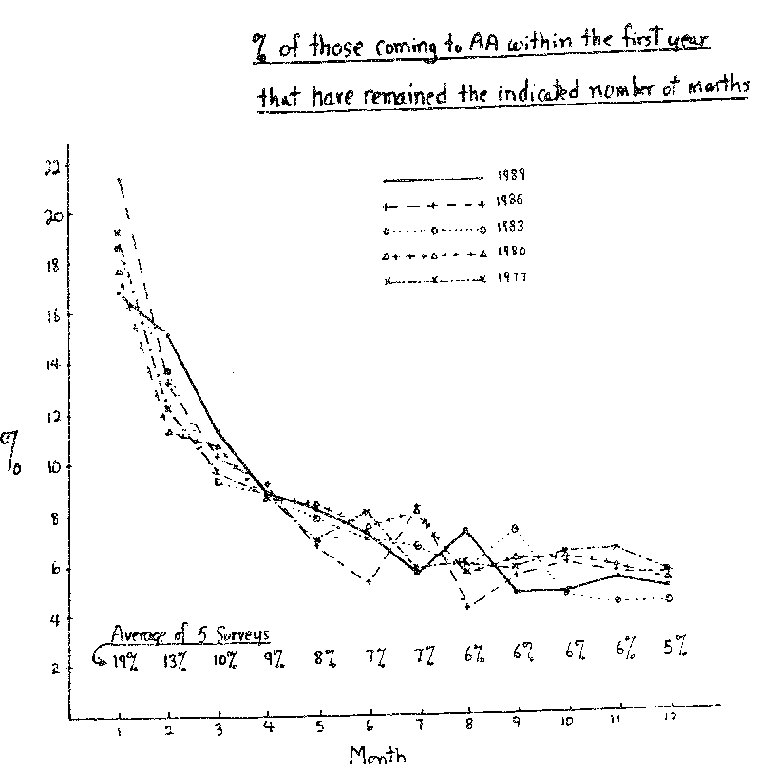




Copyright © 2016, A. Orange