Birth of the Big Book
|
by A. Orange The story of the creation of the bible of Alcoholics Anonymous, which is properly named "Alcoholics Anonymous", popularly called The Big Book, is a sad tale of lies and cheating, theft and dishonesty, all done by Bill Wilson, and even the death of an early A.A. member, Henry Parkhurst, who couldn't stand Bill Wilson's scheming and chicanery. First off, Bill Wilson was only one of many authors of the Big Book. Bill was the principal author of the non-biographical opening chapters, the much-ballyhooed "first 164 pages." But Bill had lots of free help. There were at least 32 authors. Just for starters, Henry "Hank" Parkhurst wrote the detailed outline for the whole book, and then he wrote the chapters "To Employers" and The Unbeliever. And it's hard to say exactly what-all else Hank wrote, because Bill Wilson had a bad habit of lying and minimizing what Hank wrote, because Bill stole all of it. Bill Wilson claimed sole ownership of the Big Book when he filed for the copyright, in violation of his promises to the other A.A. members who wrote all of the autobiographical chapters, and who were led to believe that the group would jointly own the book. (Thanks to www.aaPublicControversy.com and www.aabbsg.de for the following information. Please note that the author of the following table wishes to give Bill Wilson much less credit for the opening chapters than I would. He says that Joe Worth wrote "Bill's Story" and "To Wives, and that chapters 2 through 9 and 11 were the product of "teamwork." I feel that Bill Wilson really is to blame for a lot of the insanity that is in the first 164 pages.)
Then, in April of 1939, on the copyright application form, Bill Wilson claimed sole ownership of the copyright of the Big Book for himself,
Note that Bill Wilson wrote on the copyright application that he
was the Works Publishing company:
that the book was authored by
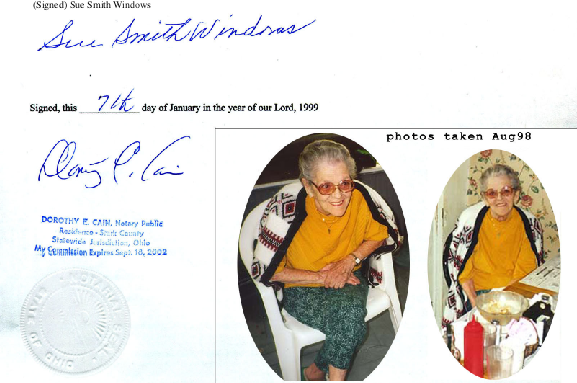
The text that Sue Smith Windows refers to on page 165 of Alcoholics Anonymous Comes Of Age is:
Four hundred mimeograph copies of the book were made and sent to everyone we could think of who might be concerned with the problem of alcoholism. Each mimeograph was stamped "Loan Copy" in order to protect our coming copyright. Doctor Bob's daughter says that Bill Wilson lied. There was no such stamp on the copies. (The A.A. historian Mitchell K. reported that he had seen about 20 of the multilith edition copies, and none of them had such a stamp on them.) You see, if the first printing isn't copyrighted, and that first multilith printing wasn't, then the copyright is lost forever and the book falls into the public domain immediately. Wilson learned that grim fact too late — he had already sold a bunch of multilith (like mimeograph) copies of the book for $3.50 each — so he fabricated the story that the multilith copies were just preliminary pre-press loaner review copies, and not a real printing. But when someone sells copies of a book, it's a real printing, no matter how small or primitive the printing is. And, as one wit said, "Losing a copyright is like losing your virginity. Once you lose it, it's gone, and you can't get it back." 
A newly-organized company, called
Works Publishing Inc. was founded June 20th, 1940.
Herbert Taylor was the President and Horace Crystal was the
Vice-President.
Bill Wilson was not involved, and not allowed to hold any
office in the new company, because he had previously taken
and spent thousands of dollars of stock subscriber cash
plus Charles B. Towns' donations and other moneys, as well as
dishonestly filing for the copyright in his own name. Note that this was a new corporation. Bill Wilson had used the name "Works Publishing" on the copyright form, but there was no such company in existence other than "Wm. G. Wilson, trading as Works Publishing Co." until this new company was incorporated in June, 1940. Henry Parkhurst and Bill Wilson had previously started up and sold shares in the "One Hundred Men Corporation", remember, and that is the company that was supposed to write and publish the book. But throughout his Alcoholics Anonymous Comes Of Age book, Bill Wilson talked constantly about Works Publishing, and says that it was the company that did it all. In that book, Wilson did not even admit that the "One Hundred Men Corporation" ever existed. He says that they went around selling stock in Works Publishing to raise the money to support writing the Big Book. That is false. William Wilson, Henry Parkhurst and William J. Ruddel were selling stock in the "One Hundred Men Corporation". See the subscription form.
Here is the financial statement that they prepared, that shows the
receipts and disbursements of the early book project. Also note the name
switch.
Stock had been sold in, and moneys collected for, Actually, what happened is the other members of Alcoholics Anonymous covered up for Bill Wilson's crimes, to avoid a scandal. They started telling a story about how they had simply decided to change the name of the company from "The One Hundred Men Corporation" to "Works Publishing". That was after Bill had copyrighted the Big Book in the name of Works Publishing, claiming that he was the publishing company — that it was a sole proprietorship, "Wm G. Wilson, dba Works Publishing". Works Publishing Company, financial statement for October 1938 through June 1940. Bill Wilson invested $100 in the company, and then was paid $1558 to write the first 11 chapters of the Big Book. He was supposed to be paid $1000 for the work, but he ended up getting paid $1558. That was very generous:
But that wasn't enough money for Bill, not nearly enough. He then took and spent much of the money that had been raised to print the book. Henrietta Seiberling was rather upset about it. Bill Wilson was so eager to make money off of the book that he printed up a premature multilith edition that contained no copyright notice and sold copies for $3.50 each. That immediately, permanently, voided any possible copyright on the book. (Once a copyright is lost, it can never be regained. If something is first published without a copyright notice, or if the first printing is not properly copyrighted, then the work immediately falls into the public domain, and remains there forevermore.)
When Wilson learned of the seriousness of his error, he fraudulently
filed
for the copyright in his own name, claiming that he was the sole author of the book,
and doing business as the publishing company "Works Publishing" (which did
not exist).
Note that the resulting copyright was invalid, and has always been invalid,
and
is still invalid. Then Bill Wilson traded the copyright that he had stolen for a lifetime income in what looks suspiciously like a blackmail deal. The "Alcoholic Foundation" absolutely had to have the copyright to be able to continue publishing the Big Book, and Bill Wilson had it, so Bill dictated terms that gave him an income for the rest of his life. (The other alcoholics did not realize that the copyright was invalid.) First, the deal was that Bill got $100 per month (if available from book sales), for the use of the book's copyright, in addition to a $120 per month stipend that came from outside donations, like from John D. Rockefeller Jr.. (Yes, those outside donations that are forbidden by the Seventh Tradition.) Later, the agreement was changed (by Bill) to Bill receiving royalties for life (and beyond) on the sales of the book. By 1944, the royalties had climbed to $200 per month, and kept going up. Bill never worked again. Bill died rich. (Lois Wilson's heirs still collect over $1 million per year in royalties from this deal and Bill's other writings.) None of the other co-authors, except Doctor Bob, got a penny from the Big Book. Bill took it all. Original Big Book assignment of copyright to Works Publishing, Inc. document. Note that the deal is not explicitly spelled out in this document; it simply says that Bill Wilson got $1 and "other good and lawful consideration." And he got a whole lot of "other good and lawful consideration"; in the end, millions of dollars.
The
www.AApublicControversy.com website points out, At $120 to $320 per month, Bill was giving himself a salary three to eight times higher than that of the average worker. In addition, the A.A. organization gave Bill a $27,000 house, which they named "Stepping Stones", and a Cadillac car. He had all of that while he was technically unemployed for nine years.
And while all of this was going on, Bill hypocritically exhorted the other members of A.A. to work unselfishly, abandon self-seeking, and to have no thought of the profit motive:
The unselfishness of these men as we have come to know them, the entire absence of profit motive, and their community spirit, is indeed inspiring to one who has labored long and wearily in this alcoholic field.
Here is an exchange of letters, to and from Clarence Snyder, the Chairman of the Cleveland Central Committee of A.A., in Cleveland, Ohio (and also the author of the Big Book chapter "Home Brewmeister"), complaining about the whole arrangement between Bill Wilson and the A.A. organization, ending in his resignation. With a name change, "Works Publishing, Inc." morphed into "Alcoholics Anonymous Publishing, Inc.", which was a private, for-profit corporation. Original Works Publishing Company name change document, page 1. Original Works Publishing Company name change document, page 2. Original Works Publishing Company name change document, page 3. Bill Wilson's royalty agreement of 1963 with A.A.W.S., Inc. Bill Wilson's Last Will and Testament, leaving ten percent of his estate to his favorite mistress, Helen Wynn, and the other ninety percent to his wife Lois. Lois Wilson's Last Will and Testament, where the royalty money for all of Bill's books leaves the A.A. fellowship forever, and goes to some people who just heard about A.A., or who maybe just saw the made-for-TV movie "My Name Is Bill W.".
There was also the problem of relapsers. Fully fifty percent of the Big Book authors had failed to maintain sobriety. Bill Wilson never publicized that fact; he just silently replaced their stories with new stories from some other A.A. enthusiasts who also grandly declared that A.A. had miraculously saved them from a life of drunkenness. Henry Parkhurst's chapter in the front of the book, To Employers, was left in, but his autobiographical story, The Unbeliever, was discarded. Hank was not in a position to complain, because he was dead. (He died drunk.) Dr. Bob's autobiographical chapter was left in, but he had been sharing in the money, so he wouldn't complain. Besides, he was a co-founder, and his writings were considered sacred. Besides, he was also dead, so he couldn't complain either. Three other people were left in, but they were vastly outnumbered, if not dead, so they couldn't make much of a fuss, even if they wished to. One of them was Fitz M., whose story Our Southern Friend had to be left in because his story was also described at the end of the We Agnostics chapter — he was the one who allegedly heard God say, "Who are you to say there is no God?" Besides which, Fitz was also a true believer, and he wouldn't complain. Clarence Snyder, the founder of A.A. in Cleveland was retained (only to be dumped out of the 4th edition). But almost everybody else was purged. The new Big Book authors got no promises about how "We will all share the ownership of the book." The new generation of authors clearly understood that Bill Wilson was the King who would be supported in comfort for the rest of his life, while they would get nothing for their stories.
The first edition Big Book authors fared like this:
The S.O.S. Europe web page says this about cult leaders:
Nothing will stand in the way of their visions, schemes and self-glorification — not even the well-being of their partners or children. They manipulate the minds of vulnerable members, extorting money and sexual favors and/or abusing them psychologically, physically and/or sexually. They got that right. Footnotes:
1)
Ernie Galbraith, A.A. Number Four: Bibliography:
http://silkworth.net/aabiography/storyauthors.html
Last updated 24 March 2012. |




Copyright © 2005, A. Orange