The Funny Spirituality of Bill Wilson and A.A.
|
by A. Orange
Whether the family goes on a spiritual basis or not, the alcoholic member has to if he would recover. The others must be convinced of his new status beyond the shadow of a doubt. Seeing is believing to most families who have lived with a drinker. This sad story is supposedly an example of a man who is living his life "on a spiritual basis", while the rest of his family does not. And it is somehow supposed to show us a man who is convincing his family of his new sober status. By smoking and getting drunk. Go figure. The man is addicted to tobacco, and he is smoking himself to death. His concerned wife is trying to save him from emphysema and lung cancer, but the "anonymous" author Bill Wilson labels her "intolerant" because she "really feels there is something rather sinful about these commodities." Notice how the author Bill Wilson grouped coffee and tobacco in the same category, as mere "commodities", so that the wife would appear more intolerant. Bill also refused to look at the numerous health aspects of smoking, or the stink, or the second-hand smoke, or the expense; he only said that she feels that "these commodities" are "rather sinful." Bill implied that the housewife was just an intolerant uptight killjoy Puritanical nag.
Notice the powerful hidden assumption in this sentence:
"He
admitted he was overdoing these things, but frankly said that he was
not ready to stop." Oh? Somebody can continue doing whatever he is doing just because he frankly says that he isn't ready to stop? When was the last time that you heard an A.A. recruiter accept that as a valid excuse for someone to continue drinking alcohol?
Sometimes, the "anonymous" author, Bill Wilson, showed flashes of sheer genius for foisting a mountain of bull, untruths, and false assumptions on the reader with just a few cleverly-worded phrases, and this is one of those times. (By the way, arguing that "Frankly, I'm not ready to quit just yet" is the propaganda trick of Arguing For Delay: "Let's not be hasty. Let's not do anything right now. Let's think about it some more. I'm not ready just now. I'm not prepared to do anything. Maybe later.") Note that tobacco is the deadliest of the four drugs mentioned there, if you do a body count. Heroin and cocaine kill 5 to 10 thousand Americans per year each; alcohol kills 100 thousand, and tobacco kills 420 thousand Americans per year. So if someone can keep on smoking tobacco until it kills him just because he "frankly" isn't ready to stop it just yet, then why shouldn't he be able to continue taking any drug on Earth, including alcohol? Why make a big deal out of the number two or number three killer drug if the number one killer drug in America is perfectly okay, and quite compatible with a life lived "on a spiritual basis"? Then, when this allegedly "spiritual" A.A. member became annoyed at his wife's attempts to save his life, he threw an angry temper tantrum and drank alcohol. Then "He had to painfully admit that [he was wrong] and mend his spiritual fences." Baloney. Even when he was on his knees, confessing his wrongs to God and "mending his spiritual fences", he secretly grinned from ear to ear, and said, "I WON! I get to keep my tobacco addiction. I really scared the Hell out of the old bitch, and now she won't be nagging me about my smoking any more!" And she doesn't. He is now free to commit suicide by cigarette. (If he really wanted to "mend his spiritual fences", why didn't he "make amends" by quitting smoking?) Then, this story says, his wife sees the error of her ways, and confesses that "she was wrong to make a burning issue out of such a matter" (horrendous pun!) — that she was wrong to worry about his potentially fatal tobacco addiction "when his more serious ailments were being rapidly cured." That's a typical Buchmanite happy ending for a story: it ends with everybody confessing that they were wrong. Baloney. And what "more serious ailments" were being "rapidly cured"? Obviously not his alcohol drinking, because he just got drunk, using alcohol to get his own way. He holds drinking over her as a blackmail weapon that he can use on her again any time she threatens his tobacco addiction. So just how is this guy's behavior "spiritual"?
What we are seeing here is not spirituality, but rather, the naked face of the Addiction Monster, that dark ghoul who says, "I don't care what the cost is, or who dies, I want my fix." Indeed, that ghoul is the same monster as the one who craves alcohol, and while it has been temporarily weaned off of alcohol, it is still alive and well, feeding itself with tobacco. And there is no way in Hell that it will tolerate someone cutting off its last food source. It will fight. It doesn't even care if its own host is dying from the effects of tobacco, it still wants its fix. A big part of the message that Bill Wilson is trying to sell us here is the idea that us good-old-boy A.A. members should be able to indulge in anything we want to, just as long as it isn't alcohol. Since we so nobly gave up drinking alcohol, we richly deserve life's other little pleasures. Both Bill W. and Doctor Bob were heavy smokers, so they said over and over again that smoking is an okay vice. According to Bill Wilson, dying of self-inflicted emphysema, lung cancer, and heart disease is perfectly okay, and completely compatible with a spiritual life, just as long as you do it sober. Bill just didn't want to quit smoking, so he rationalized his nicotine addiction, and said that he didn't really need to quit smoking — "It's just a minor bad habit, just a commodity like coffee, you know..." Notice the biased viewpoint and slanted language:
Not!
This story also features some very bad amateur psychology:
"...her intolerance finally threw him into a fit of
anger." No, it didn't. The truth is just the opposite. He chose to become angry. He made no attempt at self-control. He allowed his feelings of irritation to turn into anger — he even pushed them to it — because he felt that his tobacco addiction was being increasingly threatened by his wife's persistence, and he didn't want to give it up. He chose to throw a big angry drunken temper tantrum, and roar loudly, to tell his wife in no uncertain terms that he wasn't going to give up his beloved drug addiction, and if she pressed the point, he would get drunk, just to spite her. His actions said, "If you don't let me smoke all I want, then I'll drink myself to death, and it will all be your fault. So there!" And he succeeded in his infantile game of brinkmanship. He defeated her so totally that she never criticized his smoking again, and Bill says that she confessed that she was wrong to have even tried to get him to quit smoking. Score one more victory for the smug good old boys club. This story is so stupid, so tragic, so vicious, and so inappropriate, that only someone who has totally pickled his brain with too much alcohol for too many years could possibly think that this is a good story to put in the Big Book as an example of an A.A. member living a spiritual life while his wife doesn't. But, alas, that's what Bill Wilson did. What's also rather amazing is how many A.A. members think that The Big Book is received wisdom, the indisputable Word of God, as given to Bill Wilson. I guess their brains got pickled too.
The story above would have us believe that the way to live a spiritual life, and the way to convince your family that you are now sober for life, is to smoke yourself to death while ignoring the pleas of your concerned wife, and then drink alcohol and throw drunken temper tantrums to get your own way, and then blame it all on your wife's nagging. That is simply crazy.
The choice of that story for inclusion in the Big Book, especially in that context, is such clear evidence of something terribly wrong with Bill's mind that it is hard to ignore, and the other A.A. members have had to go out of their way to manage to ignore it for sixty years. (And to not change it through three new editions of the Big Book?) In 1947, the popular newspaper columnist Westbrook Pegler referred to the A.A. founder as "wet-brained", and his followers as "effectively deluded".22 It's easy to see why. 
The Big Book clearly shows that Bill Wilson was insane. Not just a little bit crazy, not funny crazy, but really crazy, genuinely insane, clinically diagnosable. Mr. Wilson was suffering from paranoid delusions of grandeur and a messianic complex, or a narcissistic personality disorder — or perhaps some crazy combination of all of them.
Wilson was insane while he was drinking: he was suicidally
drinking immense, almost superhuman, quantities of cheap
rotgut whiskey or gin, one or two or even more fifths of it
per day — "Drinking to Die" is what A.A. calls it.
In the Big Book,
(chapter 1, page 5, 3rd edition)
either Bill Wilson or Joe Worth wrote in Bill's Story: The Prohibition-era "Bathtub gin" was infamous for being poisonous. It was occasionally contaminated with methyl alcohol ("wood alcohol"), which is terribly poisonous, and causes immense neural damage, if not blindness and death. Then malnutrition and thiamine deficiency can lead to a horrifying condition called Wernicke-Korsakoff Syndrome where you suffer such massive brain damage that you lose your short-term memory and ability to learn or remember anything new. The A.A. saying is, "John Barleycorn promises us insanity or death." And it's true. Even Bill Wilson himself reported that problem. Bill recorded a set of autobiographical tapes before his death, which the Hazelden Foundation then used as source material to write an "autobiography" of Bill Wilson. Bill quoted Dr. William D. Silkworth as saying, in midsummer 1934, that he had originally had some hope for Bill, but...
"But his habit of drinking has now turned into an obsession, one much too deep to be overcome, and the physical effect of it on him has also been very severe, for he's showing some signs of brain damage. This is true even though he hasn't been hospitalized very much. Actually I'm fearful for his sanity if he goes on drinking." Bill wrote that Dr. Silkworth said that about Bill to Bill's wife Lois when Bill was hospitalized for detoxing at the Charles B. Towns Hospital in New York during the summer of 1934. After that, Bill stayed sober for a few months, but then returned to suicidal binge drinking. Bill also described his third detoxing at Towns Hospital in the Big Book,
After a time I returned to the hospital. ... My weary and despairing wife was informed that it would all end with heart failure during delirium tremens, or I would develop a wet brain, perhaps within a year. She would soon have to give me over to the undertaker or the asylum. Then, while Bill Wilson was hospitalized for detoxing, from December 11th to 18th, 1934, at Charles Towns' Hospital in New York yet again, for the fourth time in just a little over a year, after yet another drinking-to-die binge, Dr. William D. Silkworth gave Bill Wilson Charlie Town's specialty of the house — a hallucinogenic quack medicine "belladonna cure" for alcoholism (that was also supposedly good for curing morphine addiction, bed-wetting, kleptomania, "cafeinism", or whatever else ails you). When the drugs hit, Bill Wilson flipped out and "saw the light", and saw "the God of the preachers", he said, and got religion. It seems like his "spiritual experience" and his miraculous conversion came in time to save his liver, but not his brain. Note that even Bill's reporting of Dr. Silkworth's diagnosis of brain damage reveals Bill's delusions of grandeur. Bill Wilson thought that it was a joke, just another alcoholic war story to brag about. Bill thought that he was above minor problems like brain damage. Other men might go insane from alcohol-induced brain damage, but not Bill Wilson. It couldn't happen to a tough guy like him:
Assume on the other hand that father has, at the outset, a stirring spiritual experience. Overnight, as it were, he is a different man. He becomes a religious enthusiast. He is unable to focus on anything else. ... There is talk about spiritual matters morning, noon and night.
Denial, denial, DENIAL. And note how Bill Wilson's flawed memory twisted and warped Dr. Silkworth's words — Bill has Silkworth saying of Bill, "... he's showing some signs of brain damage. This is true even though he hasn't been hospitalized very much."
Since when does hospitalization cause brain damage?! Nan Robertson also reported Bill having a nasty problem with delusions of grandeur. Bill Wilson's life in the period of 1930 to 1934 was like this: His hangovers and hallucinations were becoming more frequent. He panhandled and stole from his wife's purse. He would ride the subways for hours after buying a bottle of bootleg gin, talking gibberish to frightened strangers. He threw a sewing machine at Lois and stormed around their house in Brooklyn kicking out door panels. She called him a "drunken sot." He would be sober for days and weeks and then settle into bottomless bingeing. He barely ate. He was forty pounds underweight. His dark, withdrawn periods alternated with delusions of grandeur. Once he told Lois that "men of genius" conceived their best projects when drunk. Nan Robertson implied that Bill Wilson's delusions of grandeur disappeared after he quit drinking, but Bill's writings do not show that. Neither does the rest of the literature about Alcoholics Anonymous.
At the beginning of recovery a man will take, as a rule, one of two directions. He may either plunge into a frantic attempt to get on his feet in business, or he may be so enthralled by his new life that he talks or thinks of little else. ...
Notice the guilt induction routine:
The next to last paragraph says that "spiritual progress"
— in other words, Alcoholics Anonymous — must come before a man's job:
The last paragraph of that large Big Book quote above describes
a family where everyone becomes a good little
Buchmanite and
confesses everything in family meetings: "As each member of a resentful family begins to see his shortcomings and admits them to the others, he lays a basis for helpful discussion. ... Little by little, mother and children will see they ask too much, and father will see he gives too little. Giving, rather than getting, will become the guiding principle." Bill Wilson was being grossly unrealistic there. Bill was just painting a picture of a happy "Dick and Jane" dream world where the whole family happily practices Buchmanism. Bill and Lois had no children, so Bill had no experience with having some scared, abused children of an alcoholic in his house. But Bill certainly had plenty of experience with being the abused son of an alcoholic father who abandoned his family when Bill was just a boy, and then Bill felt that his mother abandoned him too, leaving him to be raised by his grandparents. And Bill's mother had very serious mental problems of her own — she ended up in a mental hospital later in life. Bill Wilson seems to have gone into deep denial about the whole thing, and blanked most of that out of his memory. That is typical of narcissism — just suppress the feelings of rejection, humiliation, and helplessness, and deny that one was ever hurt; just live in a dream world where everything is wonderful. Bill does not appear to have had a clue about how abused children of an alcoholic will never get together with Father for a happy little confession session where everybody admits his wrongs and "moral shortcomings". They will think, "Anything you say can and will be used against you the next time Father gets drunk, so don't say anything, not ever." So those happy little Ozzy and Harriet family talks are as unlikely as snow in July, in Texas. That was just some more deluded wishful thinking on Bill's part, imagining that the family members will all somehow turn into happy little Buchmanites who are just tickled pink at the opportunity to have family meetings and confess all of their sins, defects, and shortcomings to each other. Also notice how Alcoholics Anonymous (Wilson-style Buchmanism) is supposed to be the religion of the whole family, not just a quit-drinking program for Father.
Assume on the other hand that father has, at the outset, a stirring spiritual experience. Overnight, as it were, he is a different man. He becomes a religious enthusiast. He is unable to focus on anything else. As soon as his sobriety begins to be taken as a matter of course, the family may look at their strange new dad with apprehension, then with irritation. There is talk about spiritual matters morning, noon and night. He may demand that the family find God in a hurry, or exhibit amazing indifference to them and say he is above worldly considerations. He may tell mother, who has been religious all her life, that she doesn't know what it's all about, and that she had better get his brand of spirituality while there is yet time. Parts of that are, of course, ludicrous. The first paragraph features all of the horrible things that will happen if Father has had a "stirring spiritual experience", perhaps a drug-induced vision of God while detoxing: The family will become increasingly concerned about father's obvious monomaniacal obsession with religion (religion, not "spirituality") — "He becomes a religious enthusiast. He is unable to focus on anything else" — "There is talk about spiritual matters morning, noon and night" — and Bill dismisses the family's apprehension with "They may be jealous of a God who has stolen dad's affections." "... they may not like the idea that God has accomplished the miracle where they failed."
Yes, somebody is insane, all right. Clinically certifiable.
Completely deluded; no contact with reality remaining: Note the paranoia — Bill can just hear all of the people talking about him behind his back, calling him insane:
Dad is not so spiritual after all, they say. If he means to right his past wrongs, why all this concern for everyone in the world but his family? What about his talk that God will take care of them? They suspect father is a bit balmy! No joke.
But Bill was apparently incapable of taking their concerns about his
sanity seriously. He dismissed their suspicions as just
part of their "jealousy of God", or their needless
general worrying.
The next line Bill wrote was,
They suspect father is a bit balmy! That is a fair description of mania. Bill Wilson called it "spiritual intoxication", but it's really mania — a kind of raving, giggling, laughing insanity. That text is also a fair description of a trap: You will only benefit if you do the program for the rest of your life. (You can't ever leave the cult.) It also begs the question, "Do you have to wait the rest of your life for the benefits to start?" No? Well then, why couldn't you benefit from doing it for less than the rest of your life, like maybe half, and then getting the "dividends" and running away?
"Giving it all away" is a deceptive
euphemism.
It really means recruiting new members for Alcoholics Anonymous.
A.A. also uses the sayings,
So, Incidentally, the line about "For a time he may try to hug the new treasure to himself" is absurd. Bill Wilson did not try to keep his new religious beliefs to himself after his drug-induced "spiritual experience" in Towns Hospital. He immediately turned into a fanatical missionary who drove all of the alcoholics around him crazy with his proselytizing and recruiting attempts. Bill was actually starting home churches within days of his pharmaceutical "vision of God". "Hug the new treasure to himself..." That's delusional, again. Then Bill admits that father isn't quite right in the head, but says that it's okay, because it's just a passing phase. And, Bill says, father's return to sanity depends on the family not annoying or irritating him:
If the family cooperates, dad will soon see that he is suffering from a distortion of values. He will perceive that his spiritual growth is lopsided, that for an average man like himself, a spiritual life which does not include his family obligations may not be so perfect after all. If the family will appreciate that dad's current behavior is but a phase of his development, all will be well. In the midst of an understanding and sympathetic family, these vagaries of dad's spiritual infancy will quickly disappear. If you let him do whatever he wants, then the situation will magically fix itself in short order. Bill says that father will quickly perceive that his behavior is inappropriate, and "these vagaries of dad's spiritual infancy will quickly disappear." Unfortunately, it doesn't look like Bill Wilson's "vagaries" ever disappeared. In 1944, Clarence Snyder complained that Bill Wilson had been unemployed and mooching off of his wife Lois or the Alcoholics Anonymous organization for nine years. And Bill never did get and keep another job. Never. He just swiped the Big Book money, and then stole the copyright to the Big Book, and blackmailed the Alcoholic Foundation into giving him and Doctor Bob most of the royalties money, and he got rich off of the book. Bill Wilson never worked a straight job again in his whole life. He just made A.A. support him. Incidentally, the American Psychiatric Association does not recognize any such mental problems as "vagaries of spiritual infancy". But if the family won't do things Bill's way:
The opposite may happen should the family condemn and criticize. Dad may feel that for years his drinking has placed him on the wrong side of every argument, but that now he has become a superior person with God on his side. If the family persists in criticism, this fallacy may take a still greater hold on father. Instead of treating the family as he should, he may retreat further into himself and feel he has spiritual justification for so doing. In other words, the solution is to let Father act crazy, even if his behavior is "alarming and disagreeable". Don't criticize him, or else really bad things will happen, Bill says. (Narcissists just can't stand criticism.) "If the family persists in criticism, this fallacy may take a still greater hold on father." That is the propaganda trick of Arguing From Adverse Consequences — declare that "Something really bad will happen if you don't do what I want." So you shouldn't bother Father with mere reality, or ask him to be sane and responsible, or tell him to go get a job, or else something really terrible will happen. Just let him neglect his family and irresponsibly devote his entire life to Alcoholics Anonymous. Housewives, just watch passively as your husband turns into a babbling bombastic believer in a crazy contentious cult. Then everything will turn out okay. He will supposedly be on a "firmer foundation" than someone who works for a living and behaves normally. This is a repetition of the idea that Bill Wilson stated earlier, that working hard, earning a living, and trying to recover financially, is a mistake — that A.A. should come first. Let your wife support you while you go recruiting for Alcoholics Anonymous.
Again, Bill Wilson used the "Argue from Adverse Consequences" propaganda trick to blackmail the housewife: Let him devote himself to his "spiritual activities" [A.A. busywork], so that "dad will be on a firmer foundation than the man who is placing business or professional success ahead of spiritual development. He will be less likely to drink again, and anything is preferable to that." Bill Wilson did not bother to define just what "spiritual development" was supposed to mean. We can only make an educated guess, and assume that Bill meant going to A.A. meetings, doing the Twelve Steps, and recruiting new members. Bill did indicate that being on a "firmer foundation" meant being less likely to drink again. So Bill Wilson was really saying,
No wonder Bill Wilson constantly accused other people — alcoholics and non-alcoholics alike — of being selfish, dishonest, manipulative, under-handed, and self-seeking. He was talking about himself. In psychology, that is called "projection": accusing others of doing what he was doing wrong, accusing others of committing the very sins and crimes that he was committing. And it turns out that this is standard behavior for a cult leader. The Europe S.O.S. web site had a good description of a cult that included this paragraph:
A frequent tactic by cult leaders is to divert attention from their own sins by accusing others inside or outside their organization of the very crimes of which they themselves are guilty. (In psychology, this is called "projection.")
Those of us who have spent much time in the world of spiritual make-believe have eventually seen the childishness of it. This dream world has been replaced by a great sense of purpose, accompanied by a growing consciousness of the power of God in our lives. We have come to believe He would like us to keep our heads in the clouds with Him, but that our feet ought to be firmly planted on earth. That is where our fellow travelers are, and that is where our work must be done. These are the realities for us.
Let's see... "Spiritual make-believe dream
world" has been replaced with "keep our heads in the clouds
with Him" and "a great sense of
purpose", that is, by a different flavor of megalomania,
or delusion of grandeur: a messianic complex. So what's the big difference? One spiritual make-believe or another, Tweedle-Dee or Tweedle-Dum... "Shall I have chocolate, strawberry, or vanilla delusions of grandeur today? Decisions, decisions..." Supposedly, God wants you to have your head in the clouds with Him, but you have to keep your feet where the "fellow travelers" are. Are the "fellow travelers" the alcoholics who have not yet been converted to the A.A. religion? Bill is indulging in vague terminology again, making up more euphemisms, but that is probably what he means. The phrase "fellow travelers" does not appear again anywhere else in the Big Book, so it is simply undefined. Typical. And that terminology, "our fellow travelers", implies that the unsaved alcoholics are somehow already the property of A.A.. "And that is where our work is; we have to save all of our fellow travelers by making them just as nutty as we are." Bill finishes by saying, "These are the realities for us." Hmmm... That is not necessarily reality for anybody else... Then Bill once again reveals that, on some level of his mind, he knows he has gone insane, but he is in deep denial about it:
We, who have recovered from serious drinking, are miracles of mental health.
We have found nothing incompatible between a powerful spiritual experience and a life of sane and happy usefulness.
And right in the middle of it, Bill wrote:
But dependence upon an A.A. group or Higher Power hasn't produced any baleful results. Excuse me, Bill? What did you just say? Denial isn't just a river in Egypt. And then Bill finished his sermon with: One more suggestion: Whether the family has spiritual convictions or not, they may do well to examine the principles by which the alcoholic member is trying to live. They can hardly fail to approve these simple principles, though the head of the house still fails somewhat in practicing them. Nothing will help the man who is off on a spiritual tangent so much as the wife who adopts a sane spiritual program, making a better practical use of it. So now the whole family has to go join Al-Anon and do Bill Wilson's 12 guilt-inducing steps because Daddy is acting crazy. And they couldn't possibly dislike Bill's Buchmanite religion: "They can hardly fail to approve these simple principles..." (Except that the "simple principles" are not spiritual principles at all, they are cult religion practices.)
As wives of Alcoholics Anonymous, we would like you to feel that we understand as perhaps few can. We want to analyze mistakes we have made. That's deceptive, to say the least. No matter how much the wives may have understood, and no matter how much "they would like you to feel" that they understand as perhaps few can, the truth is that the "wives of Alcoholics Anonymous" did not write a single word of that chapter. Bill Wilson asked Dr. Bob's wife Anne to write it, but she declined. Lois Wilson wanted to write it, and she also wanted to write the following chapter, The Family Afterwards, but Bill didn't trust her to get the "style" right, he said. That is an indication of Bill's real opinion of his wife's intellect. Bill Wilson wrote those chapters himself while pretending to be his own wife, and putting his words into her mouth. That hurt Lois' feelings, but that was just the way it was going to be.
Bill Wilson constantly hurt Lois Wilson, both before and after sobriety, what with his screaming temper tantrums, arrogant, inconsiderate behavior, philandering, and demanding that she work to support him. One evening, Lois Wilson exploded in anger when Bill Wilson wanted her to go to yet another Alcoholics Anonymous meeting. She screamed, "Damn your old meetings!" and threw a shoe at him.26 Lois Wilson's attitude was simply not acceptable to Bill Wilson. He couldn't have that. So Bill made up an explanation for Lois's anger where he had the imaginary wives saying:
Another feeling we are very likely to entertain is one of resentment that love and loyalty could not cure our husbands of alcoholism. We do not like the thought that the contents of a book or the work of another alcoholic has accomplished in a few weeks that for which we struggled for years. Bill's imagination was vivid: Even while Bill was still busy just writing the opening chapters of the Big Book in late 1938 and early 1939, he was describing wives who were jealous of the book because the book had already cured their husbands of alcoholism in just a few weeks. There's nothing like being confident that your book is going to revolutionize the world, and have magical, nay, miraculous effects on alcoholics.
That's delusions of grandeur, again. It's also characteristic of a
narcissistic personality disorder.
See the web page on The Other Women for much more on Bill Wilson's narcissistic, exploitative use of women — especially his wife Lois.
Content: Messianic abilities An interesting statement on page 139 of the same book is that Grandiose delusions can be seen in substance-abuse disorders. That makes sense — if you damage your brain with enough drugs and alcohol, you will go insane. Bill had two possibilities there: first off, the obvious immense alcohol abuse. And second, the repeated use of an extremely toxic hallucinogen, a mixture of belladonna and henbane (during his four stays at the Charles B. Towns Hospital in New York).
That description of delusions of grandeur fits Bill Wilson so well that it is uncanny:
There is also the question of "when?" In the early days, between 1934 and 1938, Bill seems to have simply had delusions of grandeur or a narcissistic personality disorder. But from the early 1940s to the mid 1950s, Bill also suffered from deep, crippling, clinical depression or an intense manic-depressive disorder. The one characteristic that Bill Wilson had that does not match the diagnosis of delusions of grandeur is the depression. Then, by the late 1950s, Bill seems to have recovered from most of his depression, but not the rest of his signs of mental illness. Another very likely diagnosis of Bill Wilson's mental problems is Narcissistic Personality Disorder, of which Bill Wilson was also a textbook case. It has the following characteristics:
Note again the mention of Substance-Related Disorders: "Narcissistic Personality Disorder is also associated with ... Substance-Related Disorders." There just seems to be no way around it: If you rot your brain with enough drugs or alcohol, you just might go insane. Again, that description matches Bill Wilson so well that it sounds like it was written about him:
And Dr. Alexander Lowen added one more characteristic of narcissism:
The tendency to lie, without compunction, is typical of narcissists. That fits Bill Wilson too.
So, basically, just call them whatever they most closely resemble. We have plenty of "wiggle room" for debating the various diagnoses for Bill Wilson, but one thing is certain: Bill was nuts.
In the mid-1940s, Wilson had sought out Dr. Harry M. Tiebout and had entered upon a regime of psychotherapy. Dr. Tiebout, a psychiatrist specializing in the treatment of alcoholics, from early on had supported Alcoholics Anonymous and had referred to the fellowship its first successful female member, Marty Mann. Throughout his long and distinguished career, the Connecticut psychiatrist published a series of perceptive analyses of alcoholism and of the therapeutic dynamic inherent in the program of Alcoholics Anonymous. Tiebout came to this comprehension largely through his knowledge of Bill Wilson, and his diagnostic understanding was both profound and simple. Drawing upon a phrase attributed to Freud, the psychiatrist pointed out to A.A.'s co-founder that both in his active alcoholism and in his current sobriety, he had been trying to live out the infantilely grandiose demands of "His Majesty the Baby."50 Alas, Bill Wilson just projected that diagnosis onto all of the other alcoholics around him, and claimed that they were all just as bad as him:
When A.A. was quite young, a number of eminent psychologists and doctors made an exhaustive study of a good-sized group of so-called problem drinkers. The doctors weren't trying to find how different we were from one another; they sought to find whatever personality traits, if any, this group of alcoholics had in common. They finally came up with a conclusion that shocked the A.A. members of that time. These distinguished men had the nerve to say that most of the alcoholics under investigation were still childish, emotionally sensitive, and grandiose. (Notice how Bill Wilson was using The Preacher's We propaganda trick once again, saying "Oh, us stupid alcoholics — we are all so immature and grandiose and resentful," when he really meant, "You guys are all so bad...")
Bill Wilson had such an outrageous inflated opinion of himself and his importance that he even wrote this about himself in the original manuscript of the Big Book, talking about that famous evening at the Mayflower Hotel in Akron, Ohio, in the Spring of 1935, when he was debating whether to backslide and have a few drinks, just before he met Doctor Bob:
"But what about his responsibilities — his family and the men who would die because they would not know how to get well, ah — yes, those other alcoholics?"
Remember, this happened in the spring of 1935, when Bill Wilson had only five months of sobriety, and he had not founded Alcoholics Anonymous yet, nor had he even met Doctor Robert Smith yet — he would meet Dr. Bob the next day. And Bill had not helped a single alcoholic to quit drinking. Not one. He had been trying to recruit more alcoholics for Frank Buchman's Oxford Group cult, but had totally failed with every last one of them, because he drove them away with his fanatical preaching. Bill had not gotten the Oxford Group a single new member, and the Oxford Group regarded Bill Wilson as a real loser. Yet Bill thought that he was so important that "the other alcoholics" would die if he drank again. That is delusions of grandeur. And it's also characteristic of a narcissistic personality disorder. Bill Wilson said pretty much the same thing again, later. TIME magazine wanted to do a cover story on Bill and A.A., but Bill refused, believing that he should maintain at least some small pretense of anonymity. (Bill was already "the most famous 'anonymous' person in the U.S.A." because of all of his speaking tours and constantly breaking his anonymity and getting his picture and his story printed in the newspapers again and again.) Bill worried that his failure to grandstand even just that one single time had fatal consequences for many alcoholics, and he tried to guesstimate how many alcoholics had had to pay the terrible price of Bill Wilson's modesty:
For all I know, a piece of this sort could have brought A.A. a thousand members — possibly a lot more. Likewise, Bill later bragged about how he had preserved his anonymity (which he didn't) with these words:
Just before publication of the (Big) Book, I toyed with the idea of signing my name to it. I even thought of calling A.A. "the Wilson movement." Had I then dropped my anonymity, it is entirely possible that you and thousands of others might not be alive today. This movement would have gotten off to a false start entirely.
For Bill Wilson to claim that thousands of alcoholics would have died if he had broken his anonymity is absurd. Bill Wilson broke his anonymity hundreds of times, and spent years constantly touring the USA, proselytizing and promoting his new Alcoholics Anonymous organization, and getting his picture and his story printed in the newspapers, and that doesn't seem to have caused thousands of alcoholics to have died. Notice how, in Bill Wilson's demented mind, he had thousands of alcoholics dying either way: Thousands of alcoholics supposedly died because Bill didn't indulge in self-aggrandizement and get his picture printed on the cover of TIME magazine, and thousands of alcoholics would have died if Bill had broken his anonymity. Those poor alcoholics just can't win. Bill Wilson's immensely inflated opinion of his own importance to other alcoholics is clear evidence of delusions of grandeur. Bill didn't — just couldn't — admit even the slightest possibility that those other alcoholics could probably find some other way to quit drinking and recover anyway, if they really wanted to, without Bill Wilson and his great teachings (Buchmanism) being the center of their lives. No, Bill Wilson declared that he was condemning those unfortunate alcoholics to death by depriving them of knowledge of his magnificent program. Remember that the Harvard Medical School says that more than 50% of all alcoholics eventually quit drinking, and 80 percent of those successful quitters quit drinking without A.A., the Twelve Steps, or even any treatment or support group of any kind. They save themselves, alone, on their own, without Bill Wilson or his followers. Likewise, the NIAAA's 2001-2002 National Epidemiologic Survey on Alcohol and Related Conditions interviewed over 43,000 people. Using the criteria for alcohol dependence found in the DSM-IV, they found:
"About 75 percent of persons who recover from alcohol dependence do so without seeking any kind of help, including specialty alcohol (rehab) programs and AA. Only 13 percent of people with alcohol dependence ever receive specialty alcohol treatment." Nevertheless, Bill Wilson even stated, during the earliest days of A.A., that he was sure that John D. Rockefeller Jr. should fund the work of Bill and Alcoholics Anonymous, because... "It was felt that raising money for such a noble enterprise should present no difficulties at all." Why, they assured each other, "this is probably one of the greatest medical and spiritual developments of all time. Certainly the rich will help us. How could they do anything else?" One of the greatest medical and spiritual developments of all time?
And Bill insisted that all other A.A. members besides himself, especially celebrities, must remain anonymous because:
"It would be harmful if the Fellowship promoted itself by publicizing, through the media of radio and TV, the sobriety of well-known public personalities who became members of AA. If these personalities happened to have slips, outsiders would think our movement is not strong and they might question the veracity of the miracle of the century." The miracle of the century? (Note how that policy will hide all A.A. failures. When you see an alcoholic going down the tubes, you will not know that he is another member of Alcoholics Anonymous who didn't make it.)
These men had found something brand new in life.
Bill Wilson also wrote in the Big Book that the first ten alcoholic members of Bill's new temperance movement would meet each evening,
... constantly thinking how they might present their discovery to some newcomer.
"Their discovery," which really meant
"Bill's discovery." Bill Wilson imagined that his "great discovery" was brand new and original. He didn't seem to be able to remember — or else he conveniently forgot — the fact that Oxford Group members, Ebby Thacher and Rowland Hazard in particular, had taught the same thing to him — that the cure for alcoholism was to turn into a religiomaniac. Bill forgot that they made him into the religious maniac that he was by attacking his mind and indoctrinating him while he was detoxing in Towns' Hospital and completely out of his head from alcohol withdrawal and hallucinogenic drugs. Bill also apparently forgot the fact that there had been many earlier temperance movements, and a lot of them had used religion as a big part of their program. They had even contributed some colorful phrases to our language, like "taking the pledge" and "falling off of the wagon."
It was on a November day in that year [1937] when Dr. Bob and I sat in his living room, counting the noses of our recoveries. There had been failures galore, but now we could see some startling successes too. A hard core of very grim, last-gasp cases had by then been sober a couple of years, an unheard-of development. There were twenty or more such people. All told we figured that upwards of forty alcoholics were staying bone dry. So, after two years of intense full-time recruiting work, including deceptive recruiting, coercive recruiting, and cherry-picking only those alcoholics who were ready to quit drinking, Bill and Bob counted 40 ex-drinkers in their club (who had anything from two years down to a few days of sobriety). On the basis of that, Bill Wilson concluded that he had discovered a new cure for alcoholism. Bill restated this "great discovery" theme in the prospectus for shares of "The One Hundred Men Corporation", which was formed to write and publish the Big Book "Alcoholics Anonymous":
In all, about two hundred cases of hopeless alcoholism have been dealt with. As will be seen, about fifty percent of these have recovered. This, of course, is unprecedented — never has such a thing happened before. That was, of course, completely untrue (which also made it a case of felony securities fraud — giving false and deceptive information on a stock prospectus). The A.A. success rate was nowhere near fifty percent (Bill and Dr. Bob calculated that it was five percent), and great numbers of people had quit drinking before Bill started Alcoholics Anonymous. People had been quitting drinking ever since the Egyptians invented beer 5000 years earlier. Very recently, there had been the countless tens and hundreds of thousands of drinkers who had joined the Women's Christian Temperance Union, and gotten Prohibition passed, and before them, there had been perhaps five or six hundred thousands who had joined the Washingtonian Movement.
Jerry McCauley was a self-described "counterfeiter's son, a runaway, a thief, a drunkard, a brawler, and a convict" who experienced three dramatic religious experiences that converted him into a Christian believer. He opened the Water Street Mission in New York in 1872. It advertised "Everybody welcome, especially drunkards", and offered the derelict alcoholics respect and compassion rather than condescension and contempt. The religious meetings there were short on sermons and long on personal stories, and sounded just like the second half of an Alcoholics Anonymous meeting:10
... the heart of the meeting was not McAuley, but the "testimonies" of the participants. The Salvation Army started in England in 1865, and came to the United States in 1880, and it promoted the disease idea of alcoholism:
[Salvation Army Founder William] Booth declared in 1890 that alcoholism was "a disease often inherited, always developed by indulgence, but as clearly a disease as opthalmia or stone." His plan for bringing salvation to the alcoholic involved attracting him with food and shelter, then providing stability through temporary employment; and finally transferring him to rural colonies, where he would learn the values of sobriety and responsibility. The vision was that Christian salvation and moral education in a wholesome environment would save the body and soul of the alcoholic. ... Also note that General William Booth published his book about recovery from alcoholism, "In Darkest England and the Way Out", back in 1890.
And then there was Keswick:
William Raws emigrated from England to the United States in 1889 in an effort to outrun his alcoholism. Following the sudden deaths of his mother and wife — the latter from alcoholism — he underwent a profound religious transformation that checked his own alcoholism and incited a desire to carry the message of religious salvation to other alcoholics. ... In 1897, along with his assistant John R. McIntyre, he founded the Keswick Colony of Mercy in Whiting, New Jersey. ... And the Emmanuel Clinic and the Lay Therapy Movement was a ready-made prescription for Alcoholics Anonymous:11
In 1906, the Rev. Drs. Elwood Worcester and Samuel McComb, along with physician Dr. Isador Coriat, opened a clinic in the Emmanuel Church in Boston, that, for 23 years, integrated religion, medicine, and psychology in the treatment of various disorders. ...
Bill Wilson liked to claim that the disease theory of alcoholism began with Bill's doctor, Dr. William D. Silkworth, and that Alcoholics Anonymous was the first organization to promote this enlightened new approach to alcoholism:
Bill listened, entranced, as Silkworth explained his theory. For the first time in his life, Bill was hearing about alcoholism not as a lack of willpower, not as a moral defect, but as a legitimate illness. It was Dr. Silkworth's theory — unique at the time — that alcoholism was the combination of this mysterious pysical "allergy" and the compulsion to drink; that alcoholism could no more be "defeated" by willpower than could tuberculosis. Bill's relief was immense. Silkworth's disease theory was obviously not new or unique. In fact, the idea was even common in the Oxford Group cult, of which Bill Wilson and Doctor Bob were members before they founded Alcoholics Anonymous. Beverly Nichols described the ideal Oxford Group wife of an alcoholic this way:
...an absolutely unselfish wife must endure, year in and year out, the persecution of a drunkard. She must never assert herself, never speak harshly to him, never protest when he revolts her sensibilities, terrifies her children, turns her house into a lunatic asylum, gambles away her money. 'It is not him,' she must say. 'It is a disease.' Or again: 'I took him for better or for worse; I must endure to the end.' (The resemblance of the Oxford Group to the Alcoholics Anonymous wives' auxiliary, Al-Anon, is unmistakeable.) Note that Beverly Nichols was describing the situation in the Oxford Group back in the nineteen-twenties and -thirties. The excuse that alcoholism is a disease was already common then. The disease concept of alcoholism did not originate with Bill Wilson, Alcoholics Anonymous, or Dr. William D. Silkworth, either. Dr. Benjamin Rush advanced the idea in 1784, in his Inquiry into the Effects of Ardent Spirits on the Human Mind and Body, where he designated addiction to spirits as a "disease of the will". There was a counterpart in Britain: the Edinburgh physician Thomas Trotter wrote in his doctoral dissertation, An essay, medical, philosophical and chemical on drunkenness, submitted in 1788 and published version in 1804, that "In medical language, I consider drunkennes to be a disease..." He also wrote that "the habit of drunkennes is a disease of the mind". Bill Wilson did not invent or discover anything when he created the A.A. cult; he just copied the Oxford Group (which in turn had copied most of its material and practices from earlier characters like Henry B. Wright of Yale University). Every single important feature of the Alcoholics Anonymous program was already commonplace in one or more of the numerous temperance movements, alcoholism treatment programs, or cult religions that existed before A.A., and yet Bill Wilson bombastically declared that his "spiritual" method of recovery was something completely new and original:
Bill Wilson could not possibly have been ignorant of the earlier history of the Temperance Movement. Bill Wilson talked about the Washingtonian Society in his book, Twelve Steps and Twelve Traditions:
The Washingtonian Society, a movement among alcoholics which started in Baltimore a century ago, almost discovered the answer to alcoholism. At first, the society was composed entirely of alcoholics trying to help one another. The early members foresaw that they should dedicate themselves to this sole aim. In many respects, the Washingtonians were akin to A.A. of today. Their membership passed the hundred thousand mark. Had they been left to themselves, and stuck to their one goal, they might have found the rest of the answer. (Note how Bill Wilson wrote of "the answer to alcoholism" as if there were one single one-size-fits-all cure for alcoholism. And of course Bill imagined that he knew "the rest of the answer" that his predecessors had failed to discover.) Bill Wilson often repeated the story about how, while he was in Towns' Hospital (December 11 to 14, 1934), after his belladonna-induced "hot flash" where he "saw God", one of his friends, either Ebby Thacher or Rowland Hazard (Bill couldn't remember which it was), brought Bill a copy of William James' book The Varieties of Religious Experience to read. Bill said that reading the book was tough going, but he got through it while he was in the hospital. It was reading Varieties that led Bill to believe that he had had a religious experience (which he later renamed to a "spiritual" experience). The Varieties of Religious Experience contains many stories of alcoholics being cured of alcoholism by religious conversion (throughout pages 198 to 263):
Before embarking on the general natural history of the regenerate character, let me convince you of this curious fact by one or two examples. The most numerous are those of reformed drunkards. You recollect the case of Mr. Hadley in the last lecture; the Jerry McAuley Water Street Mission abounds in similar instances.1 You also remember the graduate of Oxford, converted at three in the afternoon, and getting drunk in the hay-field the next day, but after that permanently cured of his appetite. "From that hour drink has had no terrors for me: I never touch it, never want it. The same thing occurred with my pipe... the desire for it went at once and has never returned. So with every known sin, the deliverance in each case being permanent and complete. I have had no temptations since conversion." (Note that Bill Wilson erroneously attributed the quote "The only radical remedy for dipsomania is religiomania" to Carl Jung, but it obviously predates Rowland Hazard's communication with Jung, because William James published Varieties in 1902. Bill Pittman reported that Jung and James met in 1909,17 so if Jung ever said it, he probably got it from James. And it's understandable that Bill couldn't remember where he read that quote — he was detoxing and tripping on hallucinogenic drugs when he read Varieties.)
We have come to believe He would like us to keep our heads in the clouds with Him, but that our feet ought to be firmly planted on earth. That is where our fellow travelers are, and that is where our work must be done. These are the realities for us. "God wants us to have our heads in the clouds with Him." If that isn't a special relationship with a deity, then I don't know what is. And God wants us to keep our feet firmly planted in the earth, because He has a special mission for us — go convert the other alcoholics to our religion. Not to make too bad of a pun of it, that is a heady mixture — a real messianic complex. And no, that is not "just an expression." You don't write a whole book of "It's just an expression" and then claim that it is the cure for alcoholism, and the only way to avoid death by alcohol. Bill Wilson stated repeatedly that the purpose of the Big Book was to present a program that would save people from an alcoholic death. It was a manual to be followed exactly. Bill meant what he was writing to be taken literally, and followed literally, step by step: To show other alcoholics precisely how we have recovered is the main purpose of this book. For them, we hope these pages will prove so convincing that no further authentication will be necessary.
Well, we finally got to the point where we really had to say what this book was all about and how this deal works. As I told you this had been a six-step program then. ... So the followers have to be locked into an iron-clad contract that is so explicit that every single detail is spelled out. None of it is "just an expression." Note, once again, Bill Wilson's actual contempt for his fellow alcoholics. A.A. isn't a "fellowship of equals" or a self-help group, it's a dictatorship where Bill Wilson gives the orders:
But wait — it just gets better and better. Wilson describes how, in Step Eleven, we learn to let God direct our thinking:
On awakening, let us think about the twenty-four hours ahead. We consider our plans for the day. Before we begin, we ask God to direct our thinking, especially asking that it be divorced from self-pity, dishonest or self-seeking motives. So, if we practice the Twelve Steps enough, we will supposedly end up in a state of mind where we are in constant conscious contact with God — a state where we are channelling God in a non-stop séance — and He is guiding us and telling us what to do, all day long. Bill Wilson admits that we may get into trouble by believing all kinds of absurd ideas, and doing all kinds of crazy things, because we think that the voice we hear in our head is God telling us to do something, but, "Nevertheless", Bill says, "We come to rely on it." Do you think that sounds like what the psychiatrist was talking about when he said, "The patient thinks he has a special relationship with a deity"?
The psychiatrist asks the patient,
"Why did you do such a stupid thing?"
And notice also how slickly the rather paranoid Bill Wilson tried,
in advance, to deflect criticism there:
He admitted that some people did absurd things and had absurd ideas
when they thought they were following instructions from God,
but he implied that they were just beginners — Like how Bill Wilson did?
Just a little more of William Wilson's special relationship to a deity, from Twelve Steps and Twelve Traditions:
In Step Eleven we saw that if a Higher Power had restored us to sanity and had enabled us to live with some peace of mind in a sorely troubled world, then such a Higher Power was worth knowing better, by as direct contact as possible. The persistent use of meditation and prayer, we found, did open the channel so that where there had been a trickle, there now was a river which led to sure power and safe guidance from God as we were increasingly better able to understand Him.
Note the delusional distortions: "those who were only beginning and still doubting themselves..." Actually, the beginners were not doubting themselves as much as they were doubting the sanity of the A.A. members, especially that Bill W., and wondering whether those Twelve Steps would really work to make people quit drinking, and wondering how a "Higher Power" who might be a bedpan or a doorknob or a Group Of Drunks could really perform miracles, and wondering whether all of that religious stuff was really necessary for quitting drinking. Admittedly, the newcomers still wondered if they could really do that program. They were probably still shaky from detoxing, and they still lacked the bombastic self-assurance that comes from convincing yourself that you are actually talking to God and getting "The Keys to His Kingdom" — the kind of smug self-confidence that Mark Twain so accurately described as "The calm confidence of a Christian holding four aces". The beginners haven't been indoctrinated and "changed" enough to display that cultish behavior yet, but their major doubts are still about the crazy behavior of the A.A. members around them, and the goofy illogical dogma and the funny things they are supposed to do to stop drinking.
And about the doubter
"who still considered his well-loved A.A. group the
higher power..."
What if the doubter did no such thing?
Bill was making quite a grandiose assumption in stating that the
doubters considered their "well-loved" A.A. group to be their
"Higher Power", something like their God.
What if they didn't really love Alcoholics Anonymous all that much?
But no matter. Bill Wilson will fix that problem
by converting them all to his own religious beliefs: And A.A. still declares that it isn't a religion... Outrageous.
And this line is rather disturbing: That sounds like brainwashing. The least that you can call it is the underhanded disguised religious conversion of the newcomers by the old-timers. (Yes, religious conversion done by this organization that claims that it isn't a religion and it doesn't do religious conversions.)
And Wilson restated that idea in the "Spiritual Experience" appendix to the second edition of the Big Book:
Quite often friends of the newcomer are aware of the difference long before he is himself. He finally realizes that he has undergone a profound alteration in his reaction to life; that such a change could hardly have been brought about by himself alone. What often takes place in a few months could seldom have been accomplished by years of self-discipline. Yes, the brainwashing program does work, and it works without the beginners knowing what is being done to them.
We pocket our pride and go to it, illuminating every twist of character, every dark cranny of the past. Once we have taken this step, withholding nothing, we are delighted. We can look the world in the eye. We can be alone at perfect peace and ease. Our fears fall from us. We begin to feel the nearness of our Creator. We may have had certain spiritual beliefs, but now we begin to have a spiritual experience. The feeling that the drink problem has disappeared will often come strongly. We feel we are on the Broad Highway, walking hand in hand with the Spirit of the Universe.
This is obvious lunacy, and obviously delusional — genuine
delusions of grandeur
— more of that "special relationship with a deity": Mr. Wilson offers us no explanation for how it is that Catholics, who have been practicing confession of sins for two thousand years, have never gotten those results from their practice of confession. And, alas, the Catholics are no more immune to "the drink problem" than the rest of us. The Catholic Church even has to maintain rehab facilities for fallen priests who got hooked on drinking too much sacramental wine. The only great experience that people really get from Step Five is immense relief that such an embarrassing painful experience is finally over. The tension had been building up all through Step Four, as the subject listed every "sin", "defect of character", or "moral shortcoming" ever committed. Then the subject had to confess it all to a relative stranger who wasn't even an ordained priest, or sworn to secrecy. And then, suddenly, it's over. The pressure is off. You can relax now. Some people misinterpret that sudden release of tension as a "spiritual experience". It would be nice if confession, or God, would make "the drink problem" just disappear, but, sadly, it doesn't work that way. But Bill Wilson insisted that it does:
We will seldom be interested in liquor. ... Now that is really a delusional cure for alcoholism. Miraculously, without any thought or effort on our part, God just makes the problem disappear. Poof! No effort on our part? Don't we have to do the Twelve Steps? (Note the implied pay-back: If we do Step Five and confess all of our sins to God and our sponsor, that will please God so much that He will give us a miracle in Step Seven in return, and remove our "defects".) It is extremely childish to imagine that there is a magical quick fix for alcoholism. It's fun to read the story of Cinderella and her Fairy Godmother, who waved her magic wand and made everything suddenly wonderful. And kids love the Harry Potter books now, too, with their wizardry and magic. Harry waves his magic wand, and Hermione incants a magic spell, and suddenly the problem is solved and everything is okay. But mature adults should be a little more realistic than that, and should know that there is no easy panacea, no simple 12-Step magical formula that will just suddenly fix all of their problems. And to imagine that the fix will happen without any thought or effort on our part... That's insane. That's Looney Tunes... And no, that isn't a typo, and no, I'm not exaggerating. Bill Wilson repeated that claim in his next book:
So in a very complete and literal way, all A.A.'s have "become entirely ready" to have God remove the mania for alcohol from their lives. And God has proceeded to do exactly that. And:
This does not mean we expect all our character defects to be lifted out of us as the drive to drink was.
(Can you believe that large numbers of drug and alcohol counselors are actually pushing the A.A. 12-Step program as a real medical treatment program for drug and alcohol problems? It would be a hilarious joke if it weren't such a tragedy, with so many people dying.) Bill Wilson wrote and said several times that Doctor Robert Smith, the co-founder of Alcoholics Anonymous, was one of those people who always suffered from cravings for alcohol. God never removed the desire for drink from Dr. Bob. Poor Dr. Bob was "white-knuckling it" every day for the rest of his life, suffering a lot, and still, Bill Wilson cranked out this happy fluff about how God just magically makes the drink problem disappear, without any thought or effort on our part: Obviously, Bill Wilson was not sharing his experiences with us; he was writing down his deluded wishful thinking. (Never mind the question of whether Bill Wilson was really sneaking drinks like how he was sneaking cigarettes.) Note that if you say that Cinderella's Fairy Godmother is going to magically solve all of your problems for you, then people will immediately label you as insane. But if you say that God is going to do it all for you, then people will say that you are really religious. They will give you the benefit of the doubt, and think that you might not be insane. The A.A. true believers also completely miss the point that there is a major contradiction between having God cure our alcoholism — having the drink problem just "miraculously removed", and not ever being able to drink again. The A.A. doctrine that controlled drinking is impossible for a former alcoholic — indeed, that there is no such thing as a "former alcoholic" — says that you haven't been changed. The slogan is "Once an alcoholic, always an alcoholic." And that slogan is certainly true of some people, including me. We simply cannot drink alcohol any more, not even just one beer, or we will become re-addicted immediately. But if God and Bill Wilson's Twelve Steps had really fixed us, then we should be done with alcoholism, and should be able to drink in moderation, just like normal people. The fact that us alcoholics cannot dare to ever drink alcohol again only proves that God and A.A. have fixed nothing. Lest there be any doubt about God miraculously fixing us, William Wilson emphatically said it again in his second book, Twelve Steps and Twelve Traditions:
Of course, the often disputed question of whether God can — and will, under certain conditions — remove defects of character will be answered with a prompt affirmative by almost any A.A. member. To him, this proposition will be no theory at all; it will be just about the largest fact in his life. He will usually offer his proof in a statement like this: What self-pitying nonsense. He tried to quit drinking a few times, but failed because when he craved a drink, he rationalized that it was okay to drink. He told himself that he could have just a few drinks now and then, and keep it down to a dull roar, and it would be okay. But he was wrong. He returned to habitual binge drinking. So then he declared defeat, and declared that it was impossible for him to quit drinking. What a wimpy loser.
Notice the really bizarre complaint: It's really ridiculous to think that someone else could do the quitting for you. It's insane. But that's what Bill Wilson wanted: "an easier, softer way" where Somebody Else, like God, did all of the hard work for him, where somebody else did the quitting for him:
His lone courage and unaided will cannot do it. Surely he must now depend upon Somebody or Something else.
Remember that we deal with alcohol — cunning, baffling, powerful! Without help it is too much for us. But there is One who has all power — that One is God. May you find Him now! And remember the ultimate "easier way" quote from above:
We will seldom be interested in liquor. ... No thought or effort on our part? It just doesn't get any easier than that. Wanting things easy is just what Bill Wilson accused other people of, if they didn't want to do his Twelve Steps. The following lines from the Big Book are read out loud at the start of almost every A.A. meeting:
If you have decided you want what we have and are willing to go to any length to get it — then you are ready to take certain steps. That is yet another example of Bill Wilson's habit of psychological projection — he accused others of the crimes or sins of which he was personally guilty. Bill wanted things to be easy, so he accused everyone else of wanting things to be easy. Then, Wilson claimed that God really had "removed the mania for alcohol from their lives." Unfortunately, we end up with the same grim facts as before: A.A. doesn't work, and is no more effective than no treatment at all. All of the fair, unbiased, medical testing of A.A. that has ever been done has shown those same sad results. Then, as if to cover for all of the failures, with both new and old members relapsing and dying drunk, Mr. Wilson declared that God only fixes us for one single day at a time, and that we have to please God by doing slave labor for Him every single day, and then beg God to remove our alcoholism, every single day, for the rest of our lives. This directly contradicts what Bill just wrote above, that God fixes us "without any thought or effort on our part":
We are not cured of alcoholism. What we have is a daily reprieve contingent on the maintenance of our spiritual condition. Every day is a day when we must carry the vision of God's will into all of our daily activities. "How can I best serve Thee — Thy will (not mine) be done." These are thoughts which must go with us constantly. We can exercise our will power along this line all we wish. It is the proper use of the will.
This is some of the most incredible lunacy that any faith-healer
or TV evangelist ever came up with:
And it is strange that Bill Wilson says that we can use our wills
(which we should not have, because we supposedly already gave them
to the care of "God as we understood Him" in Step Three),
to become sycophant slaves.
No other use of our will power is valid, but
choosing to be slaves of God is an okay use of our will power,
and, What rot. The proper use of the will? Only someone who has seriously damaged his brain with alcohol, or someone who was insane to start with, or both, could really believe such absurd nonsense. It isn't a matter of believing in God, it's a matter of believing in the crazy ravings of a genuine lunatic.
Also note that Bill Wilson's fascist leanings are showing again —
If you are really a spiritual person, then you should use your
will power to voluntarily choose to be a grovelling slave of
Der Führer im Himmel (the Leader in Heaven):
So now we are becoming psychic, "God-conscious", and can sense what God's will is with our new "vital sixth sense". We will actually be channelling God, sort of like a Shirley MacLaine on steroids, but only "if we have carefully followed directions"... What directions? Whose directions? Well, Bill Wilson's directions, of course.
Note how carefully Mr. Wilson phrased that:
He didn't say, Bill Wilson even bragged about his sanity:
We are convinced that a spiritual mode of living is a most powerful health restorative. We, who have recovered from serious drinking, are miracles of mental health.
This is good, too: Ordinary nutty people have to rely on their psychiatrist or new medications to restore them to sanity, but not William Wilson and his gang. They all have God Almighty for their shrink. And the way in which they — "We Agnostics" — were all restored to their 'right minds' was that God made them believe in God. And Alcoholics Anonymous members still say that this isn't a religion? In the Big Book, Bill declared that what is wrong with doubters is:
Instead of regarding ourselves as intelligent agents, spearheads of God's ever advancing Creation, we agnostics and atheists chose to believe that our human intelligence was the last word, the alpha and the omega, the beginning and end of all. Rather vain of us, wasn't it?
Since Bill is one of the true believers, he
does
regard himself as an "intelligent agent, a spearhead of
God's ever advancing Creation" (whatever that is),
and Bill doesn't believe in human intelligence, because
blind faith is much better than human intelligence. It's funny how almost every religious cult that comes along sees itself as a "movement", a big wave sweeping the world — "spearheads of God's ever advancing Creation" — winning the world for God. What's funny is that God has had tens of thousands of years, at least, if not billions of years, to invade and conquer the planet Earth, and He still hasn't gotten the job done yet... Bill Wilson makes God into such a total loser when it comes to imperialism and colonialism. Darth Vader was much better at it. Heck, bacteria are better at it.
(But actually, that's a good thing. If God had really finished the job, then all of those guys with messianic complexes wouldn't know what to do with themselves. :-) Bill Wilson's alleged story of his own religious conversion at the hands of Ebby Thacher is very revealing, too:
Despite the living example of my friend [a sober Ebby Thacher] there remained in me the vestiges of my old prejudice. The word God still aroused a certain antipathy. When the thought was expressed that there might be a God personal to me this feeling was intensified. I didn't like the idea. I could go for such conceptions as Creative Intelligence, Universal Mind or Spirit of Nature but I resisted the thought of a Czar of the Heavens, however loving His sway might be. I have since talked with scores of men who felt the same way.
Yes, Bill Wilson was genuinely insane, and he showed us that over and over again in the Big Book and his other writings like Twelve Steps and Twelve Traditions. Bill even became the leader of a religious cult. He's literally a classic textbook case of 297.10 Delusional (Paranoid) Disorder, Grandiose Type. (And it is funny that Bill Wilson couldn't stand the idea of a "Czar of the Heavens". I guess Bill was basically like Frank Buchman, just anti-Russian and anti-Communist, because soon, Bill was really happy with a Nazi God dictating orders to him.)
We were now at Step Three. Many of us said to our Maker, as we understood Him: "God, I offer myself to Thee — to build with me and to do with me as Thou wilt. Relieve me of the bondage of self, that I may better do Thy will. Take away my difficulties, that victory over them may bear witness to those I would help of Thy Power, Thy Love, and Thy Way of life. May I do Thy will always!" We thought well before taking this step making sure we were ready; that we could at last abandon ourselves utterly to Him. Bill Wilson really did think he was writing a new Bible. The anachronistic "Thou"s, "Thy"s, and "Thee"s are ridiculous. This book was written in 1938, not the year 938, and Bill wasn't Amish or Quaker. The infantile masochistic grovelling before an authoritarian God is just plain sick, and the escapism is insane: God will take away all of your difficulties, and solve all of your problems, and you will be a happy little brown-nosing slave forevermore. That is infantile narcissism: You regress to being a helpless baby, and the Cosmic Big Daddy will take care of you and tell you what to do.
And Bill really doesn't know what he is talking about when he begs God to be relieved from "the bondage of self". Bill doesn't understand that you do not loose your ego, your selfhood, just by wishing that it would go away, or by begging God to make it go away, or by saying that you are surrendering to God. It isn't that easy. If it were, everybody would be doing it.
Remember the old Zen problem: A student who has been working for ten years to free
himself from all desires goes to his Zen master and asks,
"But Master, how do I get rid of my last desire,
the desire to be free of all desires?"
Similarly, if the student asks the master,
"How do I get released from the ego, and the bondage of self?" It's like a genuine Chinese finger trap; the harder you try to pull your fingers out, the more tightly the trap holds them. The more you try to get rid of your "self", the more you reassert your own will and your "self" — especially your wish to be rid of self. If such a misguided spiritual student is not careful, he can end up totally preoccupied with himself — constantly talking about "my desires" and "my enlightenment" and "my ego" — while trying to get rid of "self".
And what does Bill have in mind for himself, once he
has been released from "The Bondage of
Self"? Death? The death of ego? But in the Christian mystic, Buddhist, Hindu, and Sufi religions, release from self is a kind of voluntary death that ends up making you into something greater: you voluntarily die and expand into or dissolve into and merge with the universe, or with God, or both. The Sufis say, "Die before you die, and live forever." Make no mistake about it: You die.
But Bill refused that; he wanted to be freed from selfhood, he said, but
he didn't want his ego to die. When Bill Wilson
felt ego loss coming on, he fought against it:
Bill talks the talk, but he doesn't walk the walk.
That is more than just arrogant, it is a fair description of megalomania, or delusions of grandeur. In fact, Bill Wilson wrote the Twelve Steps so that members would exactly follow his prescribed course of action, and do exactly what he said. He had no intentions of cutting anyone any slack, or giving them any flexibility in their program of recovery, or of letting them see anything for themselves. Bill wanted them to all follow his orders, and do everything exactly his way. (Remember the quote above, where Bill Wilson wanted 12 steps so explicit that there was "no room for drunks to wiggle out of it.")
It was only the stubbornness of the other early A.A. members,
after a long and loud screaming contest, that forced Bill to write
a preface to the Twelve Steps
that said that the Steps are only "suggested as a
course of recovery."
(See page 59 of the Big Book.)
Bill Wilson wanted the Twelve Steps to be a requirement for membership.
But Bill soon got his revenge: On the very first page of
the next chapter that he wrote, chapter 6, Bill declared
that you were in danger of relapse if you didn't do all of his
Twelve Steps: (The Big Book, 3rd Edition, William G. Wilson, page 72, the first page of chapter 6.) And, later, in Twelve Steps and Twelve Traditions, Mr. Wilson proclaimed that doing his Twelve Steps was really a matter of life or death, not a choice at all:
Unless each A.A. member follows to the best of his ability our suggested [MY required] Twelve Steps to recovery, he almost certainly signs his own death warrant. His drunkenness and dissolution are not penalties inflicted by people in authority; they result from his personal disobedience to [MY] spiritual principles [cult practices]. That is some cute double-talk: follow our "suggestions," or die. Why, it's just like "The Godfather" making you an offer you can't refuse:
Don Corleone: "Hey, Paisano, whatsa this I hear? People are tellin' me that youza not goin' to the meetins no more... People are sayin' that youza not doin' the Twelve Stepsa no more... What kinda example youza settin' for our poor little babies? Youza wouldn't wanna confuza duh newcomers, now would ya'? I suggest that youza better get back into those rooms and start doin' those Twelve Stepsa real hard now, before something really bad happens to you ass..." And note that Bill wrote "our" suggested steps, not "MY" suggested steps, as if other A.A. members had helped to create them — they didn't — or as if the A.A. membership was unanimous in declaring that you had to do Bill's Twelve Steps, or else. They weren't. Many of "The First 100" (who really numbered 40),8 about half of them, in fact, thought that Bill's Twelve Steps were just a bunch of stupid bombastic religious fanaticism that would drive away the very alcoholics whom the program was supposed to help. They were the members who demanded that the Steps be called "suggestions", and not "requirements." They said that people should just go straight for total sobriety, and not waste any time on Bill Wilson's stupid Steps. The level of detail in Bill Wilson's Big Lie that is revealed by that "our" versus "my" word choice, is quite remarkable: Like a skilled craftsman, Wilson actually carefully chose every word that he wrote while constructing his Big Lie, to create just the right false impression, to slip some carefully-chosen idea into people's unsuspecting minds... And Wilson did that in sentence after sentence, chapter after chapter, book after book. That is no small feat. If there is some kind of award, sort of like the Oscars, for the creation of masterpieces of propaganda, then Bill Wilson at least deserves a nomination for his books Alcoholics Anonymous and Twelve Steps and Twelve Traditions.
And again, Mr. Wilson showed his delusions of grandeur there:
in Bill's demented mind, if you wouldn't do his Twelve Steps,
then you were guilty of, and would
die from, "personal disobedience to spiritual principles."
Bill implied that only he knew and had written down
The Real Spiritual Rules of God, and that they are embodied
in Bill's Twelve Steps: "No other church is valid or useful here — their spiritual principles are worthless, and practicing them will not save you from a fate worse than death. Either follow Bill's 'suggested' rules to the best of your ability, or you are disobeying The Real Spiritual Principles of God, and you will pay for your stupid disobedience with your life. You are signing your own death warrant if you don't do what Bill Wilson says." Bill Wilson also declared that you won't be able to handle the trials and tribulations of real life if you don't do his Twelve Steps:
We are sober and happy in our A.A. work. Things go well at home and office. We naturally congratulate ourselves on what later proves to be a far too easy and superficial point of view. We temporarily cease to grow because we feel satisfied that there is no need for all of A.A.'s Twelve Steps for us. We are doing fine with just a few of them. Maybe we are doing fine with only two of them, the First Step and that part of the Twelfth where we "carry the message." In A.A. slang, that blissful state is known as "two-stepping." And it can go on for years. Bill says that you can happily, blissfully, two-step for years. Well then, who needs the Twelve Steps? They are obviously not needed for quitting drinking, and staying blissfully quit for many years. Bill Wilson says so. Notice how Bill Wilson is again using the preacher's trick of using the word "we" when he means "you", the way a preacher will say "we are guilty" when he means "YOU are guilty":
We are sober and happy...
Notice how Bill Wilson equates the following of his dictates with
"spiritual growth": How did Bill Wilson become such an expert on spiritual matters?
And Bill warns us that eventually, we won't feel so good: Sooner or later the pink cloud stage wears off and things go disappointingly dull. We begin to think that A.A. doesn't pay off after all. We become puzzled and discouraged. So, if any people were ever unhappy, at any time in the next dozen years, it supposedly proved that they had fallen for the "two-step illusion." People will become "puzzled and discouraged", Bill said, if they don't grovel before their sponsor, confessing all of their sins and shortcomings, as well as doing all of the other Twelve Steps. Do you know what very important thing Bill Wilson totally failed to mention there? Cigarette smoking. After the initial rush of health that comes from quitting drinking, many people become more aware of the harm that smoking is doing to their bodies. They start to feel very depressed when they realize that they are still sick and addicted, and might die from it. But Bill wouldn't talk about that, because he was a totally addicted cigarette smoker who never quit. (Remember, we started this web page with the "spiritual" story of how Bill or one of his buddies wouldn't quit smoking.) Bill smoked himself to death, and died of emphysema and pneumonia, while telling people that smoking was okay. Bill didn't tell people to quit smoking if they felt depressed and discouraged, and wanted to feel better. He just told them to practice the Twelve Steps more. Bill was insane.
Continuing with that quote, Bill said that something bad will eventually happen in your life. I agree. It's Murphy's Law. Something bad will always happen, eventually, sooner or later. Bill said that you won't be able to handle it unless you do Bill's Twelve Steps. I disagree. There is absolutely no evidence that the Twelve Steps make you better able to handle those nasty blows and hard knocks that life can deliver, and Bill offered us no evidence of that, either. Then, in another verbal shell game, more slick double-talk, Bill arbitrarily declared that we surely have a chance if we switch to doing all twelve of his steps, and if we also receive the grace of God. Yes, and I surely have a chance of winning the lottery, if I buy a ticket. But how much of a chance? There is not necessarily any connection between doing Bill's Twelve Steps, and receiving grace from God, but Bill deceptively linked them together in one sentence, as if he had a special exclusive wholesale distribution arrangement with God — as if God would give you His grace only if you were willing to do all twelve of Bill Wilson's Steps. What incredible arrogance. That's Bill's insane delusions of grandeur, again. That's "The patient thinks he has a special relationship with a deity", again. And if you read those lines carefully, you will see that Bill was actually saying that the strength comes from receiving the grace of God — "that grace of God which can sustain and strengthen us in any catastrophe" — not from doing Bill's Twelve Steps, but Bill still wanted us to do all twelve of his Steps anyway.
Current sponsors do it Bill's way, which becomes
yet another bait and switch stunt: Apparently, Doctor Bob also saw people abstain without A.A.'s help for plenty of years. The Big Book says of one man who didn't join A.A.:
He stayed "dry" for thirteen years! Dr. Bob often said that it was a record for what he felt was a typical alcoholic. Note how the word "dry" is in quotes. This man who abstained from both alcohol and Alcoholics Anonymous for thirteen years didn't quite qualify as really dry, in the authoress' opinion. Apparently, he was only just "sort of dry", without doing all of those meetings and those Twelve Steps. Actually, this is just some more standard A.A. cult dogma: "You are not "in recovery" or "sober" unless you are doing A.A. and The Twelve Steps; you are "only abstaining" or "only dry". But this cultish true-believer authoress, Ethel M., didn't feel that this thirteen-year winner even deserved the word "dry", so she put it in quotes. This begs the question: "If this guy's relapse after thirteen years of sobriety is used as yet another example to prove that you can't do it without A.A. and The Twelve Steps, then why don't all of those A.A. members' relapses after just a few months or years prove that you can't do it with A.A.? According to Bill Wilson, if you are sober for 6 months by doing the Twelve Steps, then that proves that the Twelve Steps work. But if you are sober for only 13 years without A.A. and the Twelve Steps, then that proves that you can't do it without A.A.... And this brings up yet another problem with Bill's logic: he constantly contradicts himself. He will, for instance, sound very humble and reasonable one minute, and then make arrogant absolute and dictatorial statements the next. For example:
Our book is meant to be suggestive only. We realize we know only a little.
We have no desire to convince anyone that there is only one way by which faith can be acquired. ... (Note that Alcoholics Anonymous is an "acquire faith" program...)
Perhaps you are not quite in sympathy with the approach we suggest. By no means do we offer it as the last word on this subject, but as far as we are concerned, it has worked with us. But then Bill pulled a bait-and-switch stunt, and changed the story to the exact opposite — He said that you are signing your own death warrant if you don't follow his "suggested" Twelve Steps precisely:
Unless each A.A. member follows to the best of his ability our suggested [Bill's required] Twelve Steps to recovery, he almost certainly signs his own death warrant.
Or Bill will tell you that God will take away the drink problem without any thought or effort on your part,
We will see that our new attitude toward liquor has been given to us without any thought or effort on our part. It just comes! That is the miracle of it. ... And then Bill will tell you that you must be a slave of God, and do His bidding every day, or else God won't take away the drink problem, and you will die a horrible death.
We are not cured of alcoholism. What we have is a daily reprieve contingent on the maintenance of our spiritual condition. Every day is a day when we must carry the vision of God's will into all of our daily activities.
(Just where did that "vision" come from? Prayer, meditation,
belladonna,
delirium tremens,
LSD, or
delusions of grandeur? And then, in the next sentence, Bill wrote that the only proper use of our free will is to choose to become slaves of God:
"How can I best serve Thee — Thy will (not mine) be done." These are thoughts which must go with us constantly. We can exercise our will power along this line all we wish. It is the proper use of the will.
Or Bill will exhort all of the A.A. members to abandon self-seeking, and work selflessly and without any thought of personal profit, while he takes all of the money for himself... And Bill Wilson only faked humility. While he exhorted everyone else to give up ego, and to stop being self-seeking, he actually wanted the Alcoholics Anonymous organization to have the name "The Bill W. Movement."18 But the other alcoholics just wouldn't have it:
At one point Bill considered "The Bill W. Movement" — the ego had not been totally deflated — but he was quickly talked out of that. The author here, Robert Thomsen, has a way with a phrase himself. To say that Bill's ego had not been totally deflated is so cute that it is funny. Dr. Alexander Lowen wrote a great book on the Narcissistic Personality Disorder where he declared that narcissism is not falling in love with one's self, but rather with a false image of one's self. That small subtle difference actually makes a very large difference. In the original Greek mythology, Narcissus died — starved to death — because he was obsessed with his own image and stared at it endlessly. But as Narcissus approached death, his real emaciated appearance could not have been very attractive. He must have actually looked terrible, but Narcissus just didn't see it. Narcissus was seeing an illusion, not his true appearance. Dr. Lowen advances the idea that narcissism is often caused by child abuse and prolonged humiliation and pain in childhood. The child adopts a persona where he feels no pain and is powerful and invulnerable. The child thinks, "When I grow up, I'll be so powerful and strong that no one can hurt me or humiliate me ever again." Then the child, who grows into adulthood, spends the rest of his life pursuing and defending an illusion. Narcissists are obsessed with defending and preserving their image — they can't stand it if somebody "makes them look bad" — they can't stand criticism. They deny their true feelings and put on a mask of unfeeling, because they imagine that it will keep them from being hurt again. Likewise, they completely disregard other people's feelings. They are obsessed with power and control, so that they can control the world around them and prevent anyone from humiliating them again. Narcissists are often extremely seductive and manipulative people, often charismatic charmers, and occasionally high achievers as well. They lie habitually, without giving it a second thought. They fear insanity. In other words, Dr. Lowen was describing Bill Wilson, the abused son of an alcoholic father and a neurotic mother.
Even in childhood, Bill displayed signs of narcissism — he had to be the first and the best at everything — the president of his senior class in high school, the best baseball player and the captain of the baseball team, and "The Number One Man — the very first American to ever make a working boomerang" and the young electronics wiz who allegedly kept his whole village agog with his amateur radio feats.
But my radio adventures created quite a sensation in the town and marked me out for distinction, something which, of course, I increasingly craved, until at last it became an obsession. All of those "accomplishments" were meant to compensate for Bill's feelings of inadequacy and inferiority,25 and whenever Bill couldn't get the best of everything, or couldn't be the best at everything, he went into another long period of deep, crippling, chronic depression. (Notice how the narcissistic, insecure Bill Wilson even bragged about his childhood activities like making a boomerang and tinkering with amateur radio. He listed them in the autobiographical tape recordings that he made before his death, upon which some of the biographies of Bill Wilson are based. Few normal people feel that such childhood hobbies prove their greatness — "marked me out for distinction".)
"My mother was a disciplinarian, and I can remember the agony of hostility and fear that I went through when she administered her first good tanning with the back of a hairbrush. Somehow, I never could forget that beating. It made an indelible impression on me." In 1909, Bill was sent to The Burr & Burton Seminary, a private school in Manchester, Vermont. Then Bill's teenage girlfriend at Burr & Burton, Bertha Banford, with whom he was very much in love, died suddenly from complications following an operation for a brain tumor, and it affected Bill deeply — he went into a three-year-long fit of depression, and failed to even graduate from Burr & Burton.24
The loss of Bertha marked the beginning of what Bill remembered as a three-year depression, the second such period in his life. "Interest in everything except the fiddle collapsed. No athletics, no schoolwork done, no attention to anyone. I was utterly, deeply, and cumpulsively miserable, convinced that my whole life had utterly collapsed." His depression over Bertha's death went far beyond normal human grief. "The healthy kid would have felt badly, but he would never have sunk so deep or stayed submerged for so long," Bill later commented. The staff of A.A.W.S. gave this explanation for Bill's failure:
What had caused Bill to change from a high achiever to a helpless depressive? As he saw it, the major problem was that he could no longer be Number One. "I could not be anybody at all. I could not win, because the adversary was death. So my life, I thought, had ended then and there.
So Bill Wilson felt that he couldn't be "The Number One Man" —
he couldn't be "anybody at all" — because
he couldn't defeat death?
Isn't that just a little bit melodramatic and grandiose?
Then, of course, Bill later turned into a raging alcoholic, and displayed all of the signs of narcissistic personality disorder and delusions of grandeur. And then Bill suffered from severe, prolonged, bouts of deep crippling chronic depression for most of his life. (His last period of depression lasted for 11 years, from 1944 to 1955.) It is difficult to say exactly who did what to Bill, but together, they induced in Bill an insanity from which he never recovered.
The Family Group speakers asked and answered plenty of questions like these: "Weren't we just as powerless over alcohol as the alcoholics themselves? Sure we were." "And when we found that out, weren't we often filled with just as much bitterness and self-pity as the alcoholic ever had been? Yes, that was sometimes a fact." "After the first tremendous relief and happiness which resulted when A.A. came along, hadn't we often slipped back into secret and deep hurt that A.A. had done the job and we hadn't? For many of us, it was certainly so." "Not realizing that alcoholism is an illness, hadn't we taken sides with the kids against the drinking member? Yes, we had often done that, to their damage. No wonder then, that when sobriety came, the emotional benders in our homes often went right on and sometimes got worse." The simple answer to all of those questions is, "No."
The narcissistic Bill Wilson just hated his wife Lois criticizing him for drinking too much and misbehaving. She angrily called him "a drunken sot" when he threw a drunken screaming temper tantrum — tearing up the house and kicking out door panels and throwing a sewing machine at her19 — and Bill doesn't seem to have ever forgiven her for it. Even twenty years later, Bill Wilson was still taking angry swipes at Lois, attacking her, putting her down, criticizing her, getting back at her for it, just like how he called Lois selfish, silly, and dishonest in the Big Book. That means that Bill Wilson nursed a bitter self-pitying resentment against his wife for at least twenty years, while he hypocritically accused all other alcoholics and their wives of "having resentments":
Like Dr. Alexander Lowen said, narcissists just can't stand being criticized. They hate whomever made them "look bad". Bill Wilson was still glowering at his wife twenty years after she had the effrontery to criticize him for getting drunk and throwing temper tantrums — and throwing a sewing machine at her.20 Likewise, Jon Krakauer wrote about narcissists' reactions to criticism:
When narcissists are confronted by people who disparage the legitimacy of their extravagant claims, they tend to react badly. They may plunge into depression — or become infuriated. As Gardner explained to the court, when narcissists are belittled or denigrated "they feel horrible.... They have this sense they're either grandiose, perfect, and beautiful people, or absolutely worthless. So if you challenge their grandiosity — these are the words in the diagnostic manual — 'They respond with humiliation or rage.' Their reaction to criticism is intense." And The Diagnostic and Statistical Manual of Mental Disorders said of narcissists:
Vulnerability in self-esteem makes individuals with Narcissistic Personality Disorder very sensitive to "injury" from criticism or defeat. Although they may not show it outwardly, criticism may haunt these individuals and may leave them feeling humiliated, degraded, hollow and empty. They may react with disdain, rage, or defiant counterattack. Such experiences often lead to social withdrawal or an appearance of humility that may mask and protect the grandiosity.
"An appearance of humility that may mask and protect the grandiosity...."
During the 1940's, both Bill and Dr. Bob were avidly pursuing a common interest outside of, but related to, AA: spiritualism. They believed that it demonstrated the existence of the "Higher Power" so central to their AA program. Thus, shortly after the Wilsons moved into their Bedford Hills home, they began to hold regular "spook sessions," complete with mysterious messages on a Ouija board, and on at least one occasion they held a "spirit rapping" session (a séance in which spirits supposedly rap out messages with an "a" being one rap, a "b" two, a "c" three, and so on, spirits evidently being too dense to learn the far more efficient Morse code.) 46 Bill Wilson fancied himself an "adept", "gifted" in the psychic sense, and he served as a medium for a variety of discarnate entities who chose to speak through him in séances and "spook sessions."4 Bill wrote, in his correspondence with Father Edward Dowling, that he was in psychic communication with a medieval monk named "Boniface". Father Dowling replied that he feared that Bill was messing with evil spirits who were deceiving him.21 And Henrietta Seiberling wrote that Bill Wilson also practiced automatic writing, another favorite trick, like the Ouija board, of would-be psychics. What you do is, just relax and let your hand write anything that comes into your mind. Then you imagine that you are "channelling" someone else's thoughts — usually the thoughts of a dead person, ghost, or spirit. (Yes, this is the channelling that Shirley MacLaine would make famous years later.) Bill imagined that he wrote dictation from a Catholic priest who had lived in the 1600 period in Barcelona, Spain.
[I can't help but wonder: That priest must have spoken Spanish and Latin while he was alive. When did he learn English? After he was dead? Do ghosts do that? Why didn't the ghost of the Priest dictate his thoughts in Latin, and leave it to Bill to get the messages translated by one of his Catholic Priest friends like Father Dowling? Then, Henrietta wrote, Wilson told Horace Crystal that he was completing the work that Christ didn't finish, and, according to Horace, he said he was the reincarnation of Christ...
And it just goes on and on. Shortly after the Wilsons moved into their Bedford Hills home, they began to hold regular "spook sessions". Bill Wilson even set aside one downstairs room as the "spook room" where the séances were held. (It is still there; you can go visit the house "Stepping Stones" and see the spook room — downstairs to the left — complete with bookshelves full of occult books.)
An account published in the official A.A. history book, PASS IT ON, tells of a pre-breakfast conversation that Bill said he had with three ghosts during a visit to Nantucket in 1944, ghosts whom Bill Wilson said were the spirits of "three distinct long-dead Nantucket citizens". (See P.I.O., page 278.) All of this sounds like just another veiled ego game: Bill Wilson fancied himself an "adept", a skilled psychic medium, more spiritual, and more in contact with the spirit world, than ordinary people, which supposedly raised Bill above the level of his fellow alcoholics, and made him more qualified to be their spiritual teacher.
Bill Wilson was messing around with the occult and talking to ghosts in séances so much that other A.A. members were very disturbed by it. One, Sumner Campbell, wrote to a man whom they all respected, C. S. Lewis at Cambridge University in England, describing Bill Wilson's spook sessions and asking his opinion. Lewis wrote back with total disapproval, saying, "This is necromancy. Have nothing to do with it." Bill Wilson ignored the criticism and continued conducting his séances and communicating with the dead people each evening anyway.27 (That is the same C. S. Lewis as the author who is famous for the Tales of Narnia books like The Lion, The Witch, and The Wardrobe, and also The Screwtape Letters.) (Also see the file, "The Heresy of the 12 Steps", for more on Bill's "spook sessions" and dabbling in the occult.)
To recap a little history, Henrietta Seiberling was the woman who introduced Bill Wilson to Dr. Robert Smith, and was directly responsible for starting the whole Alcoholics Anonymous organization. It was Henrietta who answered the phone on that fateful evening in Akron, Ohio, in the spring of 1935, when Bill Wilson was at the Mayflower Hotel and afraid that he would relapse, so he was calling around to find another alcoholic member of the Oxford Group to talk to. Bill telephoned Rev. Walter F. Tunks, who was one of the staunchest Oxford Group members in Arkon, and Tunks referred Bill to another fellow Oxford Grouper who referred Bill to Henrietta Seiberling and Dr. Robert H. Smith, two other Oxford Group members. (There was nothing amazing or miraculous how everybody from Rev. Tunks to Henritta and Dr. Bob were all Oxford Groupers, like some apocryphal stories say. Rev. Sam Shoemaker "changed" Rev. Tunks into an Oxford Grouper, and Shoemaker certainly told Bill to call Rev. Tunks while he was in Akron.) Henrietta arranged an appointment for Bill to see her friend Dr. Bob the next day (because Dr. Bob was already passing-out drunk that day). Then, the next evening, Dr. Bob didn't drink while talking with Bill. Henrietta was so impressed that she arranged for Bill to stay in Akron longer and longer, just to help keep Dr. Bob sober. Bill ended up staying for all of the summer of 1935, living rent free and happily unemployed, getting free food and cigarettes and walking-around money from somewhere. Bill and Bob started their "Alcoholic Squad" of The Oxford Group during that time, the "anonymous bunch of alcoholics" that would eventually become Alcoholics Anonymous. Henrietta Seiberling really loved Bill Wilson in the summer of 1935, and considered him a "God-send" for his help in sobering up Doctor Bob. So what made her hate him so much later on? Well, Henrietta says it was Bill Wilson stealing the money, and trying to steal the book. That is, stealing the Big Book publishing fund, and the copyright of the Big Book. Henrietta Seiberling isn't alone in that opinion: Doctor Bob's daughter, Sue Smith Windows, also says that Bill Wilson took the money and set up his own company, outside of the fellowship, and fraudulently copyrighted the Big Book in his own name, as the sole author, without the knowledge or permission of Doctor Bob or any of the other Akron members, and without the permission of the book's other co-authors.
This letter was written about 17 years later, in 1952, after Henrietta
had had plenty of time to get to know Bill Wilson better,
and observe him at work. It was written
to Clarence Snyder, who had founded one of the first Cleveland, Ohio,
groups of A.A., and who was the author of the Big Book chapter,
"The Home Brewmeister".
This is what Henrietta Seiberling ended up saying about Bill Wilson:
Henrietta dumps some incredibly heavy-duty condemnation on Bill Wilson:
And that comes from an insider, one of the principal people in the
creation of Alcoholics Anonymous... Henrietta said, point blank,
that Bill Wilson was suffering from a delusional disorder,
as well as behaving very badly: That also seems to have been the opinion of her friends Clarence Snyder, Bill Dotson, and Horace Crystal, all of whom were members of the so-called "First 100". Henrietta's references to the sixteenth chapter of Luke point to the story of a dishonest manager who financially cheated his master. The story is summed up with the lines:
Whoever is faithful in small matters will be faithful in large ones; whoever is dishonest in small matters will be dishonest in large ones. If then, you have not been honest in handling worldly wealth, how can you be trusted with true wealth? And if you have not been faithful with what belongs to someone else, who will give you what belongs to you? The statement above, about Bill Wilson imagining himself to be the reincarnation of Jesus Christ, is not the only example of such thinking. In Bill's speech at the memorial service for Dr. Bob, Bill said,
So then Dr. Bob and I talked to the man on the bed, Bill Dotson, who some of you have heard, A.A. No. 3. Here was another man who said he couldn't get well, his case was too tough, much tougher than ours, besides he knew all about religion. Well, here it was, one drunk talking with another, in fact, two drunks talking to one. The very next day, the man on the bed got out of his bed, and he picked it up and walked, and he has stayed sober ever since. A.A. No. 3, the man on the bed. Those who are familiar with the Gospels will immediately recognize the story of Jesus healing the cripple by the pool, John 5:2. Jesus healed a crippled guy, and he just got up off of the bed that he had been laying on for years, and picked up his bed, and walked away. In this alcoholic version of the story, Bill Wilson cast himself and Dr. Bob in the place of Jesus Christ. They had become the magic healers who made the sick man get up, and pick up his bed and walk. (Actually, that is highly unlikely, because the bed was really a hospital bed, and such beds are big and heavy, and the nurses don't let you take them.) See page 157 of the Big Book, in the chapter called "A Vision For You", for the story of Bill Dotson, "the man on the bed".
Note that Bill Wilson did not say that God performed a miracle, and
healed Bill Dotson, or that Jesus healed the guy: But since Dr. Bob was dead when Bill spoke at the memorial service, that only left Bill Wilson to be the Messiah and continue the miraculous healings, "one drunk talking with another", making the cripples get out of bed and walk...
(Also see this parody of the "Man on the Bed" story.)
All of the plants in the nightshade family get you high the same way: they are all deadly poisonous, and they poison you so much that you end up in a state where you have one foot in the grave and one foot in the land of the living. And you hallucinate your brains out. Dosage is critical. Overdoses are fatal. One friend who did Datura said, "If you are going to do it, get three of your biggest, strongest friends to lock you in a closet for the duration, because you are going to be completely out of your head, totally disconnected from reality. Whatever you imagine becomes real. If you think of being in a sailing ship, then suddenly, you are. You can look out the porthole, and you can look around and see every piece of wood in the ceiling and walls all around you. It is all totally real." Fortunately, I passed on that particular one. My friend had diarrhea for three months after drinking some tea of Datura, and he got off easy. Other people blew out their livers or kidneys. The stuff is just unbelievably toxic. Every part of the plant, including leaves, stems, flowers, seeds, and roots, is poisonous. Don't mess with it.
"Dr. Silkworth's belladonna cure" was actually a joint recipe of the entrepreneur Charles Towns (an insurance salesman from Georgia) and Dr. Alexander Lambert, all three of whom worked together at Charlie Towns' hospital in New York City. It was a drug cocktail made up of belladonna, henbane, zanthoxylum (which eases gastrointestinal discomfort), barbiturates, megavitamins, morphine, and some other ingredients.
The Hospital's Founding: With a background in farming, railroading, life insurance, and the stock market, Charles B. Towns — according to his own self-constructed mythology — became interested in addiction through a mysterious stranger he met in a bar shortly after he had left Georgia in 1901 to seek his fortunes in New York City. The unnamed stranger told Towns that he had the formula for a cure for the drug habits that had been discovered by a country doctor, and that he and Towns could make a lot of money selling the cure.36 Intrigued with the possibilities, Towns began reading about addiction and experimenting with the stranger's formula. A racetrack worker whom Towns persuaded to take the cure — and who was then held against his will until the cure was complete — became Towns' first success. So Charles Towns' "belladonna cure" for morphine and opium addiction — which he later declared was also good for treating alcoholism — was actually just a quack medicine recipe that he got from a guy in a bar.
The belladonna cure started off as a cure for opium addiction, but Charles Towns "turned into a perfect crackpot" and pushed the belladonna cure as a panacea — a cure-all.15 Note that Towns was "a Georgia insurance salesman who made a fortune dosing middle-class addicts with hyoscyamine and strychnine..." Charles Towns was not a doctor.16 Dr. Lambert then dissociated himself from Charles Towns and his hospital.
... before long [Towns] was billing his cure as guaranteed to work for any compulsive behavior, from morphinism to nicotinism to caffeinism, to kleptomania and bedwetting. ... Lambert's defection from the Towns-Lambert Cure was also based on the need to revise his cure estimate significantly downward; as time went on, he began to notice that people kept coming back for the cure, cure after cure, for years on end.
Known as the Towns-Lambert Cure, the belladonna method was first developed in 1906 as a treatment for addiction to opium and other narcotics; a 90 percent cure rate was claimed. Lambert, personal physician to President Theodore Roosevelt, dissociated himself from Towns when "he began to notice that people kept coming back for the cure, cure after cure, for years on end," and when Towns, whose background was in insurance rather than medicine, began "billing his cure as guaranteed to work for any compulsive behavior, from morphinism to nicotinism to caffeinism, to kleptomania and bedwetting." It is almost funny that Charles Towns repeatedly, publicly, loudly denounced all other opiate addiction and alcoholism cures as frauds and quack medicine.13
That drug cocktail was administered to the detoxing patients hourly, along with "There is also given about every twelve hours a vigorous catharsis of C.C. Pills and blue mass."12
There were a lot of powerful mind-altering drugs in all of that: belladonna, morphine, chloral hydrate, paraldehyde, hyoscyamine, strychnine, and apomorphine. Quite a trip. And that Hydrargyri chloridi mitis, an ingredient of the "C.C. Pills", is a mercury compound like mercuric or mercurous chloride. It is terribly poisonous and causes violent diarrhea and vomiting, "in accordance with the old theory that this would purge the person from whatever ill was [present] at the time...". (Thanks to Petri for that note.) And the strangest drug included there has to be the "Extracti resinae podophylli" in the "Blue Mass" pills. Podophyllum resin is a powerful tissue killer that is good for removing venereal warts. That stuff is so caustic that it will eat a wart right off of your body. Heaven only knows what it has to do with treating alcoholism. And I sure wouldn't want to swallow it.
Now I'm not implying that Bill Wilson was a deep throat, but I guess we can safely assume that his throat and digestive tract were free of venereal warts.
The amount necessary to give is judged by the physiologic action of the belladonna it contains. When the face becomes flushed, the throat dry, and the pupils of the eyes dilated, you must cut down your mixture or cease giving it altogether, until these symptoms pass. You must, however, push this mixture until these symptoms appear, or you will not obtain a clear cut cessation of the desire for the narcotic. Dr. Lambert and Charles Towns were quite aware of the hallucinogenic properties of belladonna:
Close observation is necessary in treating the alcoholic in regard to the symptoms of the intoxication of belladonna, as alcoholics are sensitive to the effects of belladonna delirium. According to Lambert, it is a less furious and less pugnacious delirium than that for alcohol. The patients are more persistent and more insistent in their ideas and more incisive in their speech concerning hallucinations. The hallucinations of alcohol are usually those of an occupation delirium; those of belladonna are not. The various hallucinations of alcohol follow each other so quickly that a man is busily occupied in observing them one after another. The belladonna delirium is apt to be confined to one or two ideas on which the patient is very insistent. If these symptoms of belladonna intoxication occur, of course, the specific must be discontinued; then beginning again with the original smaller dose.(210, pp. 987-988) Towns believed the attending physician would find it most difficult to differentiate between alcoholic delirium and belladonna delirium.(208, p. 7) In addition, Dr. Lambert liked to put alcoholics to sleep as soon as they came in. He usually used chloral hydrate or paraldehyde, but "Lambert also believed it wise to give most alcoholics 1/60 to 1/30 of a gram of strychnine every four hours."14 Those who remember the psychedelic sixties will remember that LSD was sometimes laced with the poison strychnine because it enhanced the colors and the vividness of the hallucinations. That's the "alcoholism treatment" that Dr. Silkworth gave to Bill Wilson at Towns' Hospital — four times altogether, in a little over a year.
Bill Wilson's spiritual experience, or "hot flash," as he would call it, occurred during the second or third night (depending on the source) of the above treatment. Considering his alcohol and chloral hydrate212 use upon entering Towns and adding this to the hypnotic drugs he received during the first few days of his stay, there is the possibility that his "hot flash," may have been delusions and hallucinations characteristic of momentary alcoholic toxic psychosis.213,214,215 Bill's visions or hallucinations were also most likely caused by or enhanced by delirium tremens, which is infamous for making people see pink elephants or zillions of crawling bugs or any other weird things that they might fancy. Bill Wilson wrote in the Big Book:
At the hospital I was separated from alcohol for the last time. Treatment seemed wise, for I showed signs of delirium tremens.
His fingers relaxed a little on the footboard [of the bed], his arms slowly reached out and up. "I want," he said aloud. "I want..." Note the power of suggestion at work. Ebby Thacher had been working on Bill for weeks, trying to get him to join the Oxford Group. Bill had decided to give Ebby's "spiritual" treatment program for alcoholism a try, because he knew that he would die if he kept on drinking. Just a few days earlier, he had gone to Ebby's Oxford Group meeting at Rev. Sam Shoemaker's Calvary Mission, and had "given himself to God" during the service. Then he went to Charles Towns' hospital to detox and quit drinking. Ebby and other Oxford Groupers came and worked on him some more in the hospital, indoctrinating him with more Oxford Group dogma and jabber about God. Then, when the hallucinogens hit, Bill saw "God" — just what he had been programmed to see. (Also see the description of Ebby Thacher playing guilt-tripping mind games on Bill Wilson to cause him to flip out and have his "spiritual experience".) In the A.A. book Alcoholics Anonymous Comes Of Age (1957) Bill Wilson described his experience this way:
All at once I found myself crying out, "If there is a God, let Him show himself! I am ready to do anything, anything!" In the book Bill W.: My First 40 Years, Bill Wilson described his religious experience this way:
The terrifying darkness had become complete. In agony of spirit, I again thought of the cancer of alcoholism which had now consumed me in mind and spirit, and soon the body. But what of the Great Physician? For a moment, I suppose, the last trace of my obstinacy was crushed out as the abyss yawned. Note that Mr. Wilson implied that he had the power to summon up the Spirit of God, just by demanding that God show himself, just like how socerers or wizards are supposedly able to summon up demons:
"Demon XXX, In the Name of Baelzebub and All Of The Forces Of Darkness, I command you to appear!" Ordinary sorcerers and wizards have to settle for summoning up ordinary demons by name, but not Bill Wilson. Bill Wilson waved his arms in the air and commanded God Almighty Himself to appear (and Bill didn't even say "Please"):
[Whenever I try that trick, it doesn't work for me. I guess maybe I'm not as spiritual as Bill Wilson was. (Or maybe I need better drugs...)]
Oddly enough, even though Bill Wilson became a fanatic at pushing his own point of view, he didn't even have a point of view to call his own after his drug-induced "vision of God".
Bill absorbed all of that, and then set out to convert the world.
In his mind, he was the only one with all of the answers, and he
felt that God had chosen him for that messianic mission. He was
literally out to
make converts of the whole world, and he said so.
Bill felt that saving all of the alcoholics was just the first step
in world conquest:
[We are] ... regarding ourselves as intelligent agents, spearheads of God's ever advancing Creation...
At the moment we are trying to put our lives in order. But this is not an end in itself. Our real purpose is to fit ourselves to be of maximum service to God...
We think this account of our experiences will help everyone to better understand the alcoholic. Many do not comprehend that the alcoholic is a very sick person. And besides, we are sure that our way of living has its advantages for all. The original version of Step 12 made it clear that everybody was fair game for recruiting into Bill Wilson's religion:
12. Having had a spiritual experience as the result of this course of action, we tried to carry this message to others, especially alcoholics, and to practice these principles in all our affairs. Then Bill Wilson tried to recruit the entire family into his new church:
Though an alcoholic does not respond, there is no reason why you should neglect his family. You should continue to be friendly to them. The family should be offered your way of life. Should they accept and practice spiritual principles, there is a much better chance that the head of the family will recover. And even though he continues to drink, the family will find life more bearable. Note that Bill suddenly changed the advertised effect of his "spiritual" Twelve-Step program from making alcoholics quit drinking to just making the family's life "more bearable". Are the 12 steps really a program for recovery from alcoholic drinking, or are they actually something else, like the family's religion?
And besides, we are sure that our way of living has its advantages for all. Yes indeed, "And besides..." And besides, even if the program doesn't work very well for actually getting alcoholics off of alcohol, it will get a bunch of other people seeking and doing the Will of God in a Buchmanite cult religion, and that is the real purpose of our program, anyway.
Don't be psychotic: Watch it. Watch it. As you may have guessed from the above quote of Ram Dass, I am not dismissing Bill Wilson's spiritual experience as just a drug-induced hallucination. No way, José. Being a good child of The Sixties, I believe that you can get real spiritual or religious experiences in quite a variety of ways, including fasting, chanting, meditation, yoga, sitting zazen, or consuming various herbs, fungi, or other organic chemicals. And some people even manage to do it with funny stuff like dancing, surfing, or making love, or — extremely dangerous — delirium tremens. To me, anything that works is valid. Please note that none of those means gives you any guarantees at all; most of the time, none of them, including drugs, really works for getting a spiritual experience. It takes a lot more than just an exercise or a dose to produce such an experience. The person's mind set is critically important, and setting is probably critical too. "Mind set" may include years of preparation, or even a lifetime of accumulated karma. (Some people would say "many lifetimes.") And then there just seems to be an element of luck. (Or, if you don't like the word "luck", then maybe cosmic good fortune, or good karma, or grace, or something.) Anyway, when it happens, it is great. It seems obvious to me that Bill Wilson had some kind of an experience. He was allegedly changed from a drinking-to-die alcoholic to a life-long teetotaler in just one evening. That would have been a very strong vision, if he really stayed sober, and we don't count the years of taking LSD and other drugs. And he was taking a strong enough dose: just delirium tremens alone can have you hallucinating and tripping your brains out, and seeing pink elephants and bugs crawling all over you, and when you add three or four days of consuming belladonna and henbane on top of it, you have a dose sufficient to have you hallucinating elephants of any color or stripe you wish. The accumulated brain damage from his years of drinking is also an unknown factor, and adding the morphine, tranquilizers, barbiturates, strychnine, megavitamins, and unspecified other psychoactive drugs just seems like frosting on the cake, and Heaven only knows what they all did in combination. I'm certainly not surprised that he was tripping and hallucinating. But as Ram Dass has pointed out, there are some inherent dangers in forcing a visionary experience before its time, like getting cast into outer darkness, paranoia, delusions of grandeur, and a messianic complex.6 He should know. Lots of people were getting a little funny on LSD back in the sixties. (Okay, maybe a lot funny.) So it isn't like we haven't seen it before. If Bill Wilson had been a young friend of mine back in the sixties, I probably would have said to him, "Bill, you've gone and gotten all hung up in a crazy messianic complex. Why don't you take another hit of that Purple Dome, and this time, come down normal?" I didn't say that it would be good advice, I just said that that's probably what I would have said. And Bill Wilson did try LSD back in the fifties, to see if it was any good for treating alcoholism. Apparently, he liked it. Actually, he loved it. He even shared it with his wife, Lois, and said that she benefited from it. Then he shared it with his secretary Nell Wing, and his priest Father Dowling, and his minister Rev. Sam Shoemaker Jr., and then with every A.A. member and other alcoholic he could talk into taking it... That went on for two years. Bill Wilson was doing a Timothy Leary routine before Timothy Leary. He only stopped doing it because some of the high-ranking people on the Alcoholics Anonymous General Service Board started grumbling about Bill creating yet another scandal by promoting drugs. But that's another story. The biggest mistake Bill W. made is precisely what Ram Dass was talking about: refusing to die, refusing to give up his ego. "Going in on the first round with your ego on." Bill fought to live:
"He wanted to live. He would do anything, anything, to be allowed to go on living."
Bill didn't understand that he was supposed to let go and die.
He fought to hold onto his ego and his life as if it were everything.
As if it were a matter of life and death, which it usually is,
when you start to feel like you are going to die.
That is to be expected. Unfortunately, Bill never had any
kind of spiritual training,
or a teacher to prepare him for a psychedelic experience.
He was born in the wrong decade for such
knowledge to be common, or "in the air."
His spiritual experience happened in the nineteen-thirties,
and the psychedelic revolution
didn't happen until the nineteen-sixties.
Bill's preparation for his visionary experience was nothing but
years of guzzling cheap rotgut whiskey and bathtub gin.
And that is terrible preparation.
So what happened was pretty inevitable: Bill clung to his ego, and
fought off ego loss, and ended up becoming a bombastic wet-brain,
"So this is The God of the Preachers! And there goes Bill Wilson, on a life-long ego trip, with a big fat messianic complex, bound hand and foot, and cast into outer darkness...
"Oh, God," he cried, and it was the sound not of a man, but of a trapped and crippled animal. "If there is a God, show me. Show me. Give me some sign." But in the biography of Bill that was written by Lois Wilson's personal secretary, Francis Hartigan, we learn that Bill's paternal grandfather, who was also named William Wilson, also had a bad drinking problem. In desperation, he climbed a mountain one Sunday morning and had a religious experience of a wind of Spirit blowing through him, and he never drank again:
William Wilson may have preferred inn keeping to quarrying, but inn keeping is seldom the right occupation for a hard-drinking man. His attempts to control his drinking led him to try Temperance pledges and the services of revival-tent preachers. Then, in a desperate state one Sunday morning, he climbed to the top of Mount Aeolus. There, after beseeching God to help him, he saw a blinding light and felt the wind of the Spirit. It was a conversion experience that left him feeling so transformed that he practically ran down the mountain and into town. What are the odds that both Bill's grandfather and Bill would have exactly the same dramatic religious experience, almost word-for-word identical,
Or did Bill Wilson just appropriate his grandfather's story to
embellish his own detox experience?
We are still left wondering just what this statement in the Hazelden "autobiography" of Bill Wilson really means:
There will be future historical revelations about Bill's character and behavior in recovery that will be interpreted, by some, as direct attacks on the very foundation of AA. Remember, that "autobiography" was written by Hazelden staff members, using a set of autobiographical tape recordings that Bill Wilson made before his death. So just what are they hiding in the sealed AAWS archives? What else is on those tapes? I am eager to hear those "future historical revelations".
Footnotes:
1) DSM-III-R ==
Diagnostic and Statistical Manual of
Mental Disorders, Third Edition Revised.
2) The Clinical Interview Using DSM-IV,
Ekkehard Othmer, M.D., Ph.D. and Sieglinde C. Othmer, Ph.D.,
3) DSM-IV ==
Diagnostic and Statistical Manual of
Mental Disorders, Fourth Edition. 4) Bill W. and Mr. Wilson, The Legend and Life of A.A.'s Cofounder Matthew J. Raphael, 2000, page 159.
5)
"Damn Your Old Meetings!"
Slowly I recognized that because I had not been able to "cure" Bill of his alcoholism, I resented the fact that someone else had done so, and I was jealous of his newfound friends... All I can say is: What pathetic, brain-damaged tripe. Any normal wife would be overjoyed to see her husband cured of a deadly disease. But not in the weird world of A.A. — not in the delusional mind of Bill Wilson. There, the wives are all jealous of God and A.A. (and not simply furious that he insists on going to A.A. meetings all of the time, and picking up pretty younger women for affairs, instead of getting a job).
6) Outer Darkness: (Even if it is out of the Bible, the Parable of the Wedding Feast, Matthew 22:1 to 22:14. And while we're at it, the phrase "only when you have been born again do you enter the Kingdom of Heaven" is another Biblical quote: John 3:5.) Now, I don't think "thrown into outer darkness" is too strong of a description of Bill's predicament. Bill Wilson appears to have been trapped in outer darkness from December 14, 1934, when he had his vision of God, to the very end of his life. Everything he wrote was insane, and he grew darker and more depressed, and more depressing to others, as he aged. Five years after he wrote the Twelve Steps, he went into a deep clinical depression that lasted for 11 years. He was so sick that all he could do was sit in his office and hold his head in his hands all day long. Lots of days, he just didn't even bother to get out of bed — he just laid in bed and stared at the ceiling all day. His ravings in his book Twelve Steps and Twelve Traditions, which he wrote in the middle of that period of depression, 13 years after the Big Book, are really some dark and hateful stuff. Then, Henrietta Seiberling said that Bill Wilson ended up telling people that he was the reincarnation of Jesus Christ. Ken Ragge blames Dr. Silkworth and his experimental treatments for alcoholism, like "the belladonna treatment", for making Bill Wilson's mental condition worse. Maybe so... That's the mental illness 292.11 Hallucinogen Delusional Disorder. (Do read Ragge's first chapter of his book More Revealed that is free on the Internet. It is very good, simply must reading.)
7) Forced To Be God's Slaves: Bill Wilson would have us similarly dependent upon A.A. and God for our sobriety: Either "Work the Steps" and "Seek and Do the Will of God" every day, or relapse and die drunk in a gutter.
8) The First 100: 1. The first "100" is a figment of Bill's imagination.
9) Bizarre delusions are things like:
People with Delusions of Grandeur, like Bill Wilson, do not have bizarre delusions or hallucinations like that.
In one dark moment I even considered calling the book "The B. W. Movement." I whispered these ideas to a few friends and promptly got slapped down. Then I saw the temptation for what it was, a shameless piece of egotism. But in 1984 the staff of Alcoholics Anonymous World Services Inc. released another history of A.A. that tried to gloss the whole thing over:
In a jab at his own egotism, Bill said that he had even proposed calling it "The B. W. Movement"! Talk about minimization and denial... 19) Nan Robertson, Getting Better Inside Alcoholics Anonymous, page 43. 20) Ibid., page 43. 21) The Soul of Sponsorship: The Friendship of Fr. Ed Dowling, S.J. and Bill Wilson in Letters, edited by Robert Fitzgerald, S.J., page 59. 22) Ibid., page 45. 23) 'PASS IT ON': The story of Bill Wilson and how the A.A. message reached the world, Alcoholics Anonymous World Services, Inc., page 25. 24) Ibid., pages 35-37. 25) Ibid., pages 29-30, 32. 26) Lois Wilson, Lois Remembers, page 99. Also see this earlier note. 27) Susan Cheever, My Name Is Bill: Bill Wilson — His Life and the Creation of Alcoholics Anonymous, page 207.
Bibliography:
The Alcoholics Anonymous web site is: www.alcoholics-anonymous.org
Slowly I recognized that because I had not been able to "cure" Bill of his alcoholism, I resented the fact that someone else had done so, and I was jealous of his newfound friends...
Last updated 9 March 2016. |
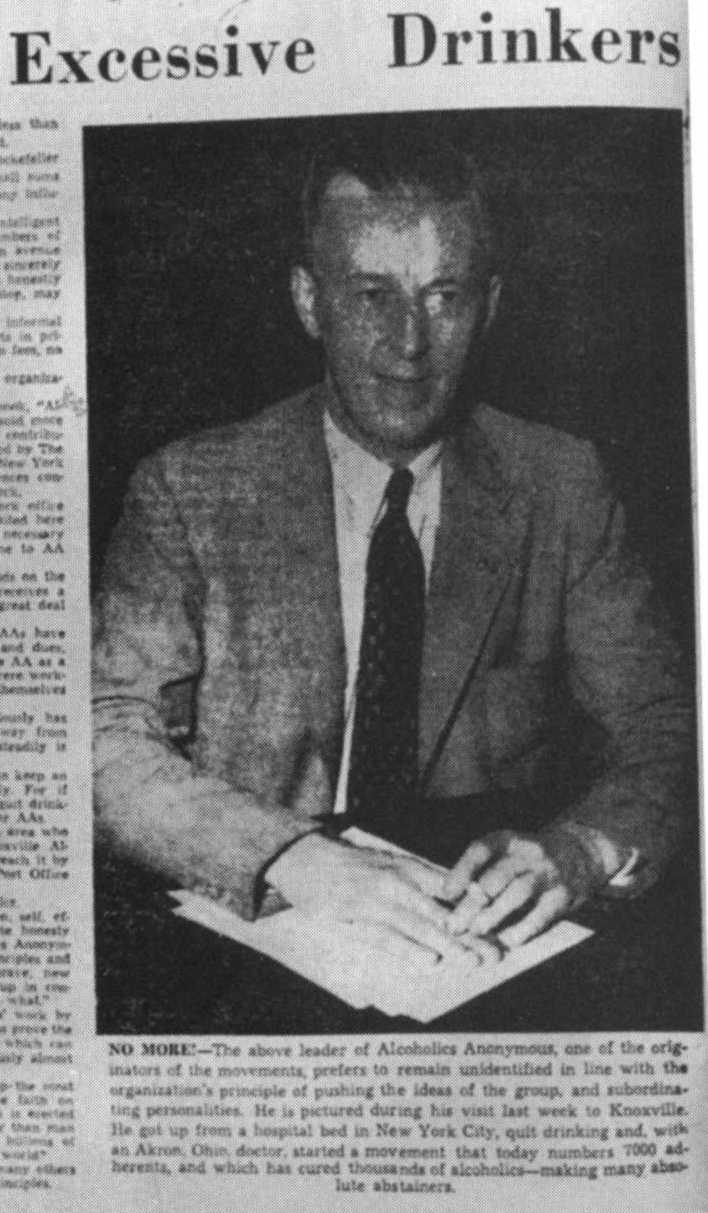
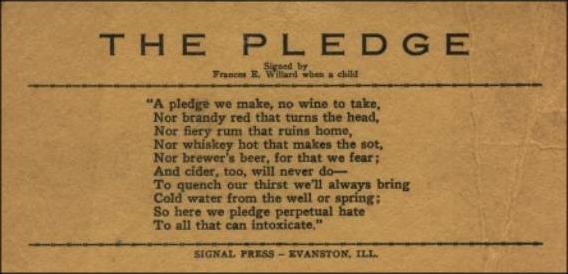
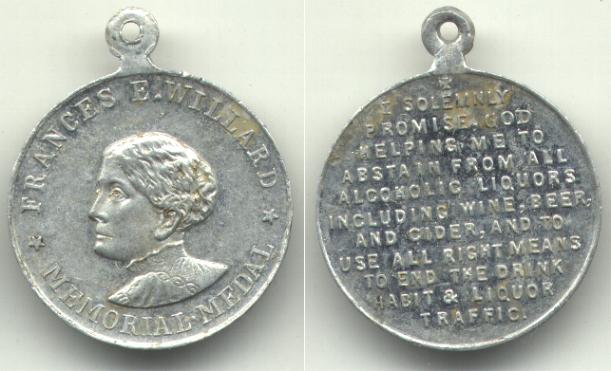
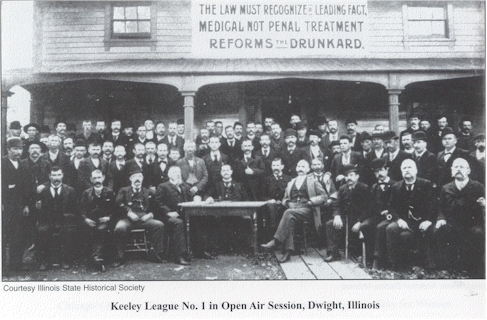


Copyright © 2016, A. Orange