Frank Buchman
|
and the Twelve Steps by A. Orange
Chapter 2:
If Frank Buchman had only acted as a mentor and source of inspiration for Bill Wilson, he might not have been such an important figure in American history, or worthy of this much attention. But Buchman gives us a sterling example of an extreme religious cult, and we still see echoes of Buchman's ideology in contemporary American politics — particularly in the fundamentalist Christian Radical Right. As one wit observed, "History doesn't repeat itself; it rhymes." Frank Buchman and his cult are, unfortunately, still relevant today. Frank Nathan Daniel Buchman was born June 4, 1878, in Pennsburg, Pennsylvania, USA, and died August 6, 1961, in Freudenstadt, Germany. His ancestry was "Pennsylvania Dutch" which really meant German (Deutsch), or German-speaking Swiss, and he grew up bi-lingual, speaking both English and Pennsylvania German, something that would come in very handy later when he spent time in Germany. Childhood acquaintances recalled that "Frank was an unusual boy from the very beginning." Children at school would taunt Buchman with "Fedanda Narische Dumbe Buchman" ("Damn Crazy Dumb Buchman"), a chant in the Pennsylvania dialect which the taunters derived from his initials "F.N.D.B.".106 More than forty years later, one of his classmates remembered Frank Buchman with this statement:
I still see him at school enjoying nothing more than loitering around with the girls indulging in silly, gossipy, trifling talk... Gossip is the core of his whole movement.
Frank Buchman resigned in protest and went away in a huff. Using his father's money, Buchman got on a ship for a long vacation in Europe. He ended up at a large religious convention in Keswick, England, where he felt that he had a spiritual transformation. A woman preacher there apparently gave a very moving sermon. Buchman claimed that he suddenly had a vision of spirituality without ego. He explained it as, "the 'I' of ego was crossed out by a horizontal stroke, producing the cross of Christ." Feeling an urge to share this experience, he went to nearby Oxford University and formed an evangelical group there among the student leaders and athletes. Then he went to Cambridge and did the same. Buchman called his new organization "First Century Christian Fellowship", and claimed that he was recreating the feelings of brotherhood and fellowship that were enjoyed by the original Christians. Later, the organization spread, and groups formed over the next twenty years in England, Scotland, Holland, India, South Africa, China, Egypt, Switzerland, and North and South America. As a result of his religious experience at Keswick, Buchman felt moved to write letters of apology to all six of the trustees in Philadelphia with whom he had squabbled, asking their forgiveness, trying to make amends. Buchman said that none of them bothered to answer him. That was rather unkind of them, wasn't it? No wonder Buchman had a disagreement with them, if they were really so haughty and inconsiderate that they would not even acknowledge a man's humble apology and request for forgiveness... There is just one small detail that Buchman left out in his telling of that story: Buchman didn't put any return address on the envelopes that he mailed back to Philadelphia.
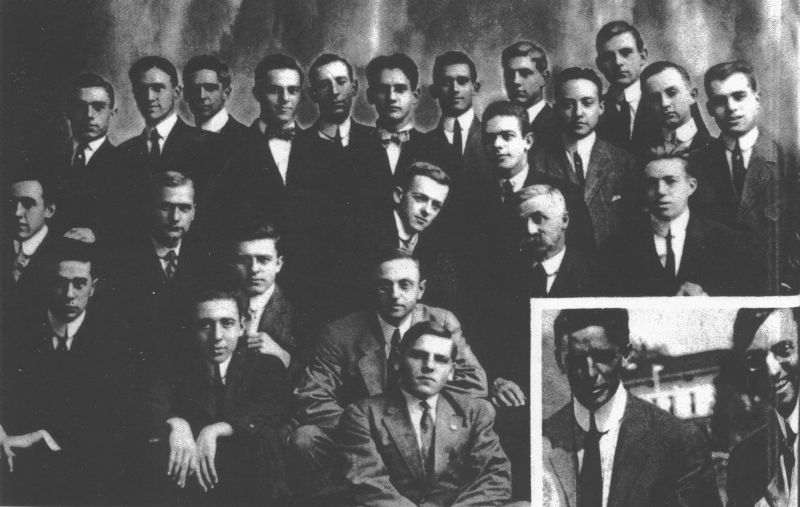
When Buchman returned to the USA, he got the position of YMCA secretary at State College, Pennsylvania, effective July 1, 1909. He moved in with the boys at the YMCA, and lived there for years. The students didn't like Buchman.
During his first year, Buchman reckoned, he was probably the most unpopular man on campus. Some of the students reacted sharply both to his earnestness and to what they felt were his puritanical attitudes, and he was nicknamed 'Pure John', a jibe derived from a contemporary cartoon figure. He became accustomed to seeing 'Pure John — 99 per cent pure' scrawled on vacant sign-boards; he was guyed in the college revue, caricatured in the college magazine. The other faculty at Penn State didn't seem to like Buchman much, either. One commented, "Buchman oozed the oil of unctuous piety from every pore. I would not be interested in seeing him again if it were at the cost of having to shake hands with him."52
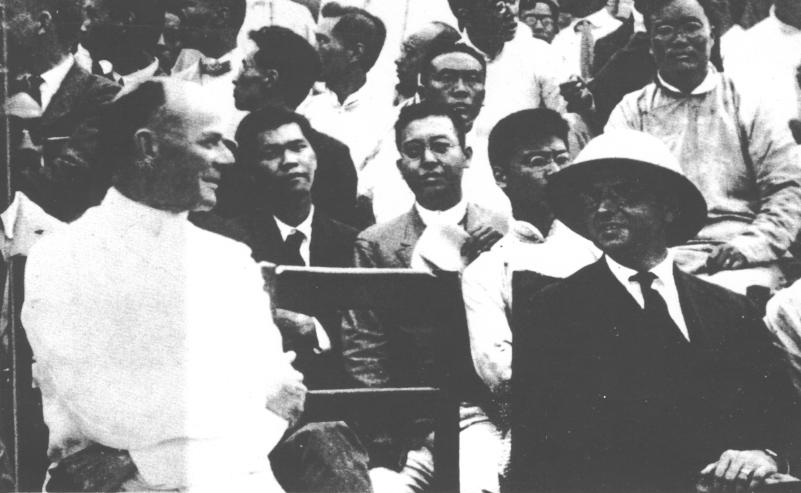
Buchman left Penn State in 1915 to travel in the Far East with evangelist Sherwood Eddy for a while. During 1915 and 1916, Buchman traveled in China, India, Korea, and Japan. He met with little success there, and unhappily noticed that the Communists were far better at recruiting than the Christian missionaries were, because the Communists did not display arrogant, condescending, know-it-all attitudes towards "the heathens", and the Communists were not out to destroy the local cultures.
When he returned to the U.S.A. in 1917, Buchman was appointed Extension Lecturer in Personal Evangelism at the Hartford Seminary, in Hartford, Connecticut. There, he moved into the students' dormitory with the boys, in spite of the fact that he was then 38 years old. Buchman gained a reputation for dwelling on the importance of sexual sin in his dealings with students. He was asked to move out of the boys' dorm when the students complained about his "intrusive methods". Buchman did not stay long at Hartford. He resigned from his position at Hartford in order to devote himself to "personal evangelism", and to living off of the largesse of wealthy backers, activities which he would pursue for the rest of his life. Buchman now had the free time and the opportunity to travel. In 1918 he was back in China. His return to China was financed by Harry Blackstone of Los Angeles, and Buchman was accompanied by a team of his own choosing that included Dr. Harry Luce, father of one of the co-founders of Time magazine.104
Back in China, Frank Buchman's behavior was so obnoxious that he offended just about everybody with whom he had contact. Buchman called together a convention of the China missionaries, where he lectured his fellow missionaries, warning them about "crushes" and "absorbing friendships", which some people could only assume were barely-veiled accusations of sexual affairs, either heterosexual or homosexual. Then Buchman objected when some people took his remarks personally.77
It was in Kuling, China, in 1918, that Buchman had started his custom of having "House Parties". He would gather around himself whatever wealthy or influential people he could get, and hold informal church services, in a rich person's home or a large hotel suite, that were more like an open house than a church service. People would come and go as they pleased, and would hang out with Frank, as he was called (never Dr. Buchman or Rev. Buchman), or hang out in some other room, as they liked, playing cards or music sometimes. In the middle of all of this, Buchman developed and expounded his beliefs. And then, from 1919 through the mid nineteen-twenties, Buchman took his style of religious meetings to American college campuses, especially favoring the rich, upscale universities like Harvard, Yale, and Princeton. 
Previous: Bill Wilson Writes the Steps
Last updated 13 July 2014. |
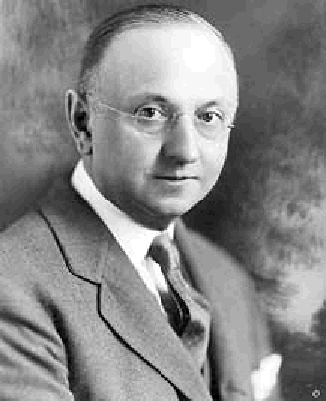 Frank Nathan Daniel Buchman


Copyright © 2016, A. Orange