A.A. and Religious Faith
|
by A. Orange
In the Big Book, chapter 4 is titled "We Agnostics". It's a highly revealing chapter. That chapter explains how all of the former agnostics and atheists in A.A. got converted into true believers in Bill Wilson's religion, and how all of the new skeptics must also be converted. In fact, the whole chapter is devoted to just one subject: how everyone must "abandon Reason and human intelligence" and come to believe Bill Wilson's religious beliefs. That chapter says nothing about how to actually quit drinking alcohol. It is more proof that A.A. is a cult religion, not a quit-drinking program. We needed to ask ourselves but one short question. "Do I now believe, or am I even willing to believe, that there is a Power greater than myself?" As soon as a man can say that he does believe, or is willing to believe, we emphatically assure him that he is on his way. On his way where?
We found that as soon as we were able to lay aside prejudice and express even a willingness to believe in a Power greater than ourselves, we commenced to get results, even though it was impossible for any of us to fully define or comprehend that Power, which is God. We commenced to get what results?
Bill Wilson didn't say. He just left it to us to guess what great benefits might have accrued to some unidentified believers. Actually, it didn't say, "benefits", did it? It just said "results". Relapsing and getting rip-roaring drunk is also a "result", isn't it? Such vague terminology and grandiose hand-waving is typical of Bill Wilson's writing style, and of A.A.'s claims of success in general. That line in the second quote about getting results, despite being unable to fully define or comprehend God, is really ridiculous: Theologians, mystics, and priests of all of the great religions of the world have been saying for thousands of years that God is far too big and complex and multi-dimensional for any human being to fully define or comprehend, so it isn't surprising that the A.A. members were unable to do it. Notice how Bill Wilson deftly segued from an open-minded, generic "Power greater than ourselves" in the middle of that sentence to just plain old "God" at the end of the sentence, a "God" without even any of the "as we understood Him" qualifiers:
We found that as soon as we were able to lay aside prejudice and express even a willingness to believe in a Power greater than ourselves, we commenced to get results, even though it was impossible for any of us to fully define or comprehend that Power, which is God.
That is a classic bait-and-switch stunt,
accomplished by redefining the object of the sentence
at the last possible instant, by tacking just three words
onto the tail end of the sentence: "Oh, by the way, I really mean the Buchmanite God of William Wilson and Dr. Robert Smith."
What a slick shell game Bill Wilson plays: "Watch the pea. Watch closely now. Freedom of Religion lasts just about that long in A.A. circles. In that last quote, Wilson said that people who didn't want to believe what he believed needed to "lay aside prejudice". Throughout that "We Agnostics" chapter of the Big Book, Bill Wilson repeatedly used the word "prejudice" for people's objections to and resistance to things like fuzzy thinking, bad logic, undefined spiritual terminology, superstition, blind faith, bombastic religiosity, and dishonest propaganda tricks. Check out this disparaging description of "their" original skeptical thinking for more examples. (And also note how Wilson used the preacher's "we" when he meant "you," as in "we have been prejudiced and narrow-minded." Bill Wilson did not think he was guilty of being an unbeliever. He thought everybody else was.)
Besides a seeming inability to accept much on faith, we found ourselves handicapped by obstinacy, sensitiveness, and unreasoning prejudice. Many of us have been so touchy that even casual reference to spiritual things made us bristle with antagonism. This sort of thinking had to be abandoned. Though some of us resisted, we found no great difficulty in casting aside such feelings. Faced with alcoholic destruction, we soon became as open minded on spiritual matters as we tried to be on other questions. In this respect alcohol was a great persuader. It finally beat us into a state of reasonableness. Sometimes this was a tedious process; we hope no one else will be prejudiced for as long as some of us were. Resistance is futile, you will be assimilated. If you drink enough alcohol, and cause enough brain damage, you can believe anything, even Bill Wilson's preaching. And if you won't abandon sane, rational thinking, and become a brainless babbling bonkers bombastic believer, then the Big Bad Booze Bogeyman will get you, and you will get beaten into a state of "reasonableness". Some more of Bill Wilson's accusations of "prejudice":
Do not let any prejudice you may have against spiritual terms deter you...
Instead of regarding ourselves as intelligent agents, spearheads of God's ever advancing Creation, we agnostics and atheists chose to believe that our human intelligence was the last word... Rather vain of us, wasn't it?
Besides a seeming inability to accept much on faith, we found ourselves handicapped by obstinacy, sensitiveness, and unreasoning prejudice. ... In this respect alcohol was a great persuader. It finally beat us into a state of reasonableness. Sometimes this was a tedious process; we hope no one else will be prejudiced for as long as some of us were.
If our testimony helps sweep away prejudice, enables you to think honestly, encourages you to search diligently within yourself, then, if you wish, you can join us on the Broad Highway.
But [the newcomer's] face falls when we speak of spiritual matters, especially when we mention God, for we have re-opened a subject which our man thought he had neatly evaded or entirely ignored. We know how he feels. We have shared his honest doubt and prejudice. Some of us have been violently anti-religious.
One of the reasons that
"the newcomer's face falls when we speak
of spiritual matters"
is that the newcomer realizes that Bill and his gang are pulling
a bait-and-switch stunt on him.
The beginner came to
what was advertised as a "quit-drinking" meeting,
to talk about alcoholism and quitting drinking,
and now this religious nut is raving about God and true faith,
and saying that
you are "prejudiced" if you don't agree with his
grandiose proclamations... 
Let's look first at the case of the one who says he won't believe — the belligerent one. He is in a state of mind which can be described only as savage. Actually, if you really want to see a savage state of mind, you should look at Bill Wilson while he was sentencing non-believers to ostracism and death by alcohol because they wouldn't believe in God the way that he dictated. Both the Big Book and Bill's second book, Twelve Steps and Twelve Traditions, tell stories of Bill Wilson and the other "elders" conspiring to kick a fellow out of A.A., and abandoning him to death when he relapsed, for refusing to believe in God. In Twelve Steps and Twelve Traditions, pages 143 to 145, you will find the story of Ed, who refused to believe in God, and said so, loudly:
Ed was an atheist. His pet obsession was that A.A. could get along better without its "God nonsense." He browbeat everybody, and everybody expected that he'd soon get drunk — for at that time, you see, A.A. was on the pious side. There must be a heavy penalty, it was thought, for blasphemy. Distressingly enough, Ed proceeded to stay sober.
So the elders — meaning Bill Wilson and his friends — wished that Ed would relapse:
The group was in anguish so deep that all fraternal charity had vanished. "When, oh when," groaned members to one another, "will that guy get drunk?" Note that "all fraternal charity" vanishes if you say things that the other group members don't want to hear. Bill Wilson says so. They will hope that you relapse and die drunk if you won't conform to the group, and please them by parroting the approved jabber and praying the approved prayers. So much for the "unconditional love and acceptance" that A.A. says newcomers will find at meetings... And so much for it not being a religion. Finally, Ed relapsed, and went off on a binge. The true believers spitefully, vindictively abandoned him, and left him to die drunk:
In those days, we'd go anywhere on a Twelfth Step job, no matter how unpromising. But this time nobody stirred. "Leave him alone! Let him try it by himself for once; maybe he'll learn a lesson!" Eventually, the book says, Ed crawled back to A.A., ready to believe in God. While he was sick and in a fever, he had had some kind of a vision or hallucination that he wouldn't talk about, but now he was willing to read the Bible and believe in God. Problem solved. (What was it that Bill Wilson said about "John Barleycorn promises us insanity or death"? If you drink enough cheap rot-gut whiskey and bathtub gin, you too will be able to believe in Bill Wilson's religious rants...) And what if Ed had not survived, or had not crawled back to A.A.? The A.A. members weren't about to help him, because he wouldn't believe in God the way that they wanted him to. They weren't really his friends at all. They were not trying to save his life. They refused to help Ed. Bill Wilson documented this vicious behavior in official A.A. literature, and even bragged about it, and offered this story as an example of how to deal with the problem of non-believers who stubbornly refuse religious conversion. Mr. Wilson rationalized the whole story by saying that if they had just kicked Ed out for "blasphemy", in the beginning when he refused religious conversion, then the man would never have come to God. So deal with such guys the way that this story teaches:
Nowadays, when oldtimers who know Ed foregather, they exclaim, "What if we had actually succeeded in throwing Ed out for blasphemy? What would have happened to him and all the others he later helped?" Isn't it funny that criticizing the hypocritical religiosity of Alcoholics Anonymous is "blasphemy"? Criticizing Bill Wilson's bombastic preaching is "blasphemy", punishable by death? Who does Bill Wilson think he is, the Pope? Or Grand Inquisitor Torquemada? Also note the total denial there: Bill Wilson and the other elders basically did throw Ed out. They ostracized him, they 'bad-vibed' him, "all fraternal charity vanished", they wished that Ed would relapse, and then they abandoned Ed to death by alcohol when he relapsed. Then they sanctimoniously pretended that they had done no such things. Denial isn't just a river in Egypt. There is a very similar story in the Big Book, Jim Burwell's story The Vicious Cycle which is on pages 246 and 247 of the third edition, and on page 228 of the 4th edition. (One A.A. member has told me that the "Ed" of Twelve Steps and Twelve Traditions and Jim Burwell are actually the same person.) Jim Burwell was the resident atheist of Alcoholics Anonymous in the earliest days of A.A., and he is famous for having demanded that the Twelve Steps be considered suggestions, not requirements, of A.A. membership, like it says on page 59 of the book. Jim Burwell bragged that he is the one who got those words in there. For revenge, Bill Wilson would not even allow Jim Burwell's story to be included in the first edition of the Big Book, just because Jim was an atheist who didn't parrot Bill's party line. Burwell didn't get his story into the Big Book until the second edition, after Burwell had [ostensibly] undergone a religious conversion and become an A.A. believer. 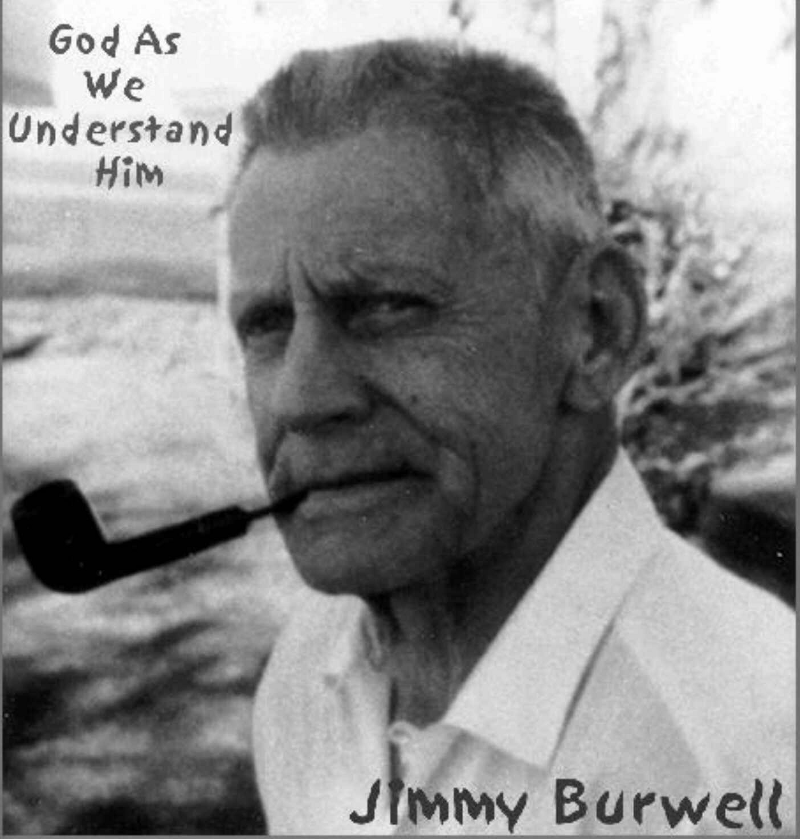
In his story, Burwell described his earlier treatment as an atheist member of Alcoholics Anonymous:
Much later I discovered the elders held many prayer meetings hoping to find a way to give me the heave-ho but at the same time stay tolerant and spiritual.
Those "elders" sure had funny ideas of tolerance and spirituality:
Bill Wilson really had a mean, hateful, side to him (which is typical of Narcissistic Personality Disorder). He self-righteously condemned men to slow painful deaths by alcohol for not believing in God in the way that Bill dictated. Bill Wilson only granted Ed acceptance in A.A. after he experienced religious conversion, and did what Bill wanted, and believed what Bill said. Those non-compliant alcoholics may have "signed their own death warrants" by not following Bill's "suggestions", but apparently, Bill Wilson didn't have any problem with vindictively arranging their executions for them. So much for the "unconditional love" that they say you will find in Alcoholics Anonymous.
Note that such behavior continues in Alcoholics Anonymous even today. Newcomers who refused to believe what their sponsors told them, or refused to do what their sponsors instructed, have been advised to It is obvious now that, as far as Bill Wilson was concerned, the real purpose of Alcoholics Anonymous was not to help people to quit drinking, but to make them believe in God — specifically, believe in Bill Wilson's ideas of God, as well as to follow Bill's dictates, which he called "God's dictates":
And A.A. actually has the gall to say that it isn't a fanatical religion, just a nice, friendly, easy-going quit-drinking program. Will the Catholics or the Baptists abandon you to death in the streets just because you won't believe in God quite the way that they want you to? In this town, I see the Catholics, the Baptists, the Seventh Day Adventists, the Salvation Army, the Union Gospel Mission, and a bunch of other unnamed Christian sects getting together and feeding and helping the poor and homeless, and I've never seen them refuse anything to a doubter just because he wouldn't believe the way that they wanted. In fact, I've never even seen them ask anyone what he believed before they hand out the food. Some of them preach, most of them don't, but they all just hand out the food, regardless of what you believe. — Speaking of which, I've never seen A.A. engage in any such charitable activities. That is Frank Buchman's religion showing again: Buchman preached that all social problems were caused by sin, and the cure was to get "changed" (changed into one of Buchman's followers). The Buchmanites would not do anything to fix the problems of society. Frank Buchman considered any attempts to fix social problems by any means other than prayer, confession, and surrender to God, to be "immoral". Hence, Buchman considered Women's Suffrage, the Civil Rights Movement, and the Labor Movement to all be "immoral activities", efforts too concerned with human well-being and not concerned enough with following "the dictates of God" (as Frank Buchman heard God dictating His orders, of course). A.A. has a similar problem: it insists, in Tradition Ten, that it does not have any opinion on outside issues, and will not get drawn into public controversy. Unfortunately, in practice, that means that A.A. is so self-absorbed, self-centered and self-seeking that A.A. offers no fix for any of the problems of society except "Join A.A., Go to Lots of Meetings, Work the Twelve Steps, Get a Sponsor, and Read the Big Book." Apparently, feeding or helping the poor and the homeless is too "controversial" for A.A. members, in spite of the fact that many of those poor and homeless people are alcoholics. And remember the quote about service:
The minute we put our work on a service plane, the alcoholic commences to rely upon our assistance rather than upon God. So don't help the alcoholics. That would make "materialists" out of them, and lead them away from dependence upon God. Also, if you have some other problem that has nothing to do with alcoholism, then form another, separate, twelve-step group, like Narcotics Anonymous, Overeaters Anonymous or Sex Addicts Anonymous, and then Do The Twelve Steps, Go to lots of meetings, Get a sponsor, and Read the big book...
This world of ours has made more material progress in the last century than in all the millenniums which went before. Almost everyone knows the reason. Students of ancient history tell us that the intellect of men in those days was equal to the best of today. Yet in ancient times material progress was painfully slow. The spirit of modern scientific inquiry, research and invention was almost unknown. In the realm of the material, men's minds were fettered by superstition, tradition, and all sorts of fixed ideas. Some of the contemporaries of Columbus thought a round earth preposterous. Others came near putting Galileo to death for his astronomical heresies. The simple answer to Bill Wilson's question is "No. We are not biased and unreasonable. We just don't like crazy double-talking religious nuts, or their irrational cult dogma." Another good answer is, "The Realm of the Spirit: blind faith, superstition, Church orthodoxy, religious bigotry, heresy trials, witch burnings, millions of women killed, millions of girls killed, and even baby girls killed for being witches, The Grand Inquisition, mass murder, millions executed... Been there. Done that. We gave that one a really good try, for a thousand years. We don't need to do that one again." Notice how Bill pulls yet another bait and switch stunt there:
And then, beginning with the very next line in that chapter, he does it all again, first offering the bait, a nice morsel of science and technology, and then pulling the switch, asking you to accept his religious beliefs:
Even in the present century, American newspapers were afraid to print an account of the Wright brothers' first successful flight at Kittyhawk. Had not all efforts at flight failed before? Did not Professor Langley's flying machine go to the bottom of the Potomac River? Was it not true that the best mathematical minds had proved man could never fly? Had not people said God had reserved this privilege to the birds? Only thirty years later the conquest of the air was almost an old story and airplane travel was in full swing. And "readiness to change our point of view" really means readiness to accept William G. Wilson's Buchmanite religious beliefs:
When we saw others solve their problems by a simple reliance upon the Spirit of the Universe, we had to stop doubting the power of God. Our ideas did not work. But the God idea did. So dump your own ideas in the trash can and just blindly believe in William Wilson's ideas.
Speaking of bad logic, Wilson then wrote:
Logic is great stuff. We liked it. We still like it. It is not by chance we were given the power to reason, to examine the evidence of our senses, and to draw conclusions. That is one of man's magnificent attributes. We agnostically inclined would not feel satisfied with a proposal which does not lend itself to reasonable approach and interpretation. Hence we are at pains to tell why we think our present faith is reasonable, why we think it more sane and logical to believe, why we say our former thinking was soft and mushy when we threw up our hands in doubt and said, "We don't know." Bill Wilson was misusing the word "logic". There is nothing "logical" about blind faith in a cult religion. Logic is a thought process where one examines facts and then draws conclusions from them, using inductive or deductive reasoning. Bill was also using his hypnotic bait-and-switch trick yet again. He started the paragraph by praising logic and saying that he liked it. But then he switched sides and attacked logic, and praised blind faith in his beliefs as being more logical than logic itself. And it's funny how Bill admitted that he was "at pains to tell why we think our present faith is reasonable, why we think it more sane and logical to believe..." The reason that it is so hard to defend that point of view is because it is completely irrational and illogical. It is based on no facts at all. It is just so much wishful thinking. Then Mr. Wilson again declared that blind faith was the goal, and "Reason" was a serious impediment to faith in Wilsonism:
Some of us had already walked far over the Bridge of Reason toward the desired shore of faith. The outlines and the promise of the New Land had brought lustre to tired eyes and fresh courage to flagging spirits. Friendly hands stretched out in welcome. We were grateful that Reason had brought us so far. But somehow, we couldn't quite step ashore. Perhaps we had been leaning too heavily on Reason that last mile and did not like to lose our support. That whole paragraph is an incredible piece of propaganda, a real fairy tale. It is also obviously as delusional as can be. The object of the Alcoholics Anonymous program was supposed to be to quit drinking, remember? But now Bill Wilson insists that the goal of the A.A. program is to abandon Reason and embrace blind faith in his teachings, to reach "the desired shore of faith" in La-La-Land. This pathetic lunatic actually has the arrogance, the sheer gall, to demand that we give up Reason and human intelligence, and become insane, completely irrational, religious maniacs, just like him.
Mr. Wilson claims that we have walked far over a
"Bridge of Reason" towards a "desired shore
of faith..." (F.Y.I.: it's located between James Hilton's The Lost Horizon — Shangri-La, H. G. Wells' The Country of the Blind, Sir Arthur Conan Doyle's The Lost World, and Edgar Rice Burroughs' The Land that Time Forgot. Just turn left at the first dinosaur that you see.) The flowery images like "The outlines and the promise of the New Land had brought lustre to tired eyes and fresh courage to flagging spirits. Friendly hands stretched out in welcome." are ridiculous. Bill Wilson really was living in La-La-Land. But, finally, at the last minute, "Reason" stops us from wholeheartedly embracing Bill Wilson's world of grandiose delusions. I should hope that it does. It shows that the rest of us still have a few functioning brain cells left, and still have at least some small amount of sanity and contact with reality remaining.
But Bill wasn't nearly finished with his attack on Reason and sanity. He continued:
Perhaps we had been leaning too heavily on Reason that last mile and did not like to lose our support. Now Bill seems to have logically proven to us that he is insane. He accuses us of having faith in a false god, the God of Reason, and of worshipping it. He thinks that because we trust our senses and our ability to think logically, that we should now feel free to abandon intelligence, reason, logic, and sanity, and just believe in the religious proclamations of Bill Wilson. But what Bill frivolously overlooks is the logical conclusion of his line of reasoning: Because we simply trust that our minds and our perceptions are working correctly, we cannot really know anything for sure. We are in fact flying on faith; we can only assume that our perception of reality is correct. But our perceptions really might be all wrong; we might not really be here at all. This might all just be a dream we dreamed one afternoon long ago. So Nothing is real, Nothing to get up tight about, Strawberry Fields Forever... Nothing matters, and we can do whatever we want to do because it's all just a dream. So let's dump this boring fool Bill Wilson and go have a beer. The beer won't really be real, either, so it won't hurt anything, but the illusion sure will taste good, won't it? (Actually, the reality of the situation is that the hangovers are real. Everything else might be an illusion, but those damn hangovers are very real.)
Bill continued his sermon:
Imagine life without faith! Were nothing left but pure reason, it wouldn't be life. Nonsense. Sure it would be life. Just think about a race like the Vulcans of Star Trek. They are irritatingly logical and unemotional (to humans), and yet they do just fine. Furthermore, even if humans were logical, reasonable, and without faith, they would still have their emotions, and their passions, and their hornyness... That's life. Think about the earthworms. They almost certainly do not have faith in any "Higher Power" or God, because they don't have much in the way of brains at all. But they still manage to eat, have sex, and make baby worms. That's life. Bill Wilson continued:
But we believed in life of course we did. We could not prove life in the sense that you can prove a straight line is the shortest distance between two points, yet, there it was. Could we still say the whole thing was nothing but a mass of electrons, created out of nothing, meaning nothing, whirling on to a destiny of nothingness? Or course we couldn't. The electrons themselves seemed more intelligent than that. At least, so the chemist said.
What nonsense. Of course we can prove life.
I see that I am alive. I sit here, and type this, and I have hands that
I can see, which hit the keys, and I inhale, I watch myself breathe,
and I can see clearly that I am alive. And I occasionally eat and
reproduce, and that's life, beyond a doubt.
Likewise, you can see that you are alive. There is no doubt
about it. And who said that the electrons were created out of nothing, meaning nothing? Only Bill Wilson...
Hence, we saw that reason isn't everything. Neither is reason, as most of us use it, entirely dependable, though it emanate from our best minds. What about people who proved that man could never fly? That is some more broken logic. Reason, as Bill Wilson misuses it, is undependable, but the rest of us aren't quite that crazy. Bill argues that just because some people were convinced that heavier-than-air craft could never get off of the ground, we should all now abandon reason and stop thinking. And become what? Unreasonable? Illogical? Insane fools without reason? Well, actually, yes, something like that. The Oxford Group cult specifically demanded that people give up their rational minds. Ebby Thacher and Shep Cornell recruited Bill Wilson like this:
Ebby and Shep C. were now asking him to give up the one attribute of which he was the most proud, the one quality that set a man above the animals — his inquiring, rational mind. And they wanted him to give this up for an illusion. Bill vowed to resist such an anti-intellectual cult religion to the bitter end, but within two weeks, under the influence of delirium tremens, hallucinogenic drugs, and intense religious indoctrination, Bill Wilson broke down and gave up his "innate, inquiring, rational mind", and "surrendered", and was "changed" into an irrational true-believer Oxford Group cult member who then went on to insist that all other alcoholics must also give up their reason and rational thinking. (It's kind of like the Rabies virus, isn't it? Or like getting bitten by a vampire or a werewolf...)
People of faith have a logical idea of what life is all about.
Nonsense. People of faith have an irrational, illogical idea of what
life is all about.
They have to: By its very nature, by definition, faith is belief in spite of
the contrary evidence, or belief in spite of the complete lack of any
supporting evidence. That isn't logical or rational. Bill continued:
Hence we are at pains to tell why we think our present faith is reasonable, why we think it more sane and logical to believe than not to believe, why we say our former thinking was soft and mushy when we threw up our hands in doubt and said, "We don't know." Yes, Bill, I'm sure you are at pains in trying to explain your thinking. There is no sane, logical reason for your attitude that blind faith in your favorite religious dogma is more sane and logical than human intelligence, or reason, or realistic acceptance of some simple obvious facts, like that life exists and we can prove it. Again, by definition, faith involves believing in something in spite of the lack of any evidence to support such beliefs. Such unquestioning "faith" in the strange superstitions of the renegade fascist minister Dr. Frank N. D. Buchman isn't sane or logical.
If our testimony helps sweep away prejudice, enables you to think honestly, encourages you to search diligently within yourself, then, if you wish, you can join us on the Broad Highway. If you disagree with Bill Wilson, he says that you are prejudiced and not thinking honestly. But if you agree with him, then you can join Bill on "the Broad Highway" if you wish. What "Broad Highway"? Bill Wilson's writings are just loaded with such vague, grandiose terminology, precisely because he suffered from a bad case of delusions of grandeur.)
A few more examples of Bill's grandiose euphemisms in the Big Book:
Just watch for all of the capitalized words. I would love to satirize such speech in jokes. I can just imagine that bombastic little duck, Daffy Duck, wildly waving his arms in the air and screaming about "The Master of the Universe," "The Broad Highway," and "The Ultimate Reality." The problem is, Bill Wilson is himself so extremely bombastic, that it is almost impossible to parody him by being terribly more extreme than he already is. Daffy is definitely going to have his hands full, trying to outdo Bill. Note how Wilson said, in the quote above,
If our testimony helps sweep away prejudice, enables you to think honestly, encourages you to search diligently within yourself... Wilson thought that everyone really believed in God deep down in their hearts. If they didn't believe, it was simply because they were prejudiced and they had dishonestly decided to overlook their own faith, to deny the truth in themselves. To be a skeptic is to be dishonest, ignoring the 'obvious truth', Bill said. In Bill Wilson's opinion, people didn't decide to believe in God, the unbelievers willfully, childishly, stubbornly, dishonestly decided to *NOT* believe in God, by deliberately ignoring what Wilson considered to be overwhelming evidence:
We had seen spiritual release, but liked to tell ourselves it wasn't true.
Bill Wilson said that again in this paragraph:
But [the newcomer's] face falls when we speak of spiritual matters, especially when we mention God, for we have re-opened a subject which our man thought he had neatly evaded or entirely ignored. Thus, Wilson wrote that if you would honestly look within yourself, and quit trying to evade the subject, you would find that you really do have faith in Bill's beliefs, and really do believe in the fascist, micro-managing God of Bill Wilson after all. If you can just overcome your "prejudices" against certain "theological terms" about which you are "confused", you will find "true faith". Bill Wilson even went so far as to declare that it was actually impossible to really be an atheist, because you can't prove that there is no God.
I was not an atheist. Few people really are, for that means blind faith in the strange proposition that this universe originated in a cipher and aimlessly rushes nowhere. Wilson was so insane that he thought he was scoring good debating points with brain-damaged arguments like that. He didn't seem to notice the obvious reverse argument — that by Bill's logic, it would be impossible to really believe in God because you can't prove that there is a God.
You can forget about your own religious beliefs. You won't be needing them any more. The recruiting manual in Chapter Seven of the Big Book clearly teaches the recruiters how to tell people that their own religious beliefs are inferior to those of the A.A. members, because their own religious convictions have not kept them from drinking. Your prospect may belong to a religious denomination. His religious education and training may be far superior to yours. In that case he is going to wonder how you can add anything to what he already knows. But he will be curious to learn why his own convictions have not worked and why yours seem to work so well. He may be an example of the truth that faith alone is insufficient. Likewise, the Hazelden Foundation propaganda teaches us that religion should give us A.A.-style "spirituality", but if it doesn't, then we should set our religion aside for a while. In other words, we should abandon our current religion and just believe in Wilsonism:
"... Alcoholics Anonymous is a spiritual program, not a religious one." ...
And, in his own chapter of the Big Book, A.A. co-founder "Doctor Bob" Smith wrote:
If you think you are an atheist, an agnostic, a skeptic, or have any other form of intellectual pride which keeps you from accepting what is in this book, I feel sorry for you. So if you think for yourself (a form of intellectual pride — being proud to have a working brain), and don't readily accept the grandiose delusions of Bill Wilson, then you are in big trouble, and Doctor Bob feels sorry for you. So much for the A.A. statements that you can have any religious beliefs you wish.
From great numbers of such experiences, we could predict that the doubter who still claimed that he hadn't got the "spiritual angle," and who still considered his well-loved A.A. group the higher power, would presently love God and call Him by name. So, the real goal, the ultimate effect, of the Twelve-Step program is to get everyone — especially the doubters — to "love God and call Him by name." And yet, somehow, they still manage to keep a straight face while they insist that religious conversion is not the goal of the A.A. program...
"Of course we speak little of conversion nowadays because so many people really dread being God-bitten. But conversion, as broadly described by [William] James, does seem to be our basic process; all other devices are but the foundation."
And the Bait and Switch chapter makes a couple of points, too.
Footnotes:
2) Ibid, page 25. 3) Ibid, page 67.
4)
Walter Houston Clark, The Oxford Group; Its History and
Significance, page 110.
5) Bill W., Robert Thomsen, page 63,
and 6) Bill W., Robert Thomsen, page 72. 7) Ibid, page 72.
Last updated 26 May 2014. |




Copyright © 2016, A. Orange