The Religious Roots of Alcoholics Anonymous
and the Twelve Steps
by A. Orange
Chapter 7:
My God How the Money Rolls In
Frank Buchman's habit of collecting rich and famous converts
also meant that Buchman always had some wealthy people handy to tap
for more large donations, to continue to support his organization and his first-class lifestyle.
The problem of finance always seemed easy for Buchman. His followers
did not even admit that there was such a problem. "He is doing
God's work. Naturally, God will provide."
"Where God Guides, God Provides"
was the slogan.
But if some of Frank Buchman's
"key people" were not prompt enough at sending money,
Buchman did not hesitate to send a stiff letter of reminder.
In one case, says Arthur James "A. J." Russell,
the English newspaper reporter who was a true believer in Buchmanism
and the first official Oxford Group archivist and the chief publicist,
"Frank said their refusal to extend help where greatly needed
might involve them in a crop of cares they did not
foresee."4
One of the stiffest letters Frank permitted himself to write was to some
persons who were refusing to support him in a certain courageous action for the help
of someone in need. Frank said their refusal to extend the help where
greatly needed might involve them in a crop of cares they did not foresee
at the moment. But it was a friendly warning, nevertheless, free from
pique and resentment. Never does Frank mince matters where his correspondents
show blindness or compromise. If the man is living an undisciplined life,
he tells him so in plain words. Fearless dealing with sin all the time.
Honesty demands it. Spiritual growth is impossible without it.
Fifty or sixty letters a day are nothing to Frank.
...
After such a strenuous day,
Frank admits to his mind being tired,
...
but he is still a human dynamo.
For Sinners Only, A. J. Russell, page 200.
It would take a brave "up-and-outer" to risk such a curse from a
"man of God" like Frank Buchman.
(That is again the propaganda and debating trick of
"Argue from Adverse
Consequences" — warn that terrible things will happen to someone
if he doesn't do what you wish.)
The London newspaper reporter A. J. Russell sure had a way with words:
-
Frank Buchman brazenly committed spiritual extortion, issuing dire
warnings about what bad things would happen to people if they
did not comply with his wishes and send him money, and A. J. Russell called it
"a friendly warning, nevertheless, free from pique and resentment."
-
Likewise, 'Frank'
"permitted himself"
to write a few
"stiff"
letters of extortion.
-
And then the money was supposedly required to "courageously"
help someone who was in great need; but the Buchmanites were also notorious for
never giving any charity to anyone,
so who or what was the money really for?
That sounds like Frank Buchman was using the propaganda trick of
Hiding Behind Others — claiming that the money
was needed to help some unnamed person, when Buchman was really going to use it to
support his own lavish lifestyle.
Later, the Buchmanites would even declare that
"they never made any
appeals for money, public or private."
But usually such promptings and dire warnings were unnecessary, and the money rolled in
with a freedom and timeliness that was considered "providential."
Frank Buchman lived so comfortably that he declared, "Good food and
good religion go
together":12
He does not believe in traveling second class. One time, when some of his
followers booked a second-class passage, he told them rather sharply that he had been
guided that they should change to first class to form more significant contacts.
He is guided to eat well. Most Pennsylvania Dutch folk know good food and
eat it with gusto, and Dr. Buchman is no exception. "Good food and good religion
go together," he says.
Buchman — Surgeon of Souls, B.W. Smith, Jr.,
American Magazine, 122:26-7+, November 1936, page 151.
Frank Buchman lived so well that when he returned to the U.S.A. in March 1939,
he set up his headquarters in the Waldorf-Astoria Hotel in New York City,
where Buchman and 100 of his closest followers lived in baronial splendor.
Henry P. van Dusen, in his analysis of Buchman's organization for
Atlantic Monthly
magazine, pointed out that there was an inherent contradiction in Buchman's pursuit of
the lifestyles of the rich and
famous.64
Buchman originally called his organization First Century Christian Fellowship,
and claimed that he was recreating the spiritual life of the first Christians.
But Jesus and his first followers were all very poor people. Jesus was born
into poverty — as we all know, in a stable, and put to bed in a manger
(a hay-filled cow feeding trough).
Jesus was never rich with gold and silver.
There was something just a little bit off-base about
Frank Buchman living a life of extreme luxury and comfort in the Waldorf-Astoria Hotel in New York City,
and in the first-class salons of palatial ocean-liners like the Queen Mary,
and in the Mayfair Hotel in London, while claiming to be recreating early Christianity.
It appears that Frank Buchman was doing a far better job of recreating
the decadence of the Roman emperors.
When Frank Buchman was criticized for his outrageous self-indulgence,
he answered with another question,
"Why shouldn't we stay in 'posh' hotels? Isn't God a millionaire?"
Frank Buchman was not the only Oxford Grouper living high on the hog
through religion.
Geoffrey Williamson reported in his book,
Inside Buchmanism: an independent inquiry into the Oxford Group
Movement and Moral Re-Armament,
that any Oxford Group recruiter could "change" a wealthy man and then
live off of him indefinitely. It was common for the inner
circle of highest-ranking Oxford Groupers to receive gifts of cars,
expensive suits,
and stipends that supported them for years. Williamson
queried the leadership of The Oxford Group and Moral Re-Armament,
specifically asking about the official policy regarding such gifts and donations.
The answer was that the organization did not concern itself with such
matters at all. It regarded any such donations as merely gifts between
two private parties. Members did not report their income to the group,
nor were the more prosperous recruiters, "Life Changers", and
"Soul Surgeons" required to share their wealth with their less
fortunate
brethren.35
There are men who, though they have thrown up their normal occupations,
nevertheless appear to be living in comfort. Some have the use of mansions
in Mayfair, are always well dressed, and often have smart cars at their
disposal.
How, if they receive no salaries from Group funds, are they able to do it?
The answer I was given is that they are "helped" by private
supporters. This is explained and justified as follows: A young man receives
a call to devote himself to Buchmanism to the exclusion of everything else.
Some friend or sponsor, it seems, is always forthcoming and ready to
send the worker gifts in cash and kind. All those I met appeared to lack
nothing.
The system is recognized by those in power. It is thus always open to
any full-time worker to do the best he can for himself. If he can
"change" some wealthy sponsor, and if in gratitude that sponsor
chooses to make him a regular allowance and present him with a motor-car
to further his work, that is entirely his own affair. Some, I was told,
enter into a legal arrangement with their sponsors, who covenant to
support them for a number of years.
However successful they may be in this respect, they are not required
to pool any cash they receive, and, of course, items like this never
appear in Group accounts. The men themselves have no compunction about
solving their economic problems in this fashion. To them it is the
most natural thing in the world. "Where God guides, He provides,"
they say, justifying themselves with this familiar Buchman slogan.
Thinking this system wide open to abuse and calculated to undermine any
man's moral fibre, I tackled a member of the Council of Management about
it. He professed surprise that I should think it desirable that full-time
workers should be required to account for any money they might collect
individually from well-wishers or others. Here are his actual words:
"Personal gifts from one person to another are a private matter,
and are no more subject to inquiry than private gifts to private persons
anywhere." He added that it was quite true that motor-cars are given,
"but it has only happened in a few cases, and in each case the car
is given for an essential job for which it is needed rather than to
the person for his own use and pleasure....
"The real point of the personal economic system of the Group is that
we aim at a system where, as Dr Buchman says, everybody cares enough and
everybody shares enough and so everybody has enough. This means that on the
personal side we would not, of course, attempt to control or know about
all the gifts from one individual to another."
So, you see, the "personal economic" system is firmly established
and fully recognized in Group circles as "the done thing."
Inside Buchmanism; an independent inquiry into the
Oxford Group Movement and Moral Re-Armament,
Geoffrey Williamson, Philosophical Library, New York, c1954, pages 190-191.
The temptations of such a system are obvious. In fact,
R. H. S. Crossman of Oxford University
quoted one young Oxford Group evangelist as saying,
"I always wanted this
kind of life: big hotels, comfort, powerful cars, and the best people —
and as soon as I get changed, God gives them all to
me!"54
The whole organization was so rich and well-dressed that
Prof. A. Haire Forster of Western Theological Seminary
satirized them with this limerick:
Reinhold Niebuhr, the eminent theologian whose Serenity Prayer would
become famous in A.A. circles years later, criticized Buchman's
behavior by writing:
The idea is that if the man of power
can be converted, God will be able to control a larger area
of human life through his power than if a little man
were converted. This is the logic which has filled the
Buchmanites with touching solicitude for the souls
of such men as Henry Ford or Harvey Firestone and
prompted them to whisper confidentially from time
to time that these men were on the very threshold
of the kingdom of God. It is this strategy which
prompts or justifies the first-class travel of all the
Oxford teams. They hope to make contact with big
men in the luxurious first-class quarters of ocean liners.
Christianity and Power Politics,
Reinhold Niebuhr, in the chapter
"Hitler and Buchman".
That strategy also explains how Buchman could live the high life
while preaching "Absolute Unselfishness" for
everybody else.
Happily for Frank Buchman and his inner circle of followers,
they were not being selfish when they
demanded first-class everything for themselves; they were
doing "God's will", making contact with the rich and powerful
men who rule the world by going where such men were to be found.
After all, Buchman could argue, you won't find world leaders in
second class, now will you?
But such a social policy effectively excludes the common rabble from Salvation:
No one who has not at least some spare money and leisure can take
part in the Group's real activities.
House Parties cost participants between eleven and fifteen shillings
a day.
The Headquarters of the Group in London are at the Metropole Hotel.
Those anxious to learn what they have to teach are invited to call
there. Would anyone poverty-stricken to the extent of threadbare
or shabby clothes be likely to face a West End hotel?
Dr. Buchman has evolved a technique of evangelism that is
acceptable to Mayfair.
Saints Run Mad; A Criticism of the "Oxford" Group Movement,
Marjorie Harrison (1934), page 30.
In New York, one pastor criticized Buchman's behavior this way:
Marjorie Harrison observed in 1934 that,
The finances of the Group are a complete mystery. In Canada the same
perplexity was felt. How could a Team of fifty people travel by crack
trains and stay in the best hotels throughout an extended tour of the
Dominion and the United States unless there were a very rich backing
somewhere? The headquarters of the Group in London are divided between
Brown's Hotel and the Hotel Metropole. The Rev. Alan Thornhill, Fellow
and Chaplain of Hertford College, Oxford, in a letter to The Times
attempts to justify the use of expensive headquarters on the grounds
that drastic cuts in prices are made for numbers and that hotels are
willing to provide private sitting-rooms and large halls free of charge.
...
The Group states that it "never asks for funds by either public
or private appeal.55
Anyone doing so is disloyal to, and in direct
conflict with, the principle and practice of the Group."
As one member put it to me, "There is no collection or subscription."
Quite. But what's in a name? At a House Party there is a
"registration fee".
This fee of five shillings levied on five hundred people amounts
to 125 pounds. Any religious organization that could make sure of
securing an average of five shillings from those participating
in a concentrated activity would consider itself lucky. ...
There are large numbers of men and women who are attached to the
Teams either as permanent workers or for long periods of time at a
stretch. Who pays their expenses? Are their relations and friends
content that they should "live on faith", which usually
means living on other people? Or are they all people of substantial
independent means? Many of them are very young.
Saints Run Mad; A Criticism of the "Oxford" Group Movement,
Marjorie Harrison (1934), pages 103-105.
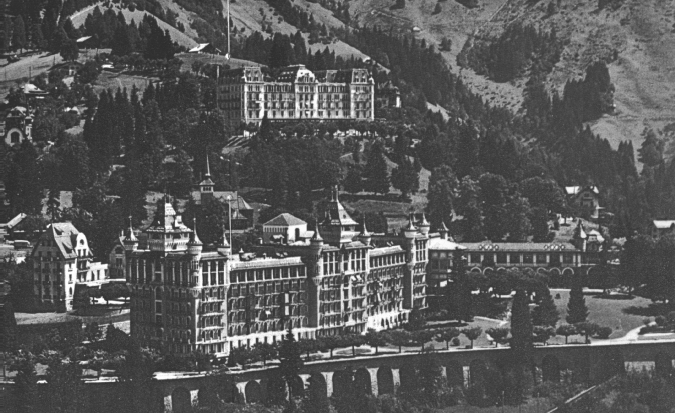
Geoffrey Williamson attended a Moral Re-Armament convention at Caux,
Switzerland in 1954, and observed:
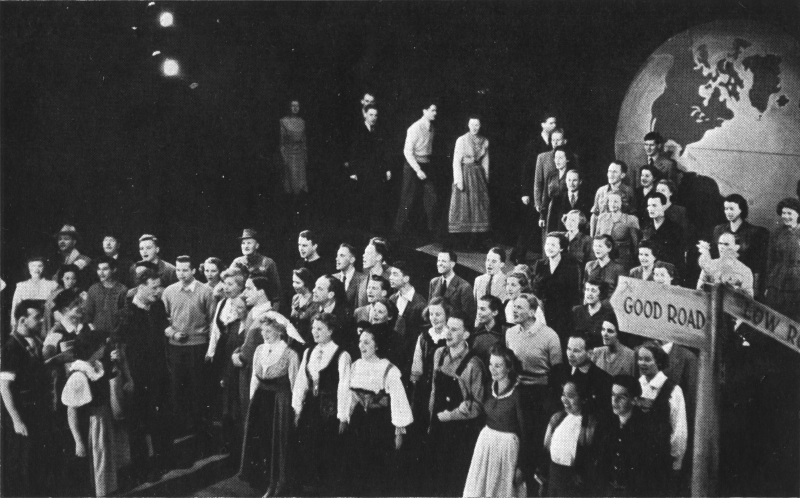
...one of the Governors of the College of the Good Road [the Moral Re-Armament
school on Mackinac Island]...
wound up his address with a request for funds to help carry
on the good work of Moral Re-Armament. I had been assured in London
that the Buchmanites never made any public appeal for funds.
Yet here was Bernard Hallward, one of the movement's leading lights,
not only asking us for money, but asking in a big way.
"We need three million francs!" he declared, "and we need
them urgently."
He went on to explain that the money, which he was sure would be forthcoming,
would be allocated equally between three main enterprises. One million
would go towards the maintainance of Mountain House [the hotel in Caux, Switzerland]; one million towards
the development of the College of the Good Road, and one million would
be used to complete the production of The Good Road film.
So, while a pianist played solemn music, ushers moved silently among
the audience with silver salvers which were soon heaped high with
contributions. No loopholes were allowed. Those without Swiss currency
or who had left their cheque books behind were given prepared slips
bearing addresses in America, Australia, Britain, Ireland, and New Zealand
to which financial contributions could be sent on their return home.
The fact that these slips had been run off on a duplicator seemed to
suggest that this practice was a fairly regular one.
I felt that it was as well that I had not played truant from that
morning's assembly. My presence had at least exploded the myth that the
Buchmanites never appeal for funds.
Inside Buchmanism; an independent inquiry into the
Oxford Group Movement and Moral Re-Armament,
Geoffrey Williamson, Philosophical Library, New York, c1954, pages 90-91.
Geoffrey Williamson found that Buchman's organization had four main sources of
income:101
- Donations which people give as they are able from time to time.
- Regular gifts made under covenant for a period of seven years or longer.
- Legacies and interest on them.
- Sales of books and other literature.
When Williamson asked how a production of the morality play The Good Road
was financed, he was told:
In the New World News for February 1949 an accountant who assisted
the Hon Treasurer tells how it was done, his article bearing the now
familiar heading: "Where Does the Money Come From?"
He says that 60,000 people saw The Good Road on a free-admission basis.
At the start there was nothing in the bank [he writes]. Many closely
associated with the venture turned out their pockets. A clerk not only gave
up every evening to help with the books, but sold his last security.
Another man gave up half of his small capital. But these were small sums
and the total (£20,000 was the estimated need) still seemed a tremendous
figure.
Though he vouches for the fact that there was no public appeal for subscriptions,
money flowed in.
Opening the morning's mail was a perpetual surprise [he declares]. Someone
writes from the West: "We have sold our savings certificates and send
you the money." An old lady with a shaky hand begs "to enclose
something towards the expenses."
A naval officer sent all his war gratuity. A typist sent the proceeds from
the sale of her bicycle. Someone sent valuable rings. Four members of the
orchestra returned part of their wages.
Inside Buchmanism; an independent inquiry into the
Oxford Group Movement and Moral Re-Armament,
Geoffrey Williamson, Philosophical Library, New York, c1954, pages 185-186.
Williamson reported:
A lot of recruits feel moved to put their savings into the Group's
coffers. At Caux, too, I spoke to a typist who said she had gladly
given everything she possessed — a matter of £50.
She was prepared, she told me, to work for the Group for nothing
for the rest of her life. And she was quite confident that her economic
needs would be met somehow.
Inside Buchmanism; an independent inquiry into the
Oxford Group Movement and Moral Re-Armament,
Geoffrey Williamson, Philosophical Library, New York, c1954, page 164.
Likewise, when Williamson asked some MRA leaders how they managed to
purchase and maintain the castle/resort hotel at Caux, Switzerland,
(after World War II), he was told,
"Where does the money come from?
"The money comes from all over Switzerland. It comes from Swiss people,
many of whom have felt that this was their best opportunity of showing
their gratitude for having been spared the horrors of war.
"They give their savings, their bank balance, their family jewels. The money
comes in because Mountain House is an investment for the future.
"One girl gave her trousseau; a business man sold his house and gave the
proceeds; others sold life insurance policies. They have invested their
inheritance because they know that Moral Re-Armament, which brings the
answer to social and international problems, offers the greatest security
for them and their children."
Inside Buchmanism; an independent inquiry into the
Oxford Group Movement and Moral Re-Armament,
Geoffrey Williamson, Philosophical Library, New York, c1954, page 177.
Likewise, the MRA book The Story of Caux bragged about all of the people
who had donated money to MRA, and the author shamelessly encouraged people
to give even their life savings, their homes and their family heirlooms:
There are many families in Switzerland who, week by week, month by month,
year by year, help to finance Caux with regular gifts which rarely come from
surplus, and often represent real sacrifice.
A mechanic in Geneva, for instance,
sends 35 francs every month to a friend of his on the permanent staff at Caux;
a worker in Basle sent 1,000 francs last Christmas for the work of MRA; a
family in central Switzerland have only soup for lunch once a week in order
to send the money saved in this way to Caux. Multiply these examples by a hundred
or a thousand and you will have the answer to the question of where the money comes from.
There are also some people in Switzerland who have chosen to follow the path
mapped out by Robert Hahnloser, a man of substance who did not hesitate to give a large
part of his fortune for Caux. A few months ago a Swiss businessman living in the Aargau
sold a house. The idea of sending a large sum to Caux occurred to him. He resisted it.
After a few weeks he plucked up the courage to mention the idea to his wife and
children. They supported the idea. He brought his cheque to Caux at a moment when money was
urgently needed to pay the current bills.
The gift of savings patiently accumulated, the sale of houses and land, shares, jewelry,
pictures, furniture — often inherited and treasured possessions — provides a
moving demonstration of the way in which Caux has always been financed.
The Story of Caux; From La Belle Epoque to Moral Re-Armament, Philipe Mottu,
Grosvenor Books, 1970, c1969, pages 90-91.
In his analysis of Buchmanism, Geoffrey Williamson concluded:
This same pernicious softening of moral fibre, it seems to me, is fostered
by the unorthodox attitude of the Buchmanites towards their economic problems.
...
"In the sweat of thy face shalt thou eat bread," says the Bible,
but some Buchmanites, ignoring this, seem to get their bread by the sweat of other
people. And they don't stop at bread. They get their homes and their clothes
and their cars and all the good things of life in this way.
The whole movement is supported by charitable gifts. But when I asked
at headquarters whether it dispensed any charity, the reply was a frank and
emphatic: "No."
No matter how sincere the followers of Buchmanism may be, no matter how
zealously they may work for the cause; no matter how honest their beliefs,
I cannot understand how they can possibly justify their actions simply by
saying: "Where God guides, He provides."
I dislike their forced heartiness and the way in which they fawn upon the
wealthy and the titled. I dislike their flattery and the way they pander
to snobbish instincts. They may possibly claim that they are only exploiting
human failings in others to bring people to their meetings. It still
revolts me.
Inside Buchmanism; an independent inquiry into the
Oxford Group Movement and Moral Re-Armament,
Geoffrey Williamson, Philosophical Library, New York, c1954, pages 220-221.

While Frank Buchman shared in the lifestyles of the rich and famous,
he expressed contempt for the poor.
Buchman preached that labor's demands for higher wages were merely
sinful greed; that if the workers would quit wasting their pay, then
they wouldn't need raises; that what the workers really needed to
do was get down on their knees and confess their sins to God.
Ebineezer Scrooge would have loved Frank Buchman.
Frank Buchman preached that all social problems were
caused by sin. The cure for all social problems was to
"surrender to God",
and start living a "God-controlled life".
Buchman saw "spirituality" as
an antidote to
the union movement's "materialism",
with its emphasis on bread-and-butter issues.
Buchman declared that any
attempts to fix the world through any means other than prayer, confession,
and surrendering to God were "immoral measures."
While thanking Heaven for giving
us Adolf Hitler,
Frank Buchman had declared,
"Human problems aren't economic. They're
moral and they can't be solved by immoral measures."
Thus, to Frank Buchman, the Civil Rights Movement, the Labor Movement, and Women's
Suffrage were all "immoral".
Only Frank's program for world salvation was moral.
In 1932, when America was in the grip of the Great
Depression, when tens of millions of people were unemployed,
hungry, and homeless, a very well-fed Frank Buchman declared,
"The President's social trends report indicates that there will
surely be a revolution in this country. We are going to make it a
spiritual revolution. What hunger marchers need is to be changed."
The Oxford Group — Genuine or a Mockery?, Literary
Digest, Jan 28, 1933, page 17.
Buchman didn't say a word about employment, housing, or food; what
those bothersome poverty-stricken marchers really needed was to get
converted to Buchmanism and to get down on their knees and start
confessing their sins.
As far as Frank Buchman was concerned, there was no such thing as an
unemployment problem. When people were "changed" and started
living a "God-guided" life, they went to work for God,
so they weren't unemployed any more. Buchman spoke of one of his followers
who was...
... an East London woman, unemployed, but fully employed, because she is
bringing a religious experience to others.
Remaking the World, the speeches of Frank Buchman, Frank N. D. Buchman,
pages 118-119.
And, presumably, those who worked for God would then be supported by the other
believers around them, who would be Guided by God to meet their financial needs.
"Where God guides, God provides."
Thus, in Frank Buchman's mind, the problem of the Great Depression was solved.
In her excellent contemporary critique of Buchman's "movement",
Marjorie Harrison told this story:
At the last meeting of the House Party, held in the Grand Hotel at
Eastbourne in December, 1933, a young girl stood up to testify to her
surrender to God. She was an exceptional young woman, because she
was one of the few people who did not use the opportunity to tell
everyone about herself. She had the courage to beg a well-fed and
well-dressed audience to consider the needs of the poor.
"When I see so many fur coats," she said, "I cannot
help thinking of all those who have no warm clothing in this bitter
winter. I think we ought to consider whether we have the right to
so many comforts when there are others who have so little."
Up rose Dr. Buchman in his wrath. He seemed to resent the reminder.
He appeared to take it as a personal affront. He valiantly defended
his own fur coat.
"It was a hand-over," he said. "Before you criticize,
find out the history of these fur coats! There is no difference between
the rich and the poor."
Well, well, well. Remarkably illuminating, but not very inspiring.
Not a word of commendation for a courageous appeal. The unfortunate
young woman was made to feel a fool. "Don't think I'm thinking
about you," Dr. Buchman shouted at her. "I've forgotten all
about you." And the whole audience roared with laughter.
The appeal was side-tracked — not skillfully, but through bluster.
Wealthy ladies, momentarily startled, settled their furs more
comfortably about them. Not one in that audience of three hundred
or more backed that appeal to their pity — the only attempt to face
reality that I ever heard at a group meeting. Yet those people
would have responded immediately if their conscience had not been
stifled as quickly as it had been aroused.
Saints Run Mad; A Criticism of the "Oxford" Group Movement,
Marjorie Harrison (1934), pages 28-30.
Again we see the narcissist's extreme intolerance of criticism. At just the
mention of fur coats, the paranoid Dr. Frank Buchman feared that the young woman
might be criticizing him.
Buchman quickly defended his own fur coat by saying that it was a used "hand-me-down":
"It was a hand-over,"
he said.
"Before you criticize, find out the history of these fur coats!"
Then Buchman lashed out in
defiant counter-attack,
humiliating the compassionate young woman and sneering at her for her concern for the poor.
John Boynton ("J. B.") Priestley, a popular playwright who was the author of
Angel Pavement, Britain at War, Thoughts in the Wilderness,
All England Listened, and many other essays and plays, would have none of
it. He came upon a Buchmanite pamphlet containing a "Message
to the Unemployed", in which the Group promised the unemployed
not only spiritual comfort but jobs. He wrote:
"This seems to me mischievous doctrine. If
young men from Oxford and Cambridge like to confess their sins to one
another, to listen-in to heaven and go charging around Canada and South
America in a state of hearty, priggish self-complacency, that is their
affair and not ours. ... But when people begin to talk
nonsense of this kind to the unemployed it is time to protest.
There is no divine plan for keeping children in poverty and misery until
the hour when all undergraduates confess their sins and stop casting
lustful glances on barmaids."
Buchman — Surgeon of Souls, B. W. Smith, Jr.,
American Magazine, 122:26-7+, November 1936, page 151.
Likewise, another contemporary critic wrote this advice to a young Oxford Group member:
And if you talk about absolute love, do realise what it implies.
Spell it out to the last letter.
You see there's no such thing as love in a vacuum, and you've always got
to ask to whom the love is to be shown and how.
...
Now it's there I'm afraid that there's some unreality creeping into the
Groups. I'm told that there's a Group meets in the St. K.----- hotel in
the West End — a rather "posh" sort of place.
Well, every time I go up to town I have to go thro' Bow and Bethnal Green,
and some folk I know are doing a top-hole work down there, spending their
time trying to get a little extra milk for tuberculous children, getting
boots and shoes for them, trying to help folk to eke out their unemployment
pay. Now when a Group leader in a boiled shirt starts talking in the hotel
about absolute love, I can't help thinking of it in the context of those
other people and — God knows it's not pernickety criticism — I can't
help wanting to know when he and the Groups are going to get busy on
this business of absolute love. It's sheer self-delusion to talk about
absolute love when you spend as much on a dinner as would keep a child
in Bethnal Green for a week, sometimes more. And it may easily become
bunkum, bilge, and flapdoodle.
For Groupers Only; Being a Judgement concerning the Oxford Groups and
contained in letters to Duncan Hyde, Undergraduate, sometimes Joyous Pagan
and a recent convert at a House-Party, B. C. Plowright, B.A., B.D., 1932, page 44.
Next: Partying with the Nazi Party
Previous: Hobnobbing with the Nabobs
Click Fruit for Menu

Last updated 18 July 2012.
The most recent version of this file can be found at
http://www.orange-papers.org/orange-rroot210.html
|