|
And Heinrich Himmler was a real nut about "spiritual" matters.
Peter Padfield notes that from late 1923 to early 1924,
Heinrich Himmler's reading included books on spiritualism, second sight,
astrology, telepathy, and the like.
Heinrich Himmler fancied himself the reincarnation of
an ancient Bavarian king, King Heinrich, returned to life to
fulfill a grand destiny.
Fascinated by tales of King Arthur and his knights, Himmler's "Camelot"
for his own knightly Order was the castle of Wewelsberg near
Paderborn in Westphalia. Having acquired it in 1934, Himmler had massive
reconstruction work done (paid for by his company "The
Society for the Protection and Maintenance of German Cultural Monuments")
— the labour came, of course, from the concentration camps.
The focal point of the castle was a huge round oak table with seating
for twelve of his senior Gruppenführers:
"They sat in high-backed chairs made out of pigskin, on each of which
was a silver disk on which the selected 'knight' had his name
engraved. Here the chiefs of the SS were compelled to sit in the company
of their Grand Master [Himmler] for hours of contemplation and meditation ...
Each 'knight' had his own quarters in the castle..."[Graber]
Beneath this room was a crypt containing pedestals where should one of
the "knights" die an urn containing his ashes [Graber] or his coat
of arms [Padfield] would be burnt. Vents in the ceiling would allow those
in the main hall to see the smoke rise or "the spirit ascend into a
type of Valhalla". [Graber]
Himmler's own private rooms in the castle were dedicated to the tenth-century
Saxon King Heinrich the first (also known as Henry the
Fowler) decked out in period fashion. According to Himmler's masseur,
Himmler believed he was the reincarnation of the king, although
Padfield notes that this sits uneasily with Himmler's ideas of life after
death (by physical transmission of blood in the clan). Himmler shared
his Christian name with the king, and may have felt he was an honorary
member of a royal clan. His father had been tutor to Prince
Heinrich of Bavaria, and the young Himmler was not only named for him
but was the Prince's godson.[Padfield] Whatever the case, at
midnight each July 2nd (the anniversary of the Saxon king's death) he
would apparently commune in silence with King Heinrich. [Graber]
Graber, G.S., History of the SS, Robert Hale, 1978
Padfield, Peter, Himmler: Reichsführer SS, Macmillan, 1990
THE NAZI NECROMANCER? The Magical World of Heinrich Himmler,
by Liam Rogers
Heinrich Himmler had agents running all over Europe, looking for the Holy Grail.
The adventure movies Raiders of the Lost Ark and its
sequel Indiana Jones and The Last Crusade were
actually based on a tiny kernel of truth.
The Nazis really did want all of the old holy relics that they
could get their hands on.
Himmler established an office called the Ahnenerbe, whose job it was
to seek out antiquities and ancient relics, and they went on digs just as portrayed
in Raiders of the Lost Ark.
Himmler declared that the S.S. was a holy order, who, like Teutonic Knights
of Old, were on a Holy Mission to ennoble humanity by making the Aryan
race pure and supreme everywhere.
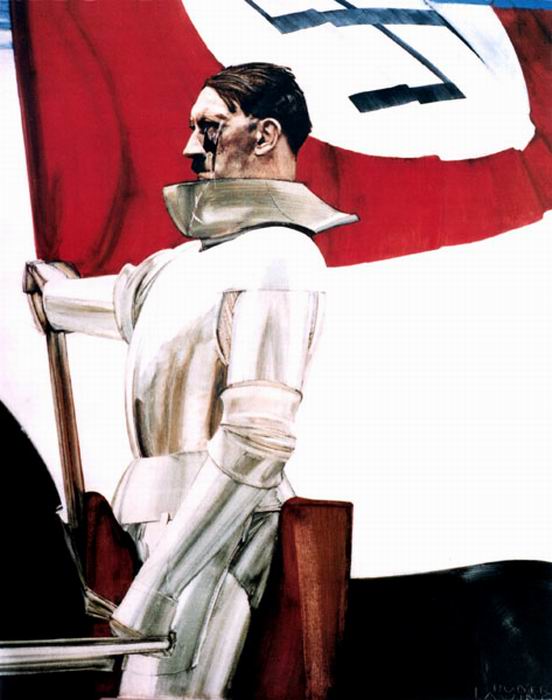
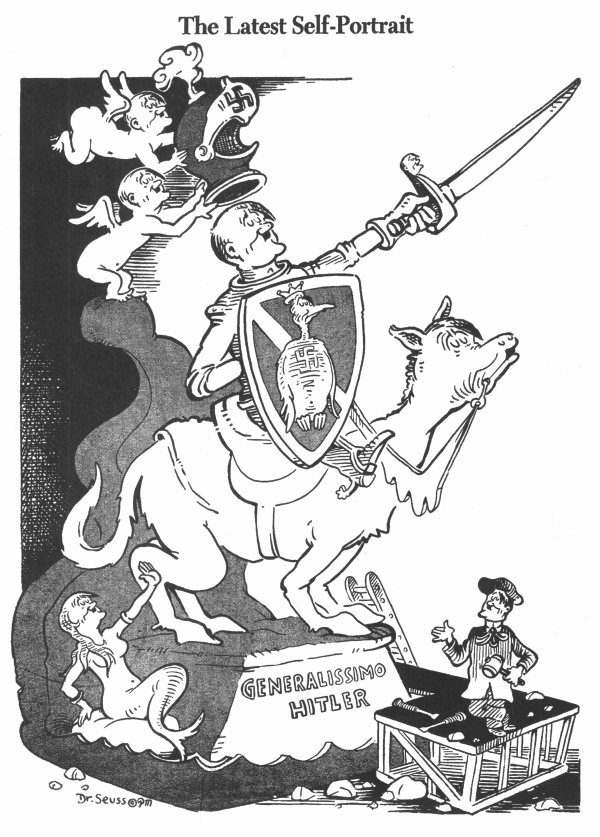
Both Hitler and Himmler even had portraits of themselves painted,
showing them as knights dressed in shining suits of armor.
They bandied about words like
"honor", "nobility", "spirituality",
and "purity", which may strike us as unbelievably hypocritical
today, but they believed them at the time.
Examples of Hitler's 'odd beliefs or magical thinking' abound in
his 'table talk', the turgid monologues which he inflicted each
night on his bored and exhausted entourage. Thus he believed he could
read other people's thoughts and exert magical control over them
and that he had a sixth sense that protected him from danger.
For example, having made a speech at the Party Beer-Cellar in
Munich just before the outbreak of the Second World War, something
suddenly prompted him to leave, instead of staying on to chat with
the Party faithful as was his custom. Within minutes of his departure
a bomb exploded, killing eight of the old comrades and injuring
scores of others. He seems to have experienced no such premonition
in March 1943 when a bomb was placed on the plane in which he flew
back to Berlin from the Eastern front, but the bomb failed to detonate.
A further attempt to assassinate him at an exhibition a few days
later also failed because, once again, he decided on impulse to leave
early. 'Who says I am not under the special protection of God?'
he exclaimed. An example of his magical thinking is his frequently
repeated declaration that he and Germany were mystically merged:
'I know that everything that you are, you are through me, and
everything that I am, I am through you alone!'
Of the 'unusual perceptual experiences' reported by Hitler, he
acknowledged that he heard voices like those which inspired Joan
of Arc: they told him to rescue the Fatherland from the Jews.
He also claimed that he had a vision of Wotan, the old German
war god, pointing to the East above the heads of the cheering
Viennese crowds at the time of Austrian Anschluss.
Prophets, Cults, and Madness Anthony Stevens
and John Price, pages 97-98.
Hitler wrote:
"Hence today I believe that I am acting in accordance with
the will of the Almighty Creator: by defending myself against
the Jew, I am fighting for the work of the Lord."
Mein Kampf, Adolf Hitler, Ralph Mannheim, ed., New York: Mariner Books, 1999, page 65.
Likewise, David Pryce-Jones reported that "Hitler believed that he had been sent by
God."139
Joseph Goebbels, Adolf Hitler's fawning Minister of Propaganda, agreed:
Destiny has sent us this man [Adolf Hitler] so that we, in this time of great
external and internal stress, shall testify to the miracle.
The Rise And Fall Of The Third Reich, William L. Shirer, page 1109.
So who is "Destiny", and how can I meet her? Is she the sister of that other popular cause
of momentous events, "Fate"?
Likewise, when he heard that President Roosevelt had died, another one of Adolf Hitler's
superstitious sycophants declared in an enthusiastic outburst of muddle-minded mysticism:
This was the Angel of History! We felt its wings flutter through the room.
Was that not the turn of fortune we awaited so anxiously?
== Count Schwerin von Krosigk
The Rise And Fall Of The Third Reich, William L. Shirer, page 1110.
Richard Noll, in his biography of Carl G. Jung, wrote about the paganism that was popular
in Germany in the early twentieth century:
The youth organization of the Monistenbund — inspired and led by Haeckel
himself — sponsored sun-worshiping festivals each summer solstice. ...
Others wanted a Wagnerian twist to their Volkish neopaganism. They
gathered in bearskins and made ritual sacrifices of animals to Wotan, Thor,
Baldur, and other Teutonic deities. They studied the symbols of the ancient
Norse runes and took visionary journeys to meet with members of the ancient
spiritual brotherhood. There were dozens of groups like these, large and small.
They convinced themselves that they were chosen, like the grail knights in Wagner's
Parsifal, to seek and protect the Holy Grail — in this case, the spiritual
purity of Aryan Blood. The most famous of these was the Tannenberg Foundation of
General Erich Ludendorff, war hero and, later, a coconspirator in Adolf Hitler's
failed putsch in 1923. The symbol of Ludendorff's organization was the hammer
of Thor. Like many in German culture at the turn of the century, Ludendorff wanted
to eradicate Christianity and replace it with an Aryan faith. As one commentator
on the neopagan movement in Germany revealed, "In line with the Tannenberg
program for the restoration of the ancient Germanic religion, General Ludendorff,
accompanied by a few young men, would from time to time retire to the forests
near Munich, where a bonfire was lighted and a horse sacrificed in honor of Thor,
the god of Thunder."46
46. Paul Bramwell Means, Things That Are Caesar's: The Genesis of the
German Church Conflict (New York: Round Table Press, 1935), 166.
The Aryan Christ: The Secret Life of Carl Jung,
Richard Noll, pages 116 and 305 (footnote).
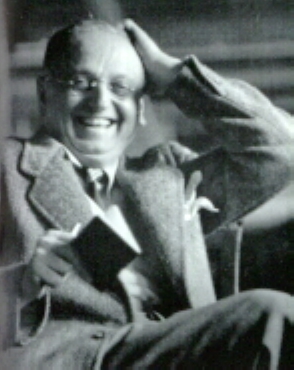
Many other books verify what Diener was saying about 'Putzi' Hanfstaengl.
The most detailed is the book written by
Ernst "Putzi" Hanfstaengl himself, called Unheard Witness, which
tells the story of Putzi's experiences with Adolf
Hitler. They met in Berlin, November 22, 1922, when Hitler gave a speech at
the Kindle Keller beer hall:
"Herr Hitler, my name is Hanfstaengl," I said. "Captain
Truman-Smith asked me to give you his best wishes."
"Ah yes, the big American," he answered.
"He begged me to come and listen to you and I can only say
I have been most impressed," I went on. "I agree with
ninety-five per cent of what you said and would very much like to
talk to you about the rest some time."
"Why yes, of course," Hitler said. "I am sure we shall
not have to quarrel about the odd five percent." He made a very
pleasant impression, modest and friendly. So we shook hands again and
I went home.
That night I could not go to sleep for a long time. My mind still
raced with the impressions of the evening. Where all our conservative
politicians and speakers were failing miserably to establish any
contact with the ordinary people, this self-made man, Hitler, was
clearly succeeding in presenting a non-Communist program
to exactly those people whose support we need.
On the other hand, I had not liked the look of those immediate
supporters I had seen. Rosenberg and the people around him seemed
to me distinctly dubious types. Then an aphorism of Nietsche floated
into my mind and provided consolation: "The first followers of
a movement do not prove anything against it."
Unheard Witness, Ernst "Putzi"
Hanfstaengl, 1957, pages 37-38.
And the upper-class Hanfstaengl family did try to polish the uncouth bumpkin Hitler:
"I felt quite embarrassed in my blue suit," Hitler told me.
"The servants were all in livery and we drank nothing but champagne
before the meal. And you should have seen the bathroom, you can even
regulate the heat of the water."
Unheard Witness, Ernst "Putzi"
Hanfstaengl, 1957, page 44.
And Putzi was so involved with all of the early Nazi party members
and their doings that he was really lucky that he wasn't put into
Landsberg prison with the rest of them after the failed Beer Hall
Putsch, for being a co-conspirator. The whole gang half lived at
Putzi's house.
(Putzi, Goering, and other prominent Nazis fled to Austria and hid out
there until things cooled
off.126)
And Putzi even confessed that he was guilty of taking
Harvard football fight songs and German folk
songs, and blending them together to make marching music for the Nazis.
Harvard was Putzi's alma mater; little did Harvard realize where their
American football education of the German aristocrat Ernst Hanfstaengl
would go...
It was on another occasion, at the house of Heinrich Hoffman, his
photographer friend, that I started playing some of the football
marches I had picked up at Harvard. I explained to Hitler all the
business about the cheer leaders and college songs and the
deliberate whipping up of hysterical enthusiasm. I told him about
the thousands of spectators being made to roar, "Harvard,
Harvard, Harvard, rah, rah, rah!" in unison and of the
hypnotic effect of this sort of thing. I played him some of the
Sousa marches and then my own "Falarah," to show how it
could be done by adapting German tunes, and gave them all that
bouyant beat so characteristic of American brass-band music. I
had Hitler fairly shouting with enthusiasm. "That is it,
Hanfstaengl, that is what we need for the movement, marvelous,"
and he pranced up and down the room like a drum majorette.
After that he had the S.A. band practising the same thing.
I even wrote a dozen marches or so myself over the course of the
years, including the one that was played by the brownshirt columns
as they marched through the Brandenburger Tor on the day Hitler
took over power. "Rah, rah, rah!" became "Sieg Heil,
Sieg Heil!" — that is the origin of it and I suppose I must
take my share of the blame.
Unheard Witness, Ernst "Putzi"
Hanfstaengl, 1957, pages 52-53.
(Actually, Putzi, I think it was, "Har-vard! Har-vard!" becomes
"Sieg-Heil! Sieg-Heil!", and "Rah, rah, rah!" becomes
"Heil Hit-ler!". You have to get the beat right. :-) But I digress.)
Ken Ragge commented on Diener's letter:
Paul Diener wrote:
<---snip--->
> Ragge is wrong when he says Buchman's fondness for Hitler should not be stressed.
<---snip--->
Paul,
What I wrote was:
> Actually, to mention Buchman's fondness for Hitler is a bit off
base — _any_ totalitarian leader was held in high regard by him
and his organization.
Leaving the inherent sarcasm of my statement aside, can you name _one_
non-Communist despot in power between the 1930's and Buchman's death in
the 60s that Buchman _didn't_ support? Was every non-Communist despot
a fascist?
Ken Ragge
Ken Ragge, in a letter to the mailing list ADDICT-L@LISTSERV.KENT.EDU,
Jan 29, 2002.
Paul Diener answered:
No, not every despot is a fascist. The fascist political tradition is a
special and unique historical phenomenon. The word 'fascism' is best used
with care, as scholars who are experts in fascist studies use it.
Your statement seemed to imply that the Hitler-Buchman connection need not
be stressed and investigated. If this is your opinion, I differ. I think
it is worth keeping this connection in mind, and investigating it.
As to Buchman's support for all 'despots', I think you underestimate
Buchman and his movement. The Buchmanites strongly attacked 'capitalism',
and demanded that big business be reformed. They vilified business leaders
who acted as 'despots'. Buchman also thought labor union 'bosses' were
despots, who manipulated the working man. Both business and union despots,
Buchman repeatedly insisted, needed to 'change'. This could happen if both
accepted the spiritual counselling of a God-controlled figure, such as
Buchman himself. Buchman also saw the hand of God as working in the New
Germany, as you know. Like Buchman, the Nazis were violently opposed to
despotic, exploitative 'capitalists'.
'Not individual greed, but common need' was the OG cry. (This was also
the cry in other fascist movements, and the Nazi Party adopted this as its
official motto). Buchman was opposed to despots who pursued 'individual
greed'. Buchman was a protofascist, not an old-style advocate of rapacious
dictators. Niebuhr and Orwell saw this clearly.
All fascist movements had, and have, a very real
reformist / revolutionary aspect. This accounts, in large part, for their
ability to attract followers. Fascisms promise some real reforms, and, in a
period of severe crisis, many middle-class persons of liberal persuasion
come to believe that ONLY fascist methods can achieve these needed reforms,
while still preserving their own class status.
Just as you misportray and misunderstand AA, so you misportray and
misunderstand the Oxford Groups. NEITHER of these movements is just an
oppressive regime, 'brainwashing' and bilking the innocent. Both movements
point to very real problems in society, and both offer solutions plausible
to many. In both movements, long-term affiliation is voluntary, though
exposure and early indoctrination is often coerced. Most important, neither
of these movements is unique. The Oxford Groups was only one of MANY
protofascist movements in the U.S. in the 1930s, and AA is only one of many
such movements today.
Paul Diener (pauldiener@PRODIGY.NET), in a letter to the mailing list ADDICT-L@LISTSERV.KENT.EDU,
Feb 02, 2002.
Also see the description of the characteristics of fascism in a letter,
here.
So Frank Buchman continued to visit Berlin and associate with the
highest-ranking Nazis, imagining
that they would soon be on their knees, begging God to fix their
moral shortcomings and defects of character...
Frank Buchman never recanted, or took back any of what he
said, or even hinted that it was
a mistake. He believed that he had spoken and acted under the
Guidance of God, and that Guidance was infallible, so there was no way
that he could or would take it back or amend
it.13
Of course not. In fact, fascism is not an undesired state of affairs
to Buchmanism; it is, rather, the logical goal of Buchmanism.
Two weeks after Buchman's Hitler-praising interview was published
in the New York World Telegram newspaper,
The Christian Century magazine printed this criticism of
Frank Buchman's remarks:
...Thus as plainly as it could be done Frank Buchman points to
fascism as the way out of our social difficulties.
...
Indeed the worst thing about a religion which undertakes to be
purely individualistic and to concern itself not at all as to the
way in which the corporate life of society is organized is that
it cannot succeed in that undertaking — it is forced to take a
political position, and its utter lack of understanding of
political realities predetermines what that position shall be.
Such a religion enters the social arena inevitably on the side of
reaction. God works through individuals it [Buchmanism] argues.
The way to make institutions good is to make the individuals
who run them good. The fewer these individuals are, the simpler
the operation. The only way to make a good government is to
convert the governors, and if there could be but one governor
dictating the policies of the nation under God's guidance, the
ideal type of state would have been achieved. Individualism in
religion thus leads by the straightest of roads to fascism in
politics.
...
It is not a question any more — if it ever was — of individual
religion versus the social gospel; it is a question of what social
gospel. Shall religion commit itself to a social ideal and program
based upon the naive assumptions of individualism or based upon
an intelligent understanding of the realities of man's collective
life? Shall it preach a social gospel of reaction or of construction?
No other alternative is in the long run possible.
The Oxford group movement is only following the logic of
its position when it declares for reaction.
Any dream of a "God-guided dictator" involves
the reality of waking to the cry, "Thank heaven for Hitler!"
A God-Guided Dictator, The Christian Century,
53:1182-3, Sept. 9, 1936, pages 1182-1183.
Reinhold Niebuhr, the eminent theologian who authored The Serenity Prayer
which is so popular in 12-Step circles,
also criticized Frank Buchman's remarks, stating
in The Christian Century magazine a month later:
On returning from Europe, Frank Buchman, Oxford group revivalist,
is quoted by a reputable New York paper as having said: "I
thank heaven for a man like Adolf Hitler, who built a front-line
defense against the anti-Christ of communism...."
In this interview the social philosophy of the Oxford group, long
implicit in its strategy, is made explicit, and revealed in all its
childishness and viciousness. This philosophy has been implicit in
Buchmanite strategy from the beginning. It explains the particular
attention which is paid by Mr. Buchman and his followers to big men,
leaders, in industry and politics. The idea is that if the man of power
can be converted, God will be able to control a larger area
of human life through his power than if a little man
were converted. This is the logic which has filled the
Buchmanites with touching solicitude for the souls
of such men as Henry Ford or Harvey Firestone and
prompted them to whisper confidentially from time
to time that these men were on the very threshold
of the kingdom of God. It is this strategy which
prompts or justifies the first-class travel of all the
Oxford teams. They hope to make contact with big
men in the luxurious first-class quarters of ocean
liners.
In other words, a nazi social philosophy has been a covert presupposition
of the whole Oxford Group enterprise from the very beginning.
We may be
grateful to the leader for revealing so clearly what has been slightly
hidden. Now we can see how unbelievably naive this movement is in its efforts
to save the world. If it would
content itself with preaching repentance to drunkards and adulterers
one might be willing to respect it as a religious revival
method which knows how to confront the sinner
with God. But when it runs to Geneva, the seat of the League of Nations,
or to Cleveland to the republican national convention,
or to Prince Starhemberg or Hitler, or to any seat of power,
always with the idea that it is on
the verge of saving the world by bringing the people who control
the world under God-control,
it is difficult to restrain the contempt one feels for this dangerous
childishness.
This idea of world salvation
implies a social philosophy which is completely innocent of
any understanding of the social dynamics of a civilization.
Does Mr. Buchman really believe that the dictators of the modern
world create their dictatorships out of whole cloth?
He does not know, evidently, that they are the creatures more
than the creators of vast social movements in modern history.
The particular social forces which create dictatorships
are on the whole the decadent forces of a very sick society.
Hitler and Buchman, Reinhold Niebuhr, The Christian Century,
53:1315-6, Oct. 7, 1936, page 1315.
Also see:
Courage to Change, An Introduction to the Life and Thought of
Reinhold Niebuhr, June Bingham, page 202.
Indeed. Frank Buchman's ideas of how society works, and of how society
ought to work,
were quite different from most Americans' politics.
In an ideal Buchmanite "God-controlled" country, you would
not want democracy, a constitution, a congress, or a bill of rights.
Those things are just problems to Buchmanism, because they prevent
the most efficient and simple implementation of "God's Will".
To a Buchmanite, democracy is just the collective opinion of a bunch of
"insane" sinners who are not listening to the voice of God.
Who would want such fools interfering with the work of a God-guided man?
Imagine if the President of the United States came under
"God-control."
Congress and the Supreme Court might block his orders whenever
those orders seriously conflicted with the Constitution or the Bill
of Rights.
His success in enforcing "the Will of God" would depend
on the prevailing political climate — upon which politicians won
the last elections, and which political hacks had been appointed
to the Supreme Court.
There would always be a small chance that Congress or the Supreme
Court might actually rise up out of the cesspool of partisan politics
and really try to uphold,
preserve and defend the Constitution of the United States, just like
their oaths of office say. (Admittedly, not very likely, but it might happen.)
They might not help the President to
carry out "the Will of God", as he hears God dictating it to him.
Remember that Frank Buchman said, while he was thanking Heaven for giving us a man like Adolf Hitler,
... Human problems aren't economic. They're
moral and they can't be solved by immoral measures.
They could be solved within a God-controlled
democracy, or perhaps I should say a theocracy, and
they could be solved through a God-controlled Fascist
dictatorship.
Hitler and Buchman, Reinhold Niebuhr, The Christian Century,
53:1315-6, Oct. 7, 1936, page 1315.
Also see:
A God-Guided Dictator, The Christian Century,
53:1182-3, Sept. 9, 1936, page 1183.
Also see:
The Mystery of Moral Re-Armament; A Study of
Frank Buchman and His Movement, Tom Driberg, 1965, pages 68-69.
That was basically what Frank Buchman's simplistic political thinking
amounted to.

Next: The War Years: On the Road Again
Previous: Sam Shoemaker Quits
Click Fruit for Menu

Last updated 4 December 2015.
The most recent version of this file can be found at
http://www.orange-papers.org/orange-rroot480.html
|