The Religious Roots of Alcoholics Anonymous
and the Twelve Steps
by A. Orange
Chapter 20:
Frank Buchman, Anti-Communist, Union-Buster, Spiritual Strike-Breaker
Playing to the Red Scare of the early 1950's,
the opportunistic Frank Buchman shifted the focus of his publicity
campaign to anti-Communism,
and he claimed that MRA was now the philosophy that would save
the world from Communism.
"The Indian people suffer from being too philosophical?
We are a lost people? We want the right people (white people)
to come and tell us the right things?"
Jeez Louise. Where did Frank Buchman find that pathetic grovelling sycophant?
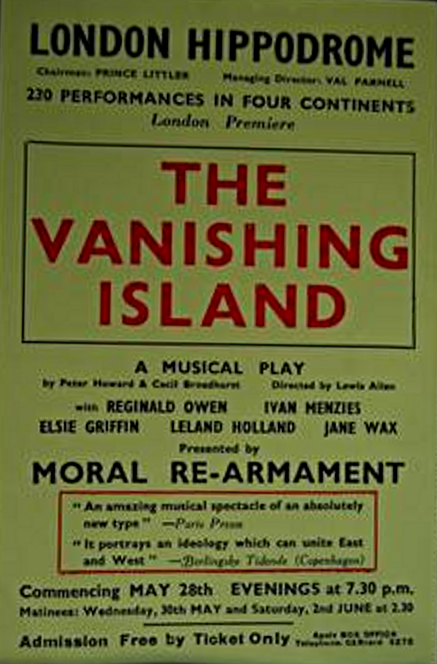
Frank Buchman sent his theatrical troup on a world-wide tour, trying to spread his
anti-Communist message around the world. He talked sympathetic people in the U.S.
Air Force into flying his show around the world for free. When this fact became
known, a scandal erupted. The Secretary of the Air Force under President Eisenhower
resigned over it, and then rationalized that he had really resigned for other
reasons. Then Buchman wrote a check to the U.S. Air Force to pay for the use of
the airplanes (which was way too small to cover the expenses), and explained that
MRA never took any free gifts from the Air Force.
In his analysis of Buchmanism, Geoffrey Williamson commented:
Finally, I think the Buchmanites have made a cardinal error in turning their
energies towards high-pressure politics in general and towards anti-Communist
activities in particular.
Again, they may contend that they are merely exploiting human fears of
another world war to lure people to Caux to listen to the "Message".
But even if that is their alibi, it still seems too drastic a departure
from their registered aims of advancing the Christian religion.
Inside Buchmanism; an independent inquiry into the
Oxford Group Movement and Moral Re-Armament,
Geoffrey Williamson, Philosophical Library, New York, c1954, page 222.
Buchman's anti-Communist campaign never caught on.
The MRA organization was reduced to being a mere shell
of its former self. Still, it hung on for a good while longer.
There were always still a few more rich arch-conservatives willing
to make donations here and there, to keep Frank Buchman going for a
little while longer.
What particularly pleased rich ultra-conservatives was Buchman's
preaching that labor's demands for higher wages were merely sinful
greed.
Remember Buchman's remarks while praising Hitler:
"Human problems
aren't economic. They're moral and they can't be solved by immoral
measures."
Buchman declared that all social and human
problems were due to sin,
and he considered labor's demands for higher wages to be
"immoral" attempts to improve the world, using social
activism when prayer and confession were the only acceptable answers
to the world's problems.
Some of the big businessmen loved the sound of that.
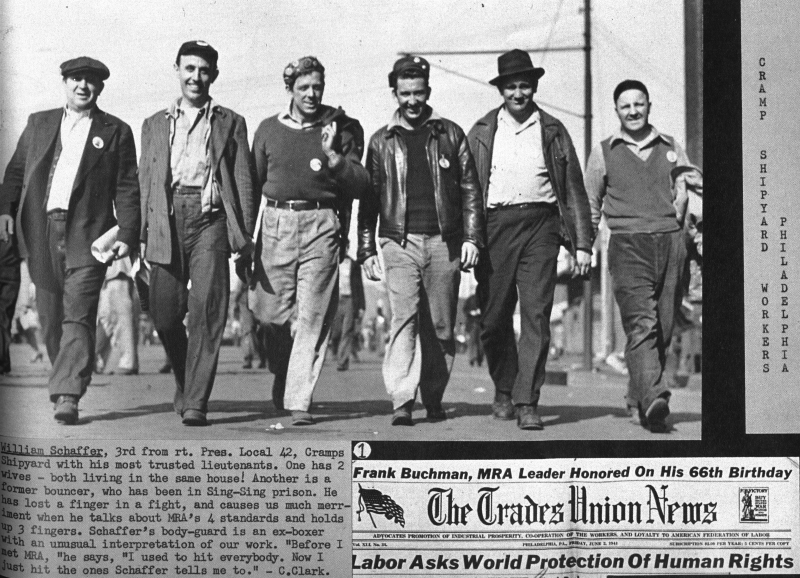
As usual, Frank Buchman exaggerated and lied about his accomplishments
in the field of labor relations.
He loved to tell rich industrialists that he had saved some other
industrialist millions of dollars by "changing" some labor
leader, like John Riffe, Executive Vice-President of the CIO, and
the labor leader had gotten down on his knees and cried to God and
confessed all of his sins and shortcomings to the business executive,
who was so touched that he had gotten down on his knees, and confessed
his sins. Then, the two of them successfully negotiated a fair labor
contract. The only problem with that story is that it never
happened.10
Still, Frank Buchman's preaching about labor's
demands for higher wages being sin was music to big business' ears,
and Frank got his donations.
Peter Howard, the fascist
who would assume the leadership of Moral Re-Armament
after Frank Buchman's death, wrote in one of his shallow books of
propaganda that Buchmanites were solving all kinds of labor problems
just by getting the leaders of labor and management to stop being angry and resentful.
This story of two young Buchmanites ending a labor strike is
typical of Frank Buchman's simple-minded solutions to major social problems:
There was no mention of money. There was no consideration of the
never-ending conflict between the stockholders' demands for
greater profits and the workers' demands for higher wages.
Frank Buchman's understanding of economics was non-existent.
Once again, we see Buchman's belief that
"Human problems aren't economic.
They're moral and they can't be solved by immoral measures."
In Frank Buchman's simple mind, conflicts between labor and management were
all just a matter of bad feelings, bitterness, pride, and selfish "Materialism"
— "personal difficulties" between the labor leader and the manager
— all of which could be resolved with
just a few hours of friendly "honest" talk.
Then everybody would unanimously vote to go back to work
as if nothing had ever happened. (So why did the workers go out on
strike in the first place? Did they have no genuine grievances?
Were they all just in a bad mood?)
And notice how Howard imagined that there was a "right answer to
all problems" that could be found with just a little honest talk.
That is childishly simplistic thinking.
Worse than childish was the way that Buchman and his followers constantly
exaggerated and lied about their successes. At one point, Buchman claimed
that there had been no more labor difficulties or strikes on the London docks since
Moral Re-Armament started its campaign among the dock workers. Tom Driberg,
a Labor Party Member of Parliament, immediately listed three large,
serious, prolonged and expensive strikes that had occurred in spite of Buchman's
meddling in labor union
affairs.108
Likewise, when Driberg investigated the MRA claims that their campaigns had greatly
increased production in the coal mines, he found that their claims were completely bogus,
and that their statistics were fabricated out of thin air.
The following story which MRA published also shows the standard MRA attitude about labor
unions and strikes:
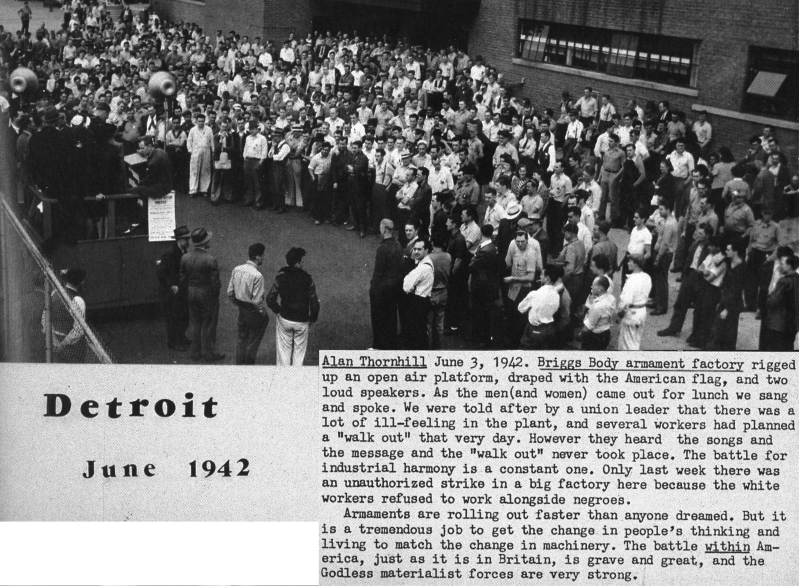
Gordon MacDonald, Briggs Local 212, United Automobile Workers Union, CIO,
speaking at Mackinac about his work in Detroit:
I worked for the company back in 1924-30 but was discharged because of an argument
with a minor executive. Four years later I was back with the company. During that
time my hatred for this person grew larger and larger. When the Union came in
during 1937 I immediately saw a chance to get back at this person. First, I took
the position of Steward over some 20 people. Then Chief Steward of some 800 people.
I went up to Chairman of the Shop Committee of 15,000 and then was elected First
Vice-President of the Company, employing 27,000. That was the spot I'd wanted.
It was one week before Pearl Harbor. I was out to get even with that person,
but an Executive Order from Washington said no more automobiles and my equipment
was taken out of my hands so fast I didn't know. Instead of having some 22,000
people to back me up I had some 22,000 saying, "Where's my job?"
The weapon was turned back at myself.
During this time our relationship with Management was terrible. I would have some
flare-up in the shop among the few people that were working and called the Management.
That was how it was until one day we were called to the office of the industrial
relations man with three or four from the Revue. So we agreed to put the show on for
our people.
By that time I had maybe 4,000 people working who had suddenly become prima donnas
in their own estimation in the world of industry. They were very touchy and easily
agitated. I was at a loss about what to do. Our meetings because chaos. We would have
commonsense for 15 minutes, then for two or three hours we battled and settled nothing.
We had the Show. I didn't see the answer to my problem, but a couple of the boys
that are in the Army now — Duncan Corcoran and Stuart Smith, every time I looked
out of my office door I saw one of them, so I came up to Mackinac and got a little
bit of philosophy, but I still had that feeling in my heart. When I went back
after the first visit here I found that the plan had dissolved a little bit.
Then the boys were on my doorstep again and back I come. After being here I went
back on the job and suddenly found, through being honest, that what I thought was
the poorest example of a personnel man wasn't such a bad chap. I found out he had
been waiting for me to be honest and I had been waiting for him, and neither one
of us was ready to give in. But the mutual respect and feelings that we have now
has done a lot. The concessions that the Company has given us in the past nine
months are more than we have got in the past six years.
Formerly we paid a high salary to a lawyer to put trick clauses in our contract.
The Company did likewise. We used to give our Chief Stewards and Committeemen an
interpretation of the contract — a Union interpretation — the Company gave their
Supervisors their interpretation, and it was like reading the Bible and reading
some fiction. They didn't jibe. We had continued quarrels. To show you the
difference — what honesty and unselfishness has done in that plant.
We signed this contract in less than 24 hours, a contract that previously took
30 to 60 days.
Preview Of A New World; How Frank Buchman Helped his country Move from isolation
To world responsibility; USA 1939-1946, Arthur Strong, page 136.
Again, we got the standard MRA story that all difficulties between labor and
management were caused by some laborer having a silly resentment against
the management, and the cure for the problem was a dose of Moral Re-Armament philosophy,
as expressed in a song-and-dance show. Henry Ford must have been pleased.
Also notice how the MRA recruiters, Duncan Corcoran and Stuart Smith,
kept coming around again and again, determined to add the scalp of a
union official to their belts. --United Auto Workers, no less.
Henry Ford must have been very pleased.
"Materialism" was one of Frank Buchman's favorite words.
Buchman found both labor and management guilty of it. When workers
wanted higher wages, that was Materialism. When factory owners wanted
greater profits, that was also Materialism.
Materialism is our great enemy. It is the chief "ism" we have to combat and conquer.
It is the mother of all "isms". There is the battleground. There the warfare must
be waged so that we can firmly establish those homely truths of honesty,
unselfishness and obedience to God that are the hallmarks of personal and
national sanity. ...
This is the battle of Moral Re-Armament. Without the conquest of materialism,
our nations will decay from within while we prepare to defend ourselves against
attack from without.
Materialism and atheism are breeding-grounds for corruption, anarchy and revolution.
These have their allies in the selfishness that rules our homes, the bitterness
that separates class from class, and the spirit of faction that divides a nation.
Remaking the World: The Speeches of Frank Buchman, Frank Buchman,
page 176.
- Is it "materialism" if you desire that your children have food and clothing?
- Is it "selfishness" to desire a good home for your family and a good
job for yourself?
- Is it "materialism" to want a fair day's pay for a fair day's work?
- Is it "materialism" to want good health care?
- Is it "materialism" to desire a retirement fund?
- How much can we rise above abject poverty and misery before we are, in the
eyes of people like Frank Buchman,
immoral and guilty of "materialism"?
That's the problem with Frank Buchman's simplistic, absolute, black-and-white thinking.
Whether someone is "materialistic" or just surviving in this material world is a
matter of shades of gray. It's easy to make absolute, sweeping statements.
It's much harder to be realistic and truthful.
And even more to the point:
-
Why didn't Frank Buchman's consider his ultra-rich sponsors
and multi-millionaire patrons guilty of wallowing in "materialism"?
How did they rate a life of wealth and leisure?
-
Why didn't Frank Buchman think about his own materialism when he
lived a luxurious first-class lifestyle in the Waldorf Astoria and Mayfair Hotels,
and in the first-class salons of floating palaces like the Queen Mary?
- Or was Frank Buchman's entire "philosophy" just so much selfish hypocrisy?
The Buchmanite true believer Arthur Strong was a
draft-dodging British photographer
who traveled with the Moral Re-Armament road shows in the USA from 1939 to 1946.
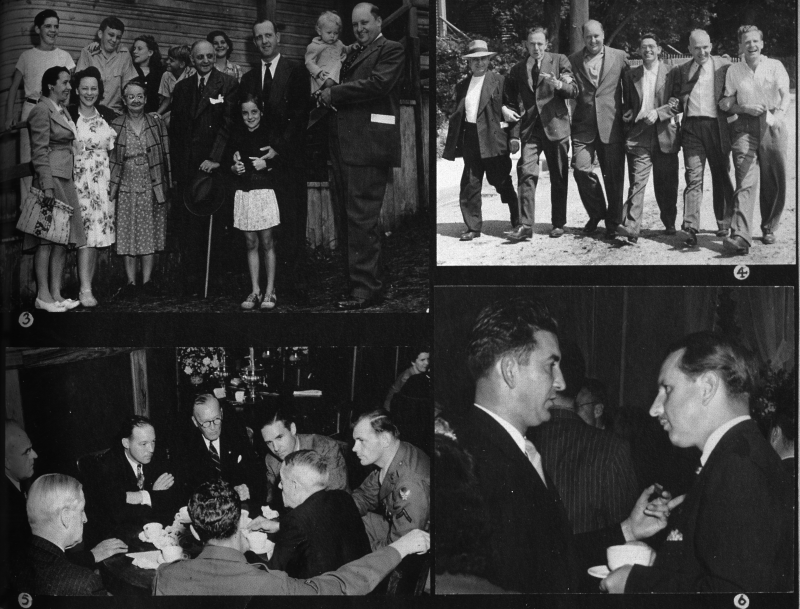
He later put together a book of photographs and
stories about that adventure. He explained how they rigged photographs of
management and labor union leaders "making peace" with the help of MRA:
At every meeting or revue performance, Bill Jaeger takes round the photographer
allotted him for the evening. He shows who and where they are sitting. These will
be labor union officials, often with their families.
The photographer makes the necessary notes, then joins the other photographers at
the back. They in turn have been shown the leading management, armed forces,
educationalists, club women and any other representative people. Then we have
guidance about what pictures to take, who with who, and above all what is the big
idea symbolic of the whole evening.
During the evening we generally have one cameraman roving for interesting
expressions and good crowd angles. Another stays at the back to cover any who
might have to leave early.
Another goes back stage to pick up any good candid shots of how we work.
It gives you an idea of the importance of pictures in the life of the work
when I mention that short as we are of tenors, I have been excused from
production to give all my time to the pictures.
The big time is when the meeting or revue is over. Then to battle stations.
Bill Jaeger is like a fast bull dog. Sometimes he has a celebrity in tow like
Admiral Sir Edward Cochrane, whom he'll take round to be photographed with
labor man after labor man. The remaining photographers cover the others as
guided (by God).
Quite often we have a youngster to every photographer, carrying flash bulbs and
fresh slides.
Of course there will be a few management with labor pictures.
With the evening fully covered we return to our temporary darkroom. Generally one
of us stays to develop, sometimes right through the night, having 5 by 7 prints
ready for the morning team meeting.
Then one photographer goes over the labor pictures with Bill, writing on the back
how many prints are needed — sometimes as many as 16 off one. Others of us go
over with responsible people in the other sections. Management generally prefer
10 by 8. Bill uses as many as 150 in a week. They are used as calling cards for
inviting people for the Sunday follow-up meeting. Bill maintains that it is the
pictures that turn the scale in getting labor to make the 300 miles from Detroit
to Mackinac.
Preview Of A New World; How Frank Buchman Helped his country Move from isolation
To world responsibility; USA 1939-1946, Arthur Strong, page 136.
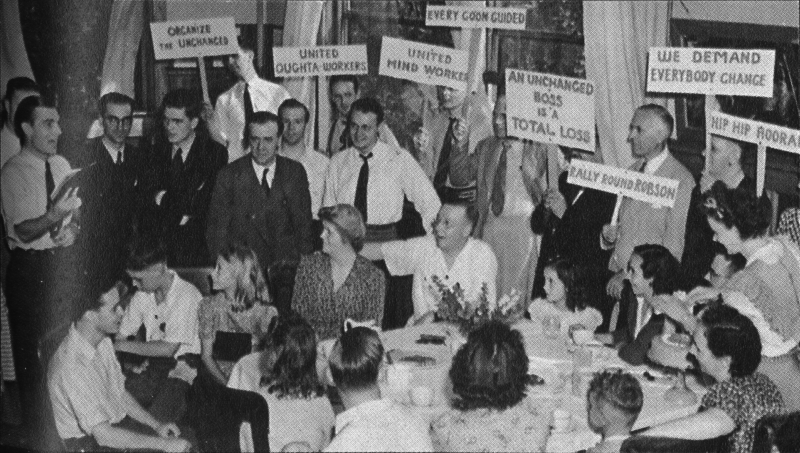
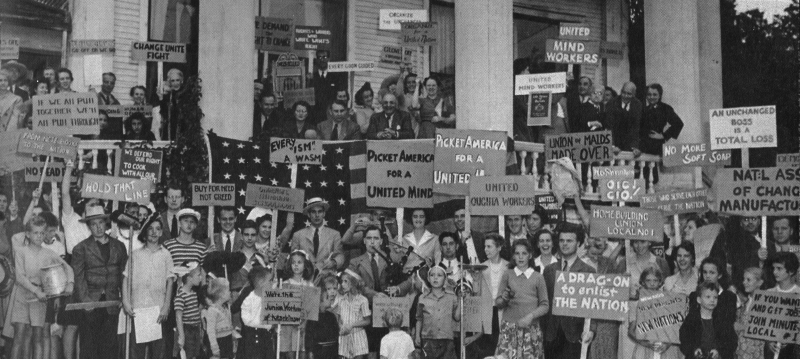
So the Buchmanites would steer labor leaders towards the managers, to be photographed
in smiling, hand-shaking poses, and then, the next day, Moral Re-Armament would be
bragging that it had brought about a new peace between management and labor.
And then Bill Jaeger and the other recruiters used the photographs as an
excuse to get in the door,
to invite people to the Sunday meetings and to lure people to the Mackinac
Island MRA training center for more indoctrination.
The labor unions did not see things the same way as Frank Buchman did.
Echoing Tom Driberg's earlier denunciation of Buchman's organization as
"spiritual strike-breakers", the International Confederation
of Free Trade Unions condemned Buchman's meddling in labor relations:
Notice how the C.I.O. was reluctant to criticize Frank Buchman's political
activities for fear that their statements would be misinterpreted
as an attack on a religion.
Buchman took full advantage of that confusion. He routinely promoted
a fascist political agenda while claiming that he was winning more souls for Christ.
If anyone criticized his behavior, Buchman hid behind the Bible
and claimed that his enemies were immoral and opposed to the Will of God.
Remember Frank Buchman's disciples Peter Howard and Paul Campbell writing:
Moral Re-Armament cannot be honestly opposed on intellectual grounds
because it is basic truth...
Opposition to Moral Re-Armament has special significance.
It always comes from the morally defeated.
Remaking Men, by Paul Campbell and Peter Howard, page 66.
TIME magazine reported:
The militantly anti-Communist International Confederation of Free Trade Unions,
which represents 97 unions in 73 countries, tossed a monkey wrench toward the
machinery of Moral Re-Armament, the nondenominational, untheological, polite
revival movement that evolved out of Frank Buchman's old Oxford Group. A report
prepared by I.C.F.T.U.'s secretariat accused the Moral Re-Armament movement of
interfering "with trade-union activities and [making] anti-trade-union
efforts, even to the extent of trying to found 'yellow unions.' " M.R.A.,
it said, was undemocratic: "Buchman does not build up his movement from below
. . . but from the ranks of leaders . . . The sources from which the Moral
Re-Armament movement draws its necessary funds are completely unknown. All that
can be said is that those who supply the money must be very well off."
TIME magazine, Oct. 05, 1953

In spite of M.R.A.'s declining fortunes and the mounting criticism and
denunciations, the true believers continued
to insist that it was a wonderful organization. When Frank Buchman
turned 80 years old, a group of his admirers put together a book
of praise of Buchman that declared:
Coming generations will value him rightly and give his work its
rightful place. The world of today, blinded by lack of ideological clarity,
is not ready to give him bouquets and crowns of laurel. But in the
hearts of all true revolutionaries he is greatly valued and respected.
I thank God for a man who gave my life a new direction.
Frank Buchman, Eighty, by His Friends, Blandford Press, page 101.
Likewise, the degree to which the Buchmanites were in denial about any
problems with their religion was almost unbelievable.
In 1963, James M. Coltart, one of the faithful, wrote a letter to Tom Driberg,
the London newspaper reporter and Labor Party Member of Parliament
who had done so much to expose the shortcomings and dishonesty
of Frank Buchman and his organization, saying:
Now may I be frank with you, because I am sure you would expect no less
from me.
When I said earlier that your constant criticism didn't disturb me,
what did concern me was that a man like yourself would persist in
criticism year after year,
yet after twenty years you had not to my knowledge been able to discover
and expose any real weakness in the beliefs of MRA.
The Mystery of Moral Re-Armament; A Study of Frank Buchman and His
Movement, Tom Driberg, 1965, page 281.
Next: Homophobia and Gay-Bashing
Previous: After the war
Click Fruit for Menu

Last updated 15 October 2013.
The most recent version of this file can be found at
http://www.orange-papers.org/orange-rroot600.html
|